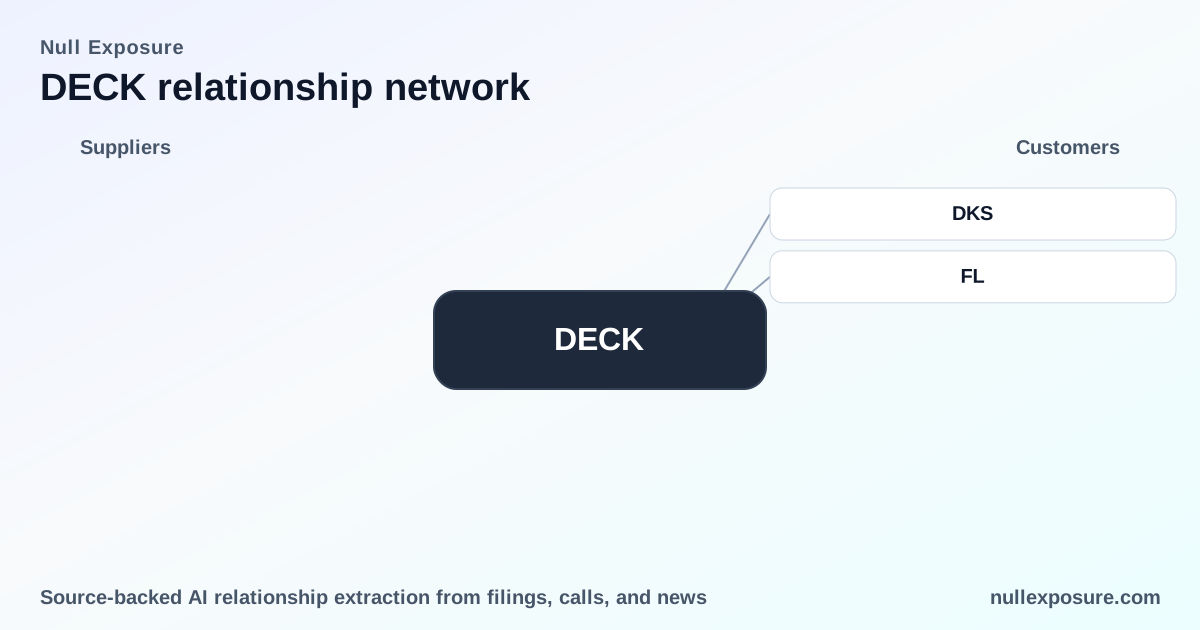
Deckers’ customer base: where UGG and HOKA find buyers and what that means for investors
Deckers Outdoor monetizes by owning premium lifestyle and performance brands (UGG, HOKA, Teva, Sanuk, and others) and selling those products through a mix of direct-to-consumer (DTC) channels and a global wholesale network of retailers and distributors. Revenue derives from higher-margin DTC sales (company-owned e‑commerce and stores) plus volume through third‑party resellers and distributors; operating leverage and brand momentum drive margin expansion when DTC share increases. For investors focused on customer risk and revenue durability, the critical questions are concentration, channel mix, geographic reach, and partner maturity. Explore the customer relationships below for evidence that supports those themes. For further corporate relationship intelligence visit https://nullexposure.com/.
What Deckers’ customer relationships look like in practice
Deckers runs a dual-channel go-to-market: owned retail and e‑commerce that give pricing control, paired with wholesale distribution that delivers scale. Public filings highlight a global footprint (company-owned e‑commerce in 56 countries) and a wholesale network that includes national chains, specialty chains, and regional distributors. One receivables concentration signal—13.6% represented by a single customer as of March 31, 2025—illustrates measurable counterparty concentration risk even as Deckers diversifies channels and geography. The company sells to both individuals (end consumers) and business counter‑parties (retailers/distributors), so credit and partner operational risk remain part of the investor thesis.
Relationship roll call: each mention from the media set
Genesco (GCO) — SG Bonline reference (Mar 2026)
Genesco’s Journeys business ran a UGG customization tour and added Nike product late in the year, indicating that Genesco’s banner-level merchandising included Deckers’ brands such as UGG in holiday activations. This underscores Deckers’ presence in specialty chains catering to lifestyle footwear customers. Source: SG Bonline coverage of Genesco’s holiday quarter, March 2026.
Urban Outfitters (URBN) — Simply Wall St mention (Nov 08, 2026 context)
Urban Outfitters launched a UGG-focused installation called “on Rotation with UGG,” a merchandising tie-in that demonstrates Deckers’ willingness to pursue branded pop-ups and partner activations with lifestyle retailers. Source: Simply Wall St article noting Urban Outfitters’ UGG promotion (reference dated Nov 08 in the cited coverage).
Citi Trends (CTRN) — InsiderMonkey earnings transcript (FY2025)
Citi Trends’ earnings transcript lists notable deals including UGG and HOKA among brands sold, which signals Deckers’ products are reaching value-oriented or off-price channels through partner assortments. Source: InsiderMonkey transcript of Citi Trends Q3 2025 earnings call.
Dick’s Sporting Goods (DKS) — Sahm Capital commentary (Mar 2026)
Analysts contrasted Deckers’ stronger DTC mix with reliance on retailers like Dick’s Sporting Goods, implying that while Dick’s remains a meaningful wholesale partner, Deckers’ pricing control benefits as DTC share grows. Source: Sahm Capital investor note on Deckers guidance, March 1, 2026.
Foot Locker (FL) — Sahm Capital commentary (Mar 2026)
Foot Locker was called out alongside Dick’s as a traditional retail channel that reduces pricing control relative to DTC; the mention signals that Foot Locker carries performance brands (HOKA and others) and that Deckers must balance retail placement with margin management. Source: Sahm Capital investor commentary, March 1, 2026.
Foot Locker (FL) — duplicate naming in Sahm Capital (Mar 2026)
A repeat reference reiterates the strategic point: Deckers’ wholesale exposure to Foot Locker continues to be visible to Wall Street and factors into margin and assortment discussions. Source: Sahm Capital investor note, March 1, 2026.
Genesco (GCO) — InsiderMonkey earnings transcript (FY2026)
Genesco’s Q4 2026 transcript noted the addition of HOKA, Saucony, and Nike, with Nike arriving late; the remark confirms Genesco’s inventory refreshes and that Deckers’ HOKA placement is propagating into multi-brand shoe retailers. Source: InsiderMonkey Genesco Q4 2026 transcript.
Dick’s Sporting Goods (DKS) — InsiderMonkey earnings transcript (FY2026)
Dick’s management discussed receptivity to running categories and brands such as HOKA versus traditional basketball assortments, an explicit signal that Deckers’ HOKA is being evaluated by major sports retailers for category rebalancing. Source: InsiderMonkey Dick’s Sporting Goods Q4 2025 earnings call transcript (published/pulled FY2026 context).
Shoe Carnival (SCVL) — InsiderMonkey earnings transcript (FY2026)
Shoe Carnival commentary referenced bringing HOKA into certain banners, noting that in some store clusters the high-end launch risked being “lost” amongst legacy inventory, which highlights executional variability when Deckers’ premium products enter discount or transition retail environments. Source: InsiderMonkey Shoe Carnival Q4 2025 earnings call transcript.
Constraints and what they reveal about Deckers’ operating model
- Global distribution with local execution. Deckers operates e‑commerce in 56 countries and sells across North America, EMEA, APAC and LATAM, so revenue is geographically diversified but requires localized retail and marketing execution. The geography evidence is a company‑level signal, not tied to any single partner.
- Channel duality shapes contracting posture. The company sells through both DTC and wholesale, creating a contracting posture that blends direct retail leverage (pricing control, higher margins) with wholesale obligations (trade terms, inventory allowances). This is a company-level characteristic reflected across the relationship set.
- Partner roles are clear: resellers and distributors matter. Filings and disclosure language classify many partners as distributors/resellers; these channels are material to scale and can be critical to seasonal sell‑through and inventory turns.
- Receivables concentration is a material risk signal. One customer represented 13.6% of trade receivables at March 31, 2025, down from a larger concentration a year earlier; this shows measurable counterparty concentration that investors must monitor for credit and collections exposure.
- Counterparty mix includes individuals (end customers). The company explicitly sells directly to individual consumers through DTC, which mitigates some wholesale concentration but introduces executional dependency on marketing and e‑commerce capabilities.
Investment implications and risk checklist
- Upside driver: Continued share shift to DTC magnifies pricing power and supports margin expansion; merchandising activations with partners (Urban Outfitters, specialty chains) increase brand liquidity and breadth.
- Concentration risk: A single large receivable counterparty representing double‑digit share of receivables is an observable concentration that raises downside tail risk if wholesale orders slow or credit terms deteriorate.
- Execution risk across partner types: Premium product placement in value or legacy banners (Shoe Carnival example) can dilute brand positioning and depress sell‑through, making retailer selection and in‑channel merchandising execution important.
- Channel volatility: Major sporting and footwear chains (Foot Locker, Dick’s) are strategic for HOKA and performance penetration but represent negotiated wholesale exposure versus the more controllable DTC channel.
Deckers’ model is brand-driven, channel-flexible, and globally scaled, but investors should balance margin upside from DTC with credit and execution risk associated with wholesale partners. For periodic updates and deeper counterpart analysis, visit https://nullexposure.com/ for relationship-level intelligence and sourcing.