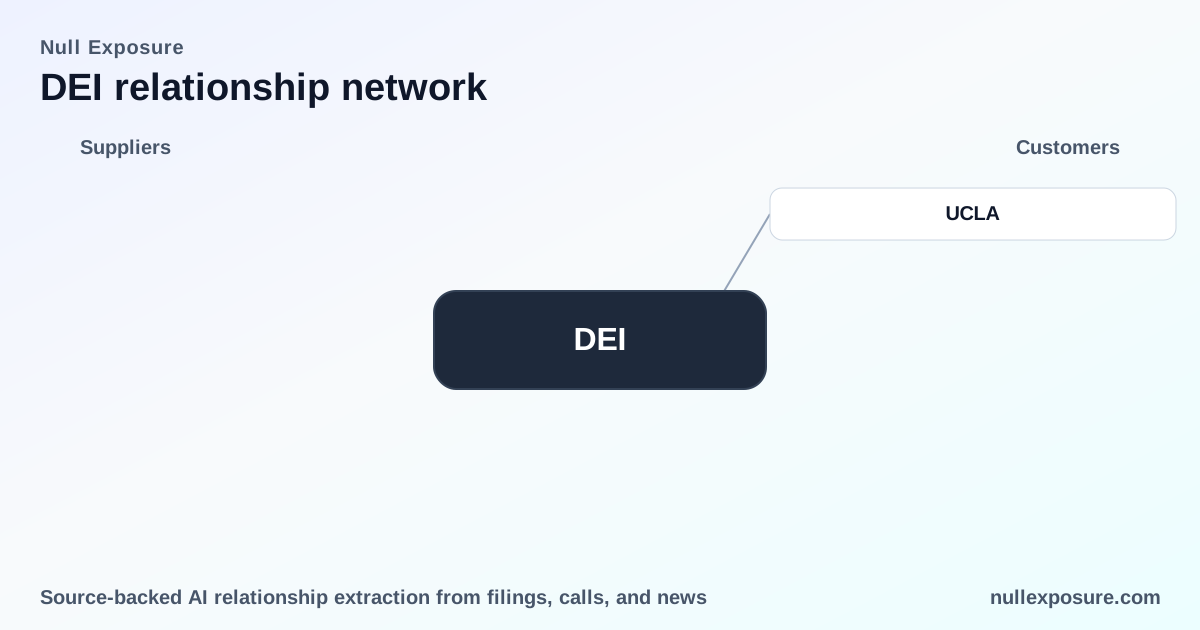
Douglas Emmett (DEI): Tenant relationships that drive cash flow and concentration risk
Douglas Emmett is a self-managed REIT that owns and operates high-quality office and multifamily properties in coastal Los Angeles and Honolulu, generating cash flow primarily through long-term lease rents and tenant services (parking, storage and related fees). The company monetizes its asset base by stabilizing occupancy in premium submarkets, selectively selling or acquiring trophy assets, and managing operating margins across office and multifamily portfolios. For investors, the actionable lens is simple: earnings and valuation are driven by lease expirations and large tenant relationships concentrated in a handful of coastal submarkets. Learn more at https://nullexposure.com/.
What matters for an investor: durable cash flow, concentrated geography, and lease timing
Douglas Emmett’s model is fundamentally contract-driven: cash flows are anchored in leases that extend across multiple years and in some cases decades. The company’s operating posture reflects long-term contracting, with documented lease expirations stretching into the 2030s, and a business that actively markets vacancies to preserve a high percent-leased metric. Geographic concentration is meaningful — Los Angeles and Honolulu submarkets house the bulk of the portfolio — which helps rent pricing power in top coastal nodes but increases exposure to local office demand cycles. Finally, the firm’s role is seller/operator of real estate and tenant services, making tenant retention and lease renewals operationally critical to near-term FFO and longer-term NAV.
Constraints and operating-model signals you need to price in
- Contracting posture (long-term): Lease expiration schedules show material expirations across multiple years and selected leases extending through 2038, indicating a portfolio of staggered, multi-year commitments that support predictable cash flow while creating distinct rollover risk windows.
- Geographic concentration (coastal submarkets): Properties are concentrated across Beverly Hills, Brentwood, Burbank, Century City, Santa Monica, and Honolulu, concentrating market risk but preserving premium rent capture.
- Relationship role (seller/operator): Douglas Emmett functions as landlord and service provider — rental income plus ancillary tenant services drive operating revenue.
- Relationship stage and maturity (active portfolio): The company reported an 81.1% percent leased rate as of December 31, 2024, signaling an active leasing market in which nearly one-fifth of office square footage was available for lease at that date.
- Segment focus (services): Core revenue lines derive from office and multifamily rental and tenant services rather than transactional development fees.
These constraints are company-level signals that shape revenue volatility, refinancing windows, and capital allocation choices. For a deeper read on tenant composition and lease roll risk, visit https://nullexposure.com/.
Relationship-by-relationship read: tenants and mentions that matter
Below are the customer/tenant relationships surfaced in the coverage set, each summarized in plain English with source attribution.
Beverly Hills Plastic Surgery Center — a tenant in a high‑end medical-office cluster
Beverly Hills Plastic Surgery Center is listed among the tenants in The Bedford Collection, which is reported as 95% leased to roughly 120 tenants including specialist and concierge medical practices that serve affluent patient populations; this positions the tenant as part of a stable, premium-income cluster within the portfolio. According to The Real Deal (April 17, 2026), the Bedford Collection’s leasing profile reflects high demand for medical-office uses at premium coastal locations: https://therealdeal.com/la/2026/04/17/douglas-emmett-buys-beverly-hills-medical-offices-for-260m/.
PEBO / Peoples Bank brand contract — an out-of-scope mention likely referencing a different “DEI”
A November 2021 Marietta Times article describes a DEI that executed a brand implementation contract with Peoples Bank covering 36 branch locations; that article identifies DEI as a design/build firm focused on bank and credit-union work and therefore does not align with Douglas Emmett’s REIT business model, indicating the mention refers to a different company using the same acronym. See Marietta Times (Nov 2021): https://www.mariettatimes.com/news/local-news/2021/11/a-new-partnership/.
UCLA — the portfolio’s largest lease expiration and a material rollover risk
UCLA is identified as the largest lease expiration in the year and has additional space scheduled to expire through 2033, making this tenant a central determinant of near- and medium-term lease-roll dynamics; management discussion on the earnings call confirmed changes in total lease size this quarter. The Q4 2025 earnings call and earnings-transcript coverage raised UCLA as the single largest upcoming expiration; see the InsiderMonkey Q4 2025 earnings call transcript (March 9, 2026) and The Globe and Mail transcript coverage (March 9, 2026) for management commentary and Q&A: https://www.insidermonkey.com/blog/douglas-emmett-inc-nysedei-q4-2025-earnings-call-transcript-1694406/ and https://www.theglobeandmail.com/investing/markets/markets-news/motley/165361/douglas-emmett-dei-q4-2025-earnings-transcript/.
Key takeaways for investors and operators
- Lease expirations determine the rhythm of results. Large, concentrated expirations — most prominently UCLA — create discrete valuation inflection points as leases reprice or renew.
- Geographic concentration is both an advantage and a risk. Premium coastal submarkets support higher rents and tenant quality but amplify localized economic shocks.
- Tenant mix includes specialty medical and institutional occupiers. Medical-office tenants such as Beverly Hills Plastic Surgery Center help diversify cash flow within office buildings, often commanding stable rents.
- Be alert for attribution noise in public coverage. Not all press mentions of “DEI” relate to Douglas Emmett; one item in the sample refers to a design/build firm, underscoring the need for careful source validation.
Portfolio-level risks to underwrite
- Roll concentration risk: Large tenants with near-term expirations can cause revenue volatility if not renewed or if re-leasing occurs at materially lower rents.
- Occupancy sensitivity: An 81.1% percent-leased baseline implies meaningful vacancy exposure that can compress short-term FFO during cyclical troughs.
- Market concentration: Heavy exposure to LA/Hõnolulu submarkets links valuation to local demand trends and office-market secular shifts.
What investors should watch next
Track quarterly leasing disclosures, the detailed lease-expiration schedule, and management’s commentary on renewal probability and new leasing velocity for the UCLA exposure and other large tenants. For continuous monitoring and deeper relationship mapping, visit Null Exposure for ongoing coverage and document-level sourcing: https://nullexposure.com/.
Bottom line: Douglas Emmett’s cash flows are rooted in long-dated leases across premium coastal submarkets; investor returns will hinge on lease-roll outcomes for large tenants and the firm’s ability to convert vacant space at resilient rental levels.