Dell Technologies — customer relationships and commercial posture
Thesis: Dell Technologies operates as a vertically integrated IT hardware and infrastructure provider that monetizes primarily through hardware sales (servers, PCs, storage), high-margin services and software, and an expanding portfolio of recurring revenue via subscriptions, as‑a‑service offerings, and financing. The company extracts cash up front from product sales while layering multi‑year maintenance, deployment and financing agreements that drive predictable, serviceable cash flows and cross‑sell opportunities.
Learn more about how these customer relationships translate into commercial risk and opportunity at https://nullexposure.com/.
Why customers matter to Dell’s valuation
Dell’s business model combines transactional hardware revenue with growing annuity streams. Hardware remains the engine for volume, but margins and valuation leverage increasingly derive from recurring software, support and consumption contracts, and from financing solutions that smooth purchasing cycles for customers. This operating posture creates concentration sensitivity to large cloud and enterprise buyers, while also producing predictable cash flows from multiyear contracts and usage‑based offerings.
Key company‑level signals: Dell operates globally with sales across enterprise, public sector, SMB and consumer channels; it offers long‑term, subscription and usage‑based contracts; and it sells across hardware, infrastructure, services and software segments (company disclosures, FY2025).
Relationship ledger — who’s buying (and how Dell shows up)
Below I list every relationship in the source results. Each entry is a concise, plain‑English description with the cited source context.
IREN — ts2.tech (FY2025)
IREN expects roughly $5.8 billion of capital expenditures specifically for Dell‑supplied GPUs and related gear, signalling a large, hardware‑centric order flow tied to AI capacity buildout. Source: TS2 Tech reporting on IREN’s FY2025 guidance.
XRX — 2025 Q4 earnings call
An earnings call referenced Dell Apex devices and service models, indicating Dell’s as‑a‑service equipment is embedded in third‑party vendor operations and client deployments. Source: XRX 2025 Q4 earnings call transcript.
NSIT — 2025 Form 10‑K
NSIT disclosed that Dell is one of its top five manufacturers and that those top five accounted for about 50% of consolidated net sales in 2025, highlighting distribution concentration through channel partners. Source: NSIT 2025 10‑K filing.
DXC — company news (FY2025)
DXC is developing on‑premises GenAI solutions with Dell and NVIDIA, positioning Dell as the hardware and systems integrator for enterprise AI projects. Source: DXC corporate announcement (FY2025).
IREN — eand.co (FY2026)
A report notes IREN is using a Microsoft prepayment to finance a $5.8 billion purchase from Dell, reinforcing Dell’s role as the supplier of record for large AI hardware transactions. Source: eand.co coverage (FY2026).
PHI — Philstar (FY2026)
PLDT’s facility houses Pilipinas AI, developed by Dell Technologies and Katonic AI to build AI models for local businesses, showing Dell’s presence in regional AI platform projects. Source: Philstar (Feb 2026).
IREN — ts2.tech (FY2025, AP reported)
A related AP‑sourced report explained IREN’s deal includes a 20% prepayment and a Dell agreement to buy $5.8 billion of chips and equipment, with phased deployment. Source: TS2 Tech summarizing AP reporting (FY2025).
VMW — Pulse2 (FY2021)
Following Dell’s spin‑off of VMware, VMware continues to use Dell Financial Services to help its customers finance digital transformations, indicating finance remains a channel for Dell influence post‑divestiture. Source: Pulse2 report on the VMware spinoff (FY2021).
HIVE — SimplyWall (FY2026)
A partnership with Hive Digital positions Dell as a core hardware and solutions supplier for next‑generation AI GPU clusters, underlining Dell’s strategic positioning in high‑performance AI infrastructure. Source: Simply Wall St (FY2026).
IREN — Cryptonews.au (FY2026)
IREN confirmed hardware will be supplied through Dell and deployed in phases in Mackenzie and Childress, reinforcing multi‑site, phased fulfillment for large GPU orders. Source: Cryptonews Australia (FY2026).
IREN — Stocktwits news article (FY2026)
A market note summarized IREN’s contracts, citing a $5.8 billion purchase of data center equipment from Dell alongside other large deals, reflecting market perception of Dell’s scale in AI infrastructure supply. Source: StockTwits news aggregation (FY2026).
IFBD (Infobird) — RTTNews (FY2010)
Under a historic partnership, Infobird’s cloud management/contact center platform was offered to Dell’s enterprise clients through Dell’s direct sales channels, showing long‑standing channel agreements in APAC. Source: RTTNews (circa 2010).
PENG — Automation.com (FY2026)
Penguin Solutions deployed Dell PowerEdge servers and PowerScale storage for an optimized AI inference infrastructure supporting Deepgram, demonstrating Dell’s role in turnkey AI infrastructure stacks. Source: Automation.com (FY2026).
WLAC — The Globe and Mail (FY2025)
Willow Lane’s agreements include partnerships with Dell to enhance Boost Run’s AI infrastructure capabilities, indicating Dell is a named partner in cloud‑adjacent AI offerings. Source: The Globe and Mail (FY2025).
CNXN — Investing.com (FY2026)
PC Connection achieved Dell Technologies Partner Program Titanium Black status for 2026, placing it among Dell’s top reseller/partner tiers and reflecting channel enablement. Source: Investing.com (FY2026).
McLaren Racing — Stockstotrade news (FY2026)
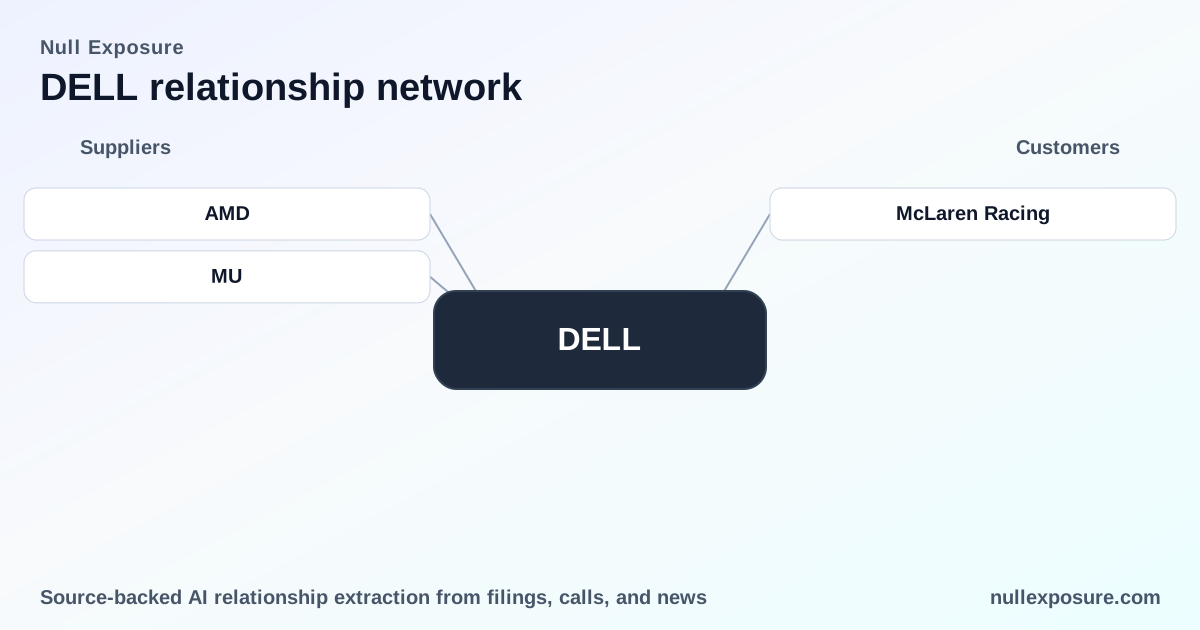
Dell’s partnership with McLaren Racing supplies AI infrastructure, storage and PCs for simulation workloads, showcasing marketing and technical collaboration in high‑performance simulation. Source: StockstoTrade coverage (FY2026).
VMW — GovConWire (FY2021)
A government‑focused recap noted VMware will continue to help clients fund digital transformations through Dell Financial Services, reinforcing the financing channel narrative (public sector emphasis). Source: GovConWire (FY2021).
CTSH — Investing.com / Sahm Capital (FY2026)
Cognizant launched the AI Factory with Dell and NVIDIA, a multi‑tenant cloud offering to standardize AI development and deployment across hybrid environments. Source: Investing.com and Sahm Capital commentary (FY2026).
PENG — TradersUnion (FY2026)
Penguin Solutions announced a partnership with Dell to develop scalable AI infrastructure for healthcare, highlighting sector‑specific solutions built on Dell hardware. Source: TradersUnion (FY2026).
CNXN — Sahm Capital (FY2026)
Analysis noted PC Connection’s Titanium Black partner recognition, reiterating Dell’s tiered partner program and its role in channel distribution. Source: Sahm Capital (FY2026).
How Dell contracts and monetizes — constraints and operating signals
Dell’s disclosures and the relationship evidence together create a consistent picture of commercial posture:
- Contracting posture: Dell combines large, multiyear contracts and leasing/loan instruments with subscription and usage‑based offerings; this structure preserves upfront hardware revenue while generating recurring streams from services and support (company filings, recurring revenue definitions).
- Customer concentration and criticality: A meaningful portion of revenues is tied to a smaller set of large enterprise and cloud customers, particularly where AI‑grade GPU capacity is involved; this elevates counterparty concentration risk but also drives outsized order flow when load ramps occur (company segment commentary).
- Commercial maturity: Many relationships show established channel and partner programs (Titanium Black partners, Dell Financial Services), reflecting mature routes‑to‑market and financing capabilities that accelerate procurement cycles.
- Global reach and counterparty mix: Dell’s go‑to‑market is global, spanning government, very large enterprises, mid‑market and SMBs, which diversifies geographic revenue while maintaining exposure to cyclical enterprise capex.
Key takeaway: Dell’s revenue profile is hybrid: hardware transactional volume fuels recurring, higher‑margin services and financing products that underpin valuation stability.
For deeper, structured customer intelligence and scenario modeling of Dell exposures, visit our research hub at https://nullexposure.com/.
Disclaimer: This analysis synthesizes reported relationship excerpts and public disclosures to characterize Dell’s customer position; it does not constitute investment advice.