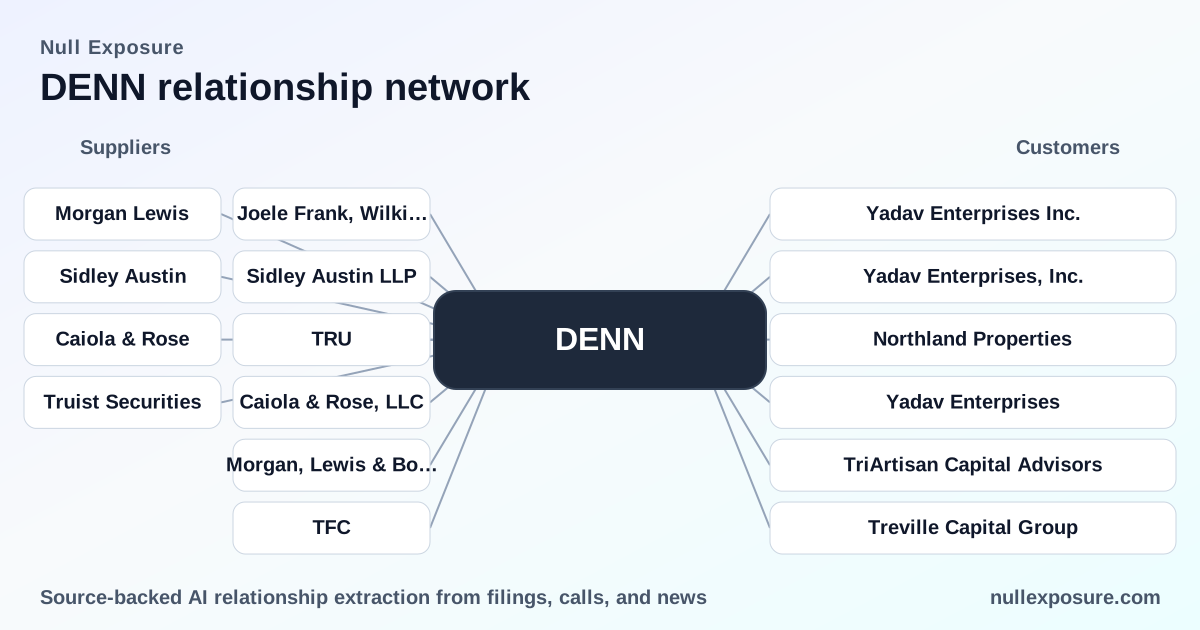
Denny’s Corporation (DENN): Franchise-centered diner brand under new private-equity ownership
Denny’s operates and monetizes a national full‑service restaurant network through a mix of company‑owned locations and a broad franchise base, collecting restaurant sales, franchise royalties, and licensing income while running ancillary concepts such as Keke’s. The company’s recent all‑cash sale to an investor group — led by TriArtisan Capital Advisors, Treville Capital Group, and major franchisee Yadav Enterprises — reshapes counterparty dynamics and places franchise relationships at the center of near‑term strategic risk and value creation. For a concise map of counterparties and what they mean for operators and investors, see Null Exposure for deeper coverage: https://nullexposure.com/.
Overview: Denny’s monetizes as a classic franchisor/operator with modest profitability and meaningful institutional ownership (78% institutional float). Fiscal metrics show FY‑TTM revenue of roughly $457m and EBITDA of $62m, which underpins a leveraged private‑equity take‑private at an enterprise valuation reported near $620m.
What the ownership change signals for customers and counterparties
The buyer group includes private equity and a large franchisee, which alters the company’s contracting posture and governance. Private‑equity ownership plus a dominant franchisee on the buy side increases incentives to harmonize franchisor and large franchisee economics, accelerate system‑level margin gains, and extract operational efficiencies — actions that will influence supplier contracts, marketing spend, and royalty/lease dynamics. The transaction was announced in late 2025 and completed in early 2026, and the deal terms are widely reported in legal and news filings.
A mid‑article note: for further structured relationship intelligence and monitoring tools, visit our home page: https://nullexposure.com/.
Company‑level operating model characteristics (company signals)
No formal relationship constraints were supplied in the reviewed material; that absence itself is a company‑level signal. From public financials and transaction coverage we infer the following operational characteristics:
- Contracting posture: franchise‑first. Denny’s business depends on franchise agreements and royalties as much as company‑operated sales, so negotiation leverage sits with parties that control scale or brand IP.
- Concentration: material counterparty concentration risk around large franchisees. The presence of a major franchisee as an investor implies concentrated exposure to a small set of counterparties that significantly influence system performance.
- Criticality: franchise relationships are critical to system revenue and same‑store sales; any operational change that disrupts large owner‑operators would directly affect system throughput.
- Maturity: established brand with modest topline growth and constrained margin expansion, consistent with a stable, low‑growth restaurant chain attractive to buyout investors targeting operational improvements rather than rapid expansion.
Counterparty map — named relationships and what they mean
Below are every counterparty relationship identified in the coverage, summarized in plain English with source citations.
Yadav Enterprises, Inc.
Yadav Enterprises is repeatedly described in Denny’s transaction filings as one of the largest Denny’s franchisees and an investor in the buyout, characterized in Nov 2025 filings as the owner‑operator of approximately 550 restaurants nationwide and in Jan 2026 press releases as operating more than 310 franchise restaurants and owning brands including Del Taco, Taco Cabana and Nick the Greek. According to Denny’s corporate announcements and accompanying media coverage, Yadav is a direct investor in the $620m take‑private transaction and therefore transitions from counterparty to co‑owner. (See Denny’s press release, Nov 3, 2025; GlobeNewswire, Jan 16, 2026; Sidley legal filing, Nov 2025.)
TriArtisan Capital Advisors
TriArtisan is the private‑equity lead in the investor group that agreed to acquire Denny’s for roughly $620 million; the firm brings restaurant and hospitality deal experience and will set the financial targets and exit horizon typical of PE owners. (See Sidley representation and transaction summary, Nov 2025.)
Treville Capital Group
Treville is the third named investor in the acquisition consortium and will play a role complementary to TriArtisan in capital allocation and alternative‑asset management for the platform post‑close. Transaction notices and legal counsel disclosures list Treville alongside TriArtisan and Yadav as principals in the buyout. (See Sidley and related transaction coverage, FY2025.)
Northland Properties
Northland Properties acquired Canadian trademarks and intellectual property rights for the Denny’s brand within Canada, giving the firm domestic brand control north of the border. This isolates Canadian licensing risk from U.S. operations and signals an international IP carve‑out for local operators. (See reporting summarized by Meyka and sourcing to Business in Vancouver, FY2026.)
TANNZ (TA National/TA Express reference)
Industry press referencing TA Express truck stop developments lists Denny’s among onsite dining options, illustrating the brand’s role as a travel‑center partner and the company’s exposure to travel‑channel operators. This is an operational relationship rather than an equity or franchising tie, and it underscores distribution variety for the brand. (See The Trucker article on TA Express additions, FY2020.)
Strategic risks and practical implications for lenders, suppliers, and partners
- Concentration risk: With a major franchisee now a co‑owner, downstream vendors should expect contract renegotiation pressure toward scale discounts or credited marketing spend aligned to system‑wide performance.
- Governance and contracting shifts: Private equity ownership accelerates margin programs and cost‑saving initiatives; suppliers and service providers will encounter more aggressive procurement postures and a heightened focus on EBITDA improvement.
- Brand partitioning: Canadian IP being held separately by Northland reduces cross‑border licensing leverage for the new U.S. owners and creates segmented risk profiles for international partners.
- Distribution diversity: Denny’s presence in travel centers (TA/TA Express) and broader franchise networks maintains diversified revenue streams but increases operational coordination burdens across franchise and non‑franchise channels.
Investor takeaway
The DENN buyout crystallizes Denny’s as a franchise‑centric, operationally optimized platform under private capital, with major franchisee influence built into ownership. That structure reduces public market volatility but concentrates counterparty and governance risk around large operators and PE playbooks. For operators, suppliers, and creditors, the priority action is to map contract exposure to Yadav and other large franchisees and to prepare for renegotiation cycles driven by margin improvement mandates.
For ongoing tracking of how these relationships convert into contract and revenue outcomes, visit Null Exposure: https://nullexposure.com/.