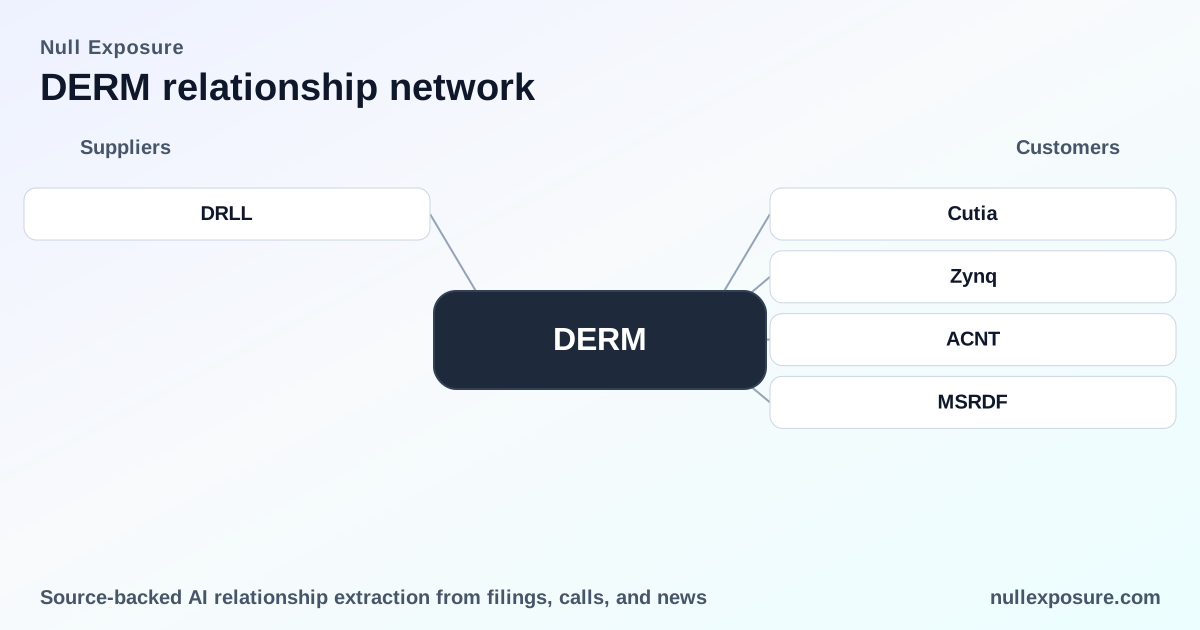
Journey Medical (DERM) — customer relationships that shape revenue cadence and distribution risk
Journey Medical sells and markets FDA-approved dermatology prescription products and monetizes through U.S. commercial sales to specialty pharmacies, wholesalers and distributors, supplemented by milestone and licensing receipts from international partners. Revenue is primarily U.S.-based and distribution-led, with occasional non‑U.S. upside from partner approvals and supply agreements that produce lump-sum milestone payments and ongoing product shipments. For investors, the mix of wholesale customers, GPO negotiations and selective international licensing defines both near-term cash flow variability and the company’s path to scale.
Learn more at https://nullexposure.com/.
How Journey Medical actually gets paid
Journey Medical’s cash flows come from two complementary streams: (1) routine U.S. product sales through wholesalers, specialty pharmacies and direct distributor channels, and (2) partner-driven milestone and supply revenues outside the U.S. The 2024 Form 10‑K records the business as a commercial-stage pharmaceutical company with all product revenues recorded in the U.S., while company filings also disclose milestone income tied to partner regulatory events. That combination creates steady base revenue domestically and episodic international upside.
What the customer roster looks like — relationship-by-relationship
Below I cover every customer relationship cited in the available records, with concise takeaways and source references.
-
Cutia
Journey recorded a $1.0 million milestone payment from Cutia in FY2024 that was payable when Cutia obtained marketing approval in the People’s Republic of China for topical 4% minocycline foam, reflecting a licensing-style revenue event. According to the company’s 2024 Form 10‑K, this milestone was recognized as other revenue for the year ended December 31, 2024. A subsequent news report noted that Journey began supplying Amzeeq to Cutia for commercial use in August 2025, converting a prior licensing milestone into an ongoing international supply relationship that can generate recurring sales beyond the one-time payment. (Sources: Journey Medical 2024 Form 10‑K; TradingView report, August 2025 / Congressional filings summarized in news coverage.) -
Zynq
Zynq is one of the three major Group Purchasing Organizations (GPOs) referenced in Journey’s Q3 2025 earnings call commentary as a counterparty in typical product launch contracting. Negotiations and contracting with Zynq are described as part of the standard go‑to‑market approach for new pharmaceutical launches, indicating Zynq’s role in access and reimbursement dynamics for Journey’s products. (Source: Q3 2025 earnings call transcript published via InsiderMonkey.) -
ACNT (Ascent)
Journey cites Ascent (ACNT) among the three primary GPOs with which launch contracts are broadly negotiated; these GPO discussions govern formulary access and purchasing terms that materially influence channel penetration and uptake. The company’s public remarks in the Q3 2025 transcript present Ascent as a standard counterparty in early contracting for new product rollouts. (Source: Q3 2025 earnings call transcript via InsiderMonkey.) -
MSR
MSR is the third named GPO in Journey’s launch playbook, explicitly listed alongside Ascent and Zynq in the company’s Q3 2025 remarks on contracting strategy. GPO agreements with MSR will affect distribution economics and shelf‑space in institutional and specialty settings. (Source: Q3 2025 earnings call transcript via InsiderMonkey.) -
EVMN (Evommune)
In FY2021, Evommune entered an exclusive license agreement with Dermira, Inc. (a Dermira entity referenced as wholly owned by Eli Lilly at the time) to develop and commercialize three development programs in inflammatory disease, representing historical R&D and licensing activity connected to Journey/Dermira’s asset base. That licensing transaction illustrates the company’s ability to monetize non‑core programs through third‑party innovation partnerships. (Source: PR Newswire release, 2021.)
Operating model and risk profile — what to watch
The relationship evidence and company disclosures point to several structural features that drive investor returns and risk.
-
Contracting posture: Journey operates primarily as a seller to wholesalers, specialty pharmacies and distributors, while also negotiating broad contracts with major GPOs at launch. This posture creates a two‑tiered negotiation dynamic: standard trade terms with wholesalers and more strategic, access‑oriented deals with GPOs. The 10‑K explicitly notes sales through wholesaler distributors and specialty pharmacies and the Q3 commentary confirms GPO negotiation behavior.
-
Concentration and geography: All product revenues are recorded in the U.S., establishing geographic concentration in domestic healthcare markets and exposure to U.S. reimbursement and regulatory cycles. At the same time, milestone payments and supply contracts—such as the Cutia arrangement—offer selective international upside without large-scale international revenue dependence.
-
Distribution criticality: The company’s accounts receivable are primarily from drug wholesalers and specialty pharmacies, making distributor relationships critical to working capital and revenue recognition. Disruptions in wholesale flows or shifts in GPO formularies could have outsized effects on near-term cash collection.
-
Revenue maturity and variability: Journey is a commercial-stage company with FDA-approved products generating base sales, but material variability comes from one-time licensing milestones and the timing of partner approvals and shipments. Milestone income like the $1.0 million Cutia payment is non-recurring in nature, while supply agreements can transition into recurring revenue if sustained.
Investment implications — upside and watch items
-
Upside: Domestic product sales provide a stable revenue floor; international licensing and supply agreements deliver episodic upside and serve as de‑risked expansion channels without heavy international build-out. The Cutia pathway demonstrates how regulatory events can translate to both milestone cash and follow‑on commercial shipments.
-
Risks: Distribution concentration and U.S.-centric revenues are the main risk vectors—changes in wholesaler payment terms, GPO contracting outcomes, or U.S. reimbursement policies will materially affect cash flow. Additionally, milestone-driven revenue introduces volatility to short‑term earnings.
Final read and next steps
For investors and operators assessing Journey Medical, the company’s revenue model is distribution-dependent domestically with strategic partner monetization internationally. Focus diligence on the durability of wholesaler and specialty pharmacy relationships, the status of GPO contracts with Ascent, MSR and Zynq, and the pipeline of partner-triggered milestones like those with Cutia. For a deeper look at the customer intelligence and how these relationships move cash flow, visit https://nullexposure.com/.
Bold takeaways: U.S. sales drive the base; GPO and wholesaler contracts determine access; partner deals provide episodic upside.