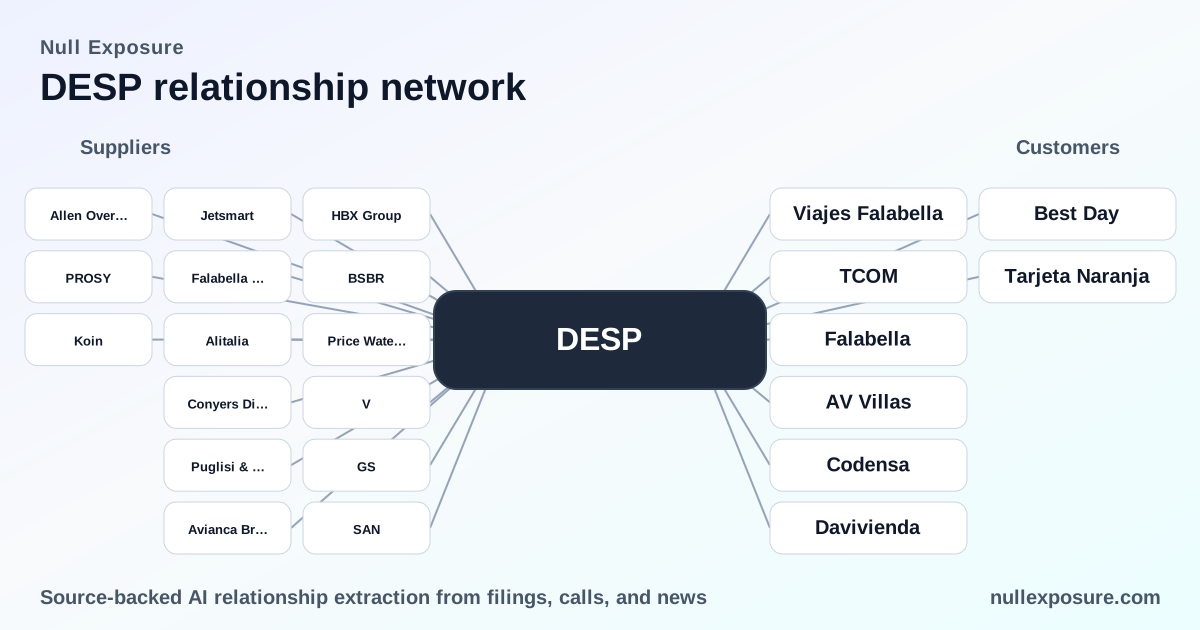
DESP Customer Relationships: Distribution partnerships drive revenue, travel inventory and B2B monetization
Despegar (DESP) operates as a travel distribution and services platform that monetizes through inventory resale, B2B white‑label solutions and distribution APIs sold to large travel, retail and financial partners. The company extracts margin by leasing or distributing hotel inventory, embedding guided accommodation into third‑party channels, and operating co‑branded offers with banks and retailers—a model that scales with partner reach rather than direct advertising. For investors, the customer book is therefore both a revenue diversification vector and a concentration risk if a small set of partners accounts for outsized volumes. Learn more at https://nullexposure.com/.
How Despegar earns with partners: the operating blueprint
Despegar’s commercial playbook is straightforward and consistent across the reported relationships: supply aggregation (hotels and accommodation), distribution via APIs and white‑label platforms, and co‑marketing with retail/financial allies. That creates three monetization levers: transactional commission on bookings, fixed or variable lease fees for inventory access, and revenue share or fee arrangements on co‑branded offers. The company’s contracting posture aligns with platform economics—longer‑term distribution deals and white‑label arrangements increase stickiness, whereas API integrations enable broader reach at lower account management cost.
- Concentration: The partner list mixes global OTA distribution (trip.com), regional travel consolidators (Best Day), and major retailers and banks (Falabella, Davivienda, Tarjeta Naranja). That mix reduces single‑counterparty dependence but concentrates commercial exposure in channel distribution rather than direct consumer margins.
- Criticality: For partners that receive exclusive or broad access (for example, leased hotel inventory), Despegar is a material supplier of Latin America accommodation content and booking flows—this gives Despegar pricing power in B2B negotiations while creating customer revenue dependency risk.
- Maturity and contracting: The relationships range from mature white‑label and platform leases to more recent API rollouts; the presence of large strategic acquirers and retail partners indicates commercial sophistication and scale.
If you want a concise view of partner exposures and how they translate to revenue streams, visit https://nullexposure.com/ for more curated analysis.
Relationship scorecard — what every named partner means for investors
TCOM (trip.com) — API connectivity for guided accommodation (FY2021)
Despegar announced that API connectivity with trip.com went live on April 28, 2021, enabling trip.com to surface Despegar’s guided accommodation inventory across its brands via mobile and web, which extends Despegar’s reach into Asia‑Pacific customer flows. Source: Despegar Q1 2021 earnings call transcript published on The Motley Fool (FY2021) — https://www.fool.com/earnings/call-transcripts/2021/05/19/despegarcom-corp-desp-q1-2021-earnings-call-transc/.
trip.com — same commercial integration noted separately (FY2021)
Despegar confirms that trip.com is consuming guided accommodation inventory via API, mobilizing Latin America supply in an international distribution channel that drives B2B booking volume. Source: Despegar Q1 2021 earnings call transcript (FY2021) — https://www.fool.com/earnings/call-transcripts/2021/05/19/despegarcom-corp-desp-q1-2021-earnings-call-transc/.
Viajes Falabella — full hotels inventory lease (FY2020)
Despegar reported that 100% of its Hotels inventory is available on lease to Viajes Falabella’s platform, signaling a deep white‑label or inventory‑leasing relationship that embeds Despegar supply into a leading regional retail travel channel. Source: Despegar Q4 2019 earnings call transcript published on The Motley Fool (FY2020) — https://www.fool.com/earnings/call-transcripts/2020/03/05/despegarcom-corp-desp-q4-2019-earnings-call-transc.aspx.
Prosus NV — strategic acquirer (FY2024)
Prosus NV announced a purchase agreement to buy Despegar for approximately USD 1.7 billion, reflecting strategic value attributed to Despegar’s platform, partner network and Latin American market leadership. The acquisition places Despegar under a technology investor with global portfolio assets. Source: Romania‑Insider reporting on Prosus acquisition (FY2024) — https://www.romania-insider.com/majority-shareholder-emag-acquires-latin-american-travel-agency-2024.
Codensa — marketing and alliance partner (FY2025)
Despegar collaborated with Codensa as one of several allied companies for offers and customer outreach, indicating co‑marketing and distribution tie‑ins with energy/utility customer bases in select markets. Source: Pulzo report on Despegar alliances (FY2025) — https://www.pulzo.com/vivir-bien/viajes-y-turismo/despegar-aviso-ofertas-con-av-villas-davivienda-falabella-codensa-viajes-PP4687446.
Davivienda — financial partner in promotional alliances (FY2025)
Despegar listed Davivienda among bank partners for promotional campaigns and offers, highlighting card‑linked and financial channel distribution as part of its monetization strategy. Source: Pulzo coverage of Despegar’s partner campaign (FY2025) — https://www.pulzo.com/vivir-bien/viajes-y-turismo/despegar-aviso-ofertas-con-av-villas-davivienda-falabella-codensa-viajes-PP4687446.
Falabella — retail channel and alliance (FY2025)
Despegar worked with Falabella in allied offers, reflecting integration into large retail ecosystems that can supply customer traffic and loyalty‑driven bookings. Source: Pulzo report (FY2025) — https://www.pulzo.com/vivir-bien/viajes-y-turismo/despegar-aviso-ofertas-con-av-villas-davivienda-falabella-codensa-viajes-PP4687446.
AV Villas — bank partner in promotional activity (FY2025)
AV Villas appears as another financial ally in Despegar’s promotional mixes, underlining the company’s strategy of leveraging bank partnerships for distribution and payment‑enabled offers. Source: Pulzo coverage (FY2025) — https://www.pulzo.com/vivir-bien/viajes-y-turismo/despegar-aviso-ofertas-con-av-villas-davivienda-falabella-codensa-viajes-PP4687446.
Best Day — platform migration and B2C synergies (FY2021)
Despegar reported that synergies in the B2C online segment are being captured as Best Day migrated to the Despegar platform, indicating platform consolidation and incremental unit‑economy benefits from scale. Source: Despegar Q1 2021 earnings call transcript (FY2021) — https://www.fool.com/earnings/call-transcripts/2021/05/19/despegarcom-corp-desp-q1-2021-earnings-call-transc/.
Best Day — operational leverage for LatAm travel (FY2020)
Despegar communicated that Best Day benefits from Despegar’s low‑cost delivery model and operating scale, confirming a supplier/partner role where Despegar supplies operational platform services to regional travel players. Source: Despegar Q4 2019 earnings call transcript (FY2020) — https://www.fool.com/earnings/call-transcripts/2020/03/05/despegarcom-corp-desp-q4-2019-earnings-call-transc.aspx.
Tarjeta Naranja — white‑label online marketplace partnership (FY2020)
Despegar committed to provide a white‑label online marketplace to Tarjeta Naranja, supporting co‑branded offers and jointly distributed travel products through a major regional card issuer. Source: Despegar Q4 2019 earnings call transcript (FY2020) — https://www.fool.com/earnings/call-transcripts/2020/03/05/despegarcom-corp-desp-q4-2019-earnings-call-transc.aspx.
What this partner map implies for investors
- Revenue diversity through B2B distribution: The mix of OTAs, banks and retailers shows Despegar earns from both transactional commissions and longer‑term white‑label/lease fees, which smooths revenue cyclicality tied to direct consumer channels.
- Commercial leverage and bargaining power: Having inventory leased to major retail travel brands and integrated via API into global players like trip.com supports pricing leverage but increases dependency on maintaining competitive content and margins.
- Integration risk and concentration management: While the partner set is broad, the company’s commercial success hinges on maintaining integrations and platform stability that underpin partner bookings. The Prosus acquisition (FY2024) signals strategic investor confidence and may accelerate deeper integration into Prosus’s portfolio.
Company‑level signals and operational constraints
No explicit contractual constraints were supplied in the source payload; as a company‑level signal, Despegar’s model exhibits platform contracting posture (multi‑year distribution/white‑label deals), moderate concentration risk in distribution partners, high operational criticality to partners that consume full inventory, and commercial maturity evidenced by platform migrations and a strategic acquisition.
Bottom line for decision makers
Despegar’s customer relationships are the core distribution engine of its monetization strategy: white‑label leases, API distribution to global OTAs, and bank/retail co‑marketing create recurring, partner‑driven revenue channels but also introduce concentration and integration risk that investors must monitor. For a focused review of how partner exposures convert to revenue and risk, visit https://nullexposure.com/ for tailored coverage and data‑driven summaries.