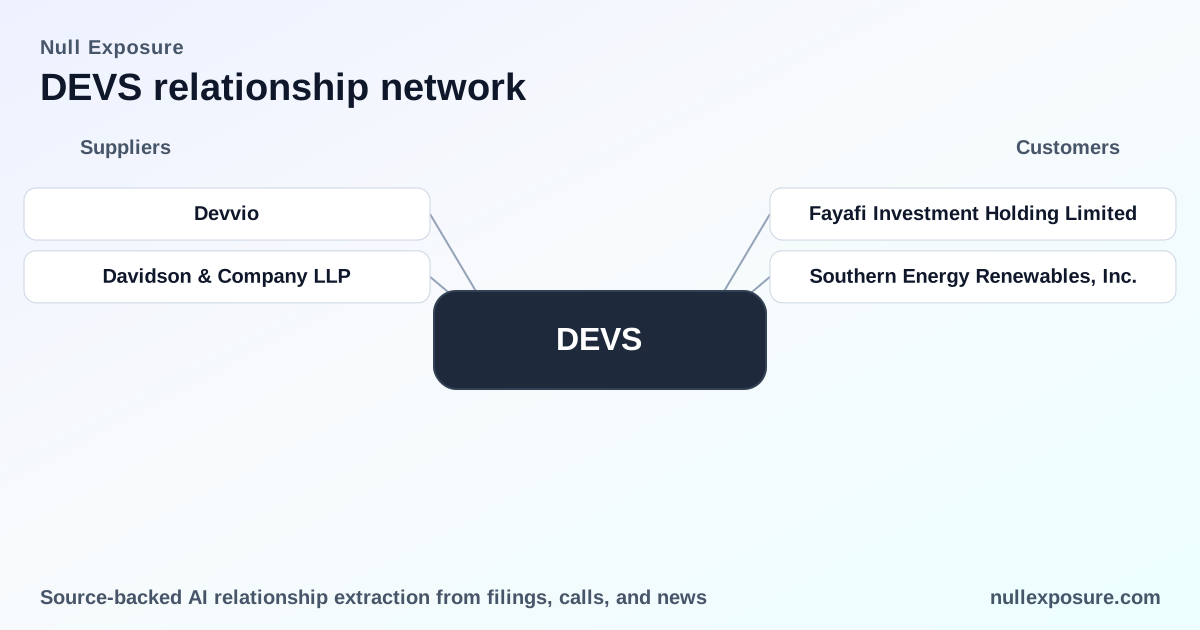
DevvStream (DEVS): Customer relationships map a services-first monetization strategy
DevvStream is a developer and manager of carbon-credit generating projects in North America that monetizes primarily through project development, environmental-asset monetization, and fee-based platform and consulting services. Revenue is concentrated in services tied to project setup, asset transfer (spot sales of credits), and recurring consulting or management fees tied to assets under management. Investors should evaluate DevvStream as an early-stage, services-led climate-asset operator with nascent revenue, elevated operating losses, and a business model that converts technical project work into one-time and recurring fees. Learn more on our homepage: https://nullexposure.com/
How the customer relationships read as a strategy
DevvStream’s customer mentions in public releases show a consistent operating posture: the company positions itself as a principal operator and manager of environmental assets, selling credits at the point control transfers and charging setup/management fees for platform partnerships. That revenue mix implies higher gross margins on bespoke services and one-time implementation fees, but also variability tied to deal flow and capital deployment by partners.
The company-level signals in its reporting reinforce this operating model:
- Contracting posture: Revenue recognition language describes sales of carbon credits as recognized at a point in time when control transfers, indicating predominantly spot transactions rather than long-term recurring subscriptions.
- Role in transactions: DevvStream’s filings state the company “acts as a principal” in revenue transactions, meaning it invoices and bears responsibility for delivery rather than functioning as a pure broker.
- Segment focus: Management reports one operating segment: development and monetization of environmental assets—this positions DevvStream as a services-first developer rather than a pure technology licensor.
- Product emphasis: The company describes itself as an ESG-led, impact investing operator focused on high-quality carbon credit projects, which supports the idea that the core product is the engineered environmental asset plus managed monetization services.
These signals together portray a firm that monetizes technical and commercial expertise through both spot asset sales and ongoing management/consulting fees rather than through stable SaaS-like annuities.
Relationship-by-relationship read: who pays DevvStream and how
Fayafi Investment Holding Limited — investment-platform setup (press release)
DevvStream will provide initial platform setup, project sourcing, and preliminary diligence services to Fayafi and is expected to receive a one-time setup fee and a recurring monthly consulting fee equal to a percentage of assets invested through the platform once feasibility is confirmed and Fayafi approves deployment. According to a company announcement on January 14, 2026, the relationship centers on a jointly governed SPV and fee-for-service economics. (BizWire press release, Jan 14, 2026 — https://markets.financialcontent.com/stocks/article/bizwire-2026-1-14-devvstream-and-fayafi-execute-investment-agreement-and-advance-plans-for-fayafi-x-devvstream-investment-platform?Language=english)
Southern Energy Renewables, Inc. — exclusive environmental-asset manager
DevvStream will act as the exclusive carbon credit and environmental-asset manager for Southern Energy Renewables’ commercial projects, positioning DevvStream as the operational lead for project monetization and credit issuance on those projects. This exclusive-manager role was described in a March 2026 release covering the companies’ commercial advancement. (Yahoo Finance / SG Finance report, Mar 2026 — https://sg.finance.yahoo.com/news/devvstream-southern-frontline-bioenergy-advance-133000397.html)
XCF Global, Inc. — transferable SAF credit collaboration
DevvStream and XCF Global are combining capabilities to support transferable SAF (sustainable aviation fuel) credits, with DevvStream indicating the platform will support XCF’s verified domestic SAF production as an asset class the company is designed to manage. This positions DevvStream to capture management and transaction fees on fuel-credit assets as SAF production scales. (Quantisnow insight piece, May 2, 2026 — https://www.quantisnow.com/insight/xcf-global-and-devvstream-combine-capabilities-to-bring-transferable-45z-clean-fuel-credits-to-6502565)
Fayafi Investment Holding Limited — Canadian–UAE climate alliance context (industry report)
An industry coverage note on the Canadian–UAE climate alliance describes the same Fayafi arrangement, confirming that DevvStream and Fayafi will create a jointly governed SPV, with DevvStream charging a one-time setup fee and ongoing consulting fees based on fund assets deployed, framing this as part of a broader $100M investment effort through 2027. This independent coverage corroborates the platform and fee-centric nature of the relationship. (carboncredits.com coverage, Mar 2026 — https://carboncredits.com/canadian-uae-climate-alliance-targets-100m-carbon-investment-push-by-2027/)
What these relationships imply for revenue, risk, and valuation
- Revenue composition: Expect a dual revenue stream of one-time implementation/setup fees and recurring consulting/management fees tied to assets under management—this structure can produce high-margin early revenue but is inherently lumpy while the partner pipeline matures.
- Cash-flow timing: Spot recognition of carbon-credit sales and principal role in transactions expedite revenue booking on completed deals, but cash flow depends on successful project completion and buyer demand at transfer.
- Concentration and counterparty risk: Current public relationships are few and strategic; this implies concentration risk until DevvStream scales a broader client base or secures long-term mandates with larger capital partners.
- Criticality and lock-in: Exclusive management agreements (e.g., Southern Energy Renewables) create higher contractual criticality and recurring revenue potential, improving valuation multiples relative to pure one-off project vendors.
- Maturity: The company’s financials show very low revenue (Revenue TTM $33,940) and negative EBITDA, indicating early-stage commercialization. Investor expectations should be calibrated for an execution and scaling phase rather than stable growth today.
Key takeaways for investors
- Services-first monetization: DevvStream sells project expertise and asset management, collecting both setup and ongoing fees rather than subscription revenue.
- Revenue is currently lumpy and project-driven, with spot credit sales recognized at transfer and DevvStream acting as principal.
- Partnerships increase scale but concentration remains a near-term risk; the Fayafi and Southern Energy relationships are strategically meaningful but limited in number.
- Upside is tied to AUM growth and recurring fee capture; downside is tied to project completion cadence and carbon-credit market demand.
For a concise, investor-focused dossier and ongoing tracking of customer and partner developments, visit our hub: https://nullexposure.com/
This assessment synthesizes company disclosures and market reports from Q1–Q2 2026 and public press releases cited above to map how DevvStream converts project execution into cash flow and where execution risk concentrates.