DeFi Development Corp. (DFDV) — Customer relationships that drive token utility and marketplace reach
DeFi Development Corp. operates a two‑pronged model: a treasury and asset-management strategy that accumulates and compounds Solana (SOL) and issues a liquid staking token (dfdvSOL), alongside a software and services platform that connects commercial real‑estate borrowers and lenders and monetizes through subscription fees and platform transaction fees. Investors should value DFDV not only as a balance‑sheet play on SOL exposure but as a business selling SaaS and marketplace services to lenders and borrowers. For a concise company dossier and more relationship analysis, visit https://nullexposure.com/.
Why customer relationships matter for DFDV’svaluation
DFDV’s commercial ties convert token utility into real-world demand and support recurring revenue from financial customers. Collateral listings, strategic investments, and platform adoption by mortgage market participants each increase the token’s economic circulation and the platform’s commercial defensibility. Below I catalogue every relationship the company has publicly cited in FY2026 and explain the investor relevance of each.
Jupiter Lend — DeFi lending marketplace expands collateral set
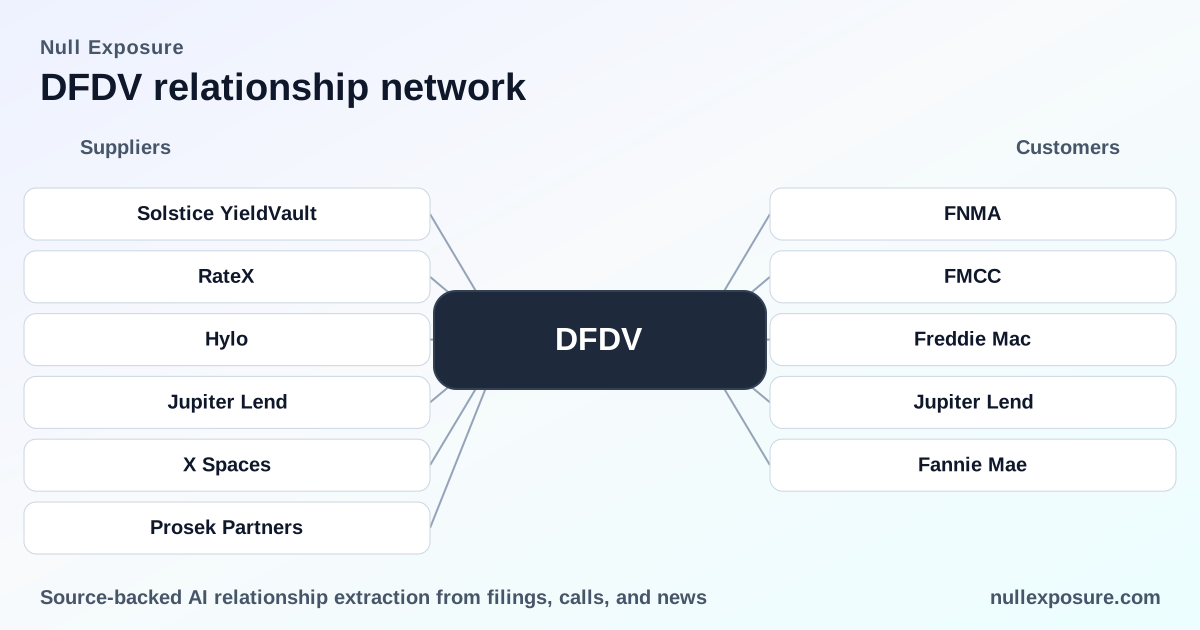
DeFi Development’s liquid staking token, dfdvSOL, was listed as collateral on Jupiter Lend, a leading Solana non‑custodial lending marketplace; that listing increased supply and lending utility for the token and enabled borrowing markets to reference dfdvSOL as collateral. According to a GlobeNewswire release on February 5, 2026, DFDV announced the collateral listing, and a Bitget article later reported supply increases from roughly 513,000 to over 656,000 dfdvSOL supported in part by Jupiter Lend integration (FY2026).
Source: GlobeNewswire press release, Feb 5, 2026; Bitget coverage, 2026.
Fannie Mae (FNMA) — Indirect platform exposure to government‑sponsored multifamily lenders
DFDV’s platform serves lenders that include Fannie Mae® multifamily lenders, meaning the company’s marketplace connects borrowers to lenders who participate in Fannie Mae programs; this positions DFDV as a conduit into institutional multifamily financing flows. Multiple press releases in early 2026 list Fannie Mae among the lender types using the platform (FY2026).
Source: GlobeNewswire / company releases (Jan–Mar 2026); MarketScreener coverage, May 2026.
Freddie Mac (FMCC) — Access to Freddie Mac‑backed multifamily lending channels
DFDV’s marketplace likewise lists Freddie Mac® multifamily lenders as part of its lender base, which gives the platform exposure to Freddie Mac‑sponsored multifamily financing channels and the corresponding pipeline of borrower demand. The company reiterated these relationships across several investor and media updates in Q1–Q2 FY2026.
Source: GlobeNewswire investor releases and SahmCapital reports, Jan–Mar 2026.
APYX (APYX) — Strategic investment into a dividend‑backed stablecoin protocol
DeFi Development invested in APYX, described in company communications as a dividend‑backed stablecoin protocol (DBS); this is a financial‑products investment that aligns with DFDV’s treasury and token strategy and reflects an expansion of its balance‑sheet activity into crypto‑native yield products. MarketScreener and GlobeNewswire reported DFDV funding or investment involvement with APYX in FY2026.
Source: MarketScreener news, May 2, 2026; GlobeNewswire press release, Feb 26, 2026.
Allied Architects, Inc. — Strategic equity investment to enter Japan
DFDV announced a planned strategic equity investment in Allied Architects, Inc., a Tokyo‑listed technology company, as part of a Japan market entry and accelerator effort; this is an explicit move to expand the company’s geographic footprint and partner ecosystem outside North America. Blockonomi and MarketScreener coverage document the investment and the Japan expansion plans (FY2026).
Source: Blockonomi report and MarketScreener coverage, Apr–May 2026.
Mooncake — Token integration powering new leveraged market products
The Solana trading venue Mooncake selected DFDV’s dfdvSOL liquid staking token to power a next‑generation leveraged market product (10Xsol), creating product demand and use cases for the token in structured trading and leverage markets. MarketScreener reported the Mooncake selection in early January 2026, signaling commercial adoption of dfdvSOL in Solana derivative and leveraged products (FY2026).
Source: MarketScreener news, Jan 8, 2026.
Operating model signals and constraints investors must price
DFDV is not a pure crypto token issuer nor a pure SaaS vendor; the company combines both modalities and that hybrid posture imposes multiple operating constraints:
- Contracting posture: The company recognizes revenue from annual SaaS subscriptions and platform fees (subscription contracts are a primary revenue driver). The platform also generates spot revenue when services are transferred at the point a lending transaction funds, introducing revenue timing volatility between recurring subscription cashflows and transactional income (evidence from FY2026 filings).
- Customer mix and counterparty types: DFDV serves a two‑sided market of lenders (including institutional multifamily lenders) and borrowers (commercial real‑estate owners and an expanding small‑business borrower segment). The borrower mix signals growth potential but also underwriting and macro sensitivity.
- Geography and concentration: The business has heavy North American exposure (platform penetration among U.S. banks and credit unions). Revenue concentration is material: three lenders accounted for 36% of revenues in the year ended December 31, 2024 — a single counterparty swing could move results materially.
- Role and criticality: The company operates as a service provider and marketplace operator; its platform is critical to creating two‑sided liquidity, so lender retention and marketplace depth are operationally important.
- Contract lifecycle and renewal risk: A meaningful portion of revenue depends on renewals and expansion of subscription customers; churn or downgrade in lender participation introduces downside to recurring revenue.
- Segment positioning: DFDV sells services and software — SaaS subscriptions, value‑added services and platform fees — which supports predictable revenue if retention is high but exposes the company to competitive SaaS dynamics and customer acquisition costs.
Investment implications and risks for operators and allocators
- Upside drivers: Collateral listings (Jupiter Lend), trading venue integrations (Mooncake), and strategic investments (APYX, Allied Architects) convert token supply into real economic utility, improving token demand and institutional use cases. Platform adoption by multifamily lenders gives DFDV direct lines into high‑value loan origination flows.
- Key risks: Revenue concentration among a few lenders, token regulatory uncertainty, and the hybrid business model’s execution risk (scaling both treasury returns on SOL and SaaS platform growth) are principal downside factors. The company reports negative operating margins and net losses, so growth must translate to improved unit economics to justify analyst targets.
- Operational priorities: Investors should monitor lender concentration metrics, subscription renewal rates, on‑chain collateral utilization of dfdvSOL, and progress on Japan expansion and APYX integration for signs of diversified revenue and increased token utility.
For a deeper read on DFDV’s commercial relationships, integrations and investor materials, see https://nullexposure.com/.
Bold conclusion: DFDV’s value combines token utility and marketplace economics — collateral listings and platform adoption create optionality, but revenue concentration and the dual‑model execution risk require active monitoring.