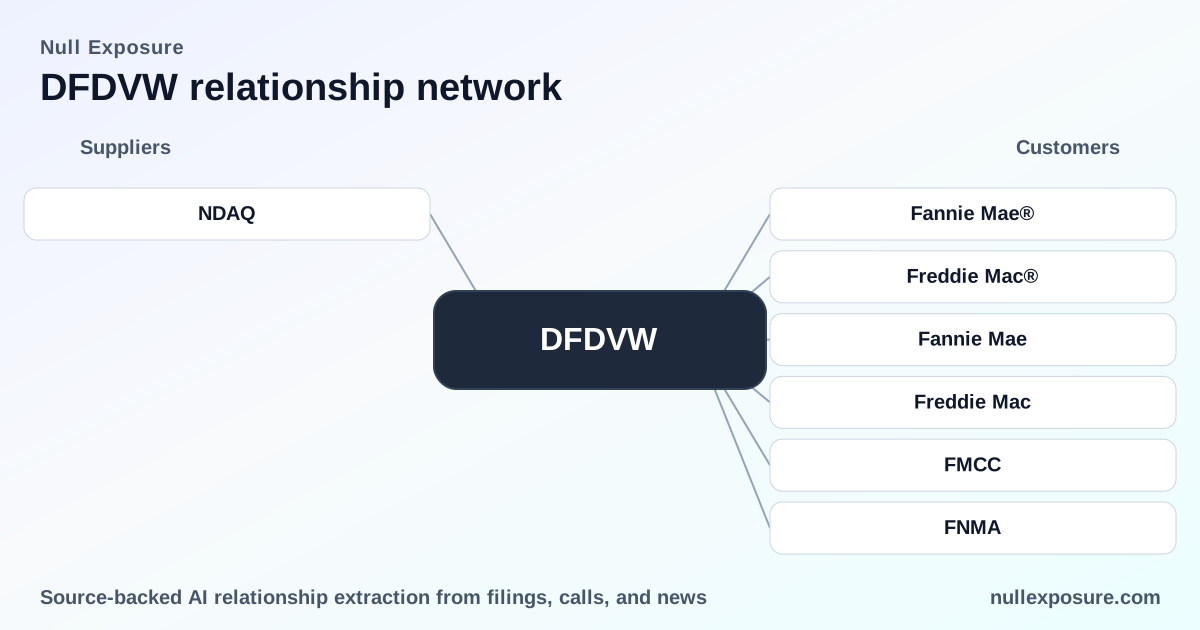
DeFi Development Corp. (DFDVW): Customer relationships and what they mean for investors
DeFi Development Corp. operates an AI-powered online platform (branded Janover) that connects commercial real estate borrowers and lenders and monetizes primarily through SaaS subscriptions and value‑added services to lenders, brokers and property owners; the company also acts as an agent on transactions and derives growth from expanding into small business lending verticals. For investors, the critical question is how durable those subscription relationships are, how concentrated revenue is among a few lenders, and how exposure to major multifamily lenders such as Fannie Mae and Freddie Mac shapes demand and product adoption. Learn more about our coverage at https://nullexposure.com/.
Why counterparties matter to DeFi Development’s business model
DeFi Development runs a two‑sided marketplace: its software and data subscriptions are the distribution channel and lenders supply the liquidity that enables transactions. The company recognizes subscription revenue over time on generally annual contracts, positions itself as a service provider to lenders and borrowers, and is actively expanding into small and medium business (SMB) loan products while remaining focused in North America. Key operating signals: subscription contracting posture, geographic concentration in NA, material revenue concentration (three lenders = 36% of 2024 revenue), and the critical role lenders play in marketplace functioning. Those dynamics create both recurring revenue upside and client concentration risk that investors must weigh.
Full relationship inventory — every mention in filings and press releases
Below I list each relationship result returned in the source payload; each entry is summarized in plain English with a concise source citation.
GlobeNewswire (Oct 8, 2025) — Fannie Mae referenced in dividend-warrant release
DeFi Development’s press release highlights that its platform serves more than one million web users annually and lists Fannie Mae as one of the multifamily lenders present on the platform, underscoring institutional lender participation on the Janover network. Source: GlobeNewswire press release (Oct 8, 2025).
GlobeNewswire (Oct 8, 2025) — Freddie Mac referenced in dividend-warrant release
The same GlobeNewswire release explicitly names Freddie Mac among the multifamily lenders using the platform, signaling that both government-sponsored enterprises are cited as participants in the company’s lender ecosystem. Source: GlobeNewswire press release (Oct 8, 2025).
Quiver Quant (Mar 9, 2026) — Fannie Mae® mentioned in trading announcement
A Quiver Quant pickup of the trading announcement repeats that Fannie Mae is among the multifamily lenders engaging with DeFi Development’s services, reinforcing public messaging about GSE participation. Source: Quiver Quant news (Mar 9, 2026).
Quiver Quant (Mar 9, 2026) — Fannie Mae named in special-dividend notice
The company’s special dividend (warrants) announcement, as reported by Quiver Quant, again cites Fannie Mae within a list of lender types using the platform, reflecting recurring emphasis on GSE relationships in corporate communications. Source: Quiver Quant news (Mar 9, 2026).
Quiver Quant (Mar 9, 2026) — Freddie Mac named in special-dividend notice
Quiver Quant’s coverage of the special dividend also lists Freddie Mac in the roster of multifamily lenders tied to the platform, repeating the company’s claim of GSE-level lender engagement. Source: Quiver Quant news (Mar 9, 2026).
Quiver Quant (Mar 9, 2026) — Freddie Mac® mentioned in trading announcement
Quiver Quant’s trading announcement copy contains a Freddie Mac mention alongside other lenders, consistent with the company’s narrative of broad lender adoption. Source: Quiver Quant news (Mar 9, 2026).
The Globe and Mail (Mar 9, 2026) — Freddie Mac (FMCC) in trading-of-warrants story
A Globe and Mail distribution of the trading announcement includes Freddie Mac (ticker FMCC) in its summary list of platform participants, reflecting third‑party pickup in financial press. Source: The Globe and Mail (Mar 9, 2026).
The Globe and Mail (Mar 9, 2026) — Fannie Mae (FNMA) in trading-of-warrants story
The Globe and Mail circulation of the same announcement names Fannie Mae (FNMA), amplifying the corporate claim that major multifamily lenders are on the platform. Source: The Globe and Mail (Mar 9, 2026).
The Globe and Mail (Mar 9, 2026) — FNMA entry (duplicate stringing of the same press pickup)
A further Globe and Mail tag repeats FNMA in the press distribution, reflecting multiple metadata entries in press aggregations rather than new contractual detail. Source: The Globe and Mail (Mar 9, 2026).
The Globe and Mail (May 2, 2026) — Fannie Mae cited in dividend-of-warrant notice
The company’s dividend-of-warrant notice, hosted through Globe and Mail feeds, again cites Fannie Mae among lenders, reinforcing continuity in public statements across filings. Source: Globe and Mail press release feed (May 2, 2026).
The Globe and Mail (May 2, 2026) — Freddie Mac (FMCC) cited in dividend-of-warrant notice
The corresponding Globe and Mail entry for the dividend notice includes Freddie Mac, underscoring repeated association with major multifamily lenders in corporate disclosures. Source: Globe and Mail press release feed (May 2, 2026).
GlobeNewswire (Nov 6, 2025) — Fannie Mae mentioned in commencement-of-trading release
A GlobeNewswire release on commencement of trading includes a reference to Fannie Mae among multifamily lenders, which investors should read as part of the company’s effort to underscore credible lender participation. Source: GlobeNewswire press release (Nov 6, 2025).
GlobeNewswire (Nov 6, 2025) — Freddie Mac mentioned in commencement-of-trading release
That same GlobeNewswire trade‑commencement announcement includes Freddie Mac alongside Fannie Mae, reinforcing the narrative of GSE engagement in public communications. Source: GlobeNewswire press release (Nov 6, 2025).
GlobeNewswire (Nov 6, 2025) — FNMA referenced in the trading commencement copy
GlobeNewswire’s trading‑commencement distribution includes an FNMA tag, consistent with multiple feed entries that cite the GSEs as platform participants. Source: GlobeNewswire press release (Nov 6, 2025).
How these relationships affect valuation and risk
- Counterparty quality and demand signal: Repeated public references to Fannie Mae and Freddie Mac in corporate press indicate the company positions its product as relevant to large multifamily lenders; that supports the revenue thesis for lender-focused SaaS.
- Revenue concentration is a tangible risk: Company disclosures show three lenders accounted for 36% of 2024 revenue, which makes lender retention and renewals central to topline stability rather than passive user growth alone.
- Contracting posture drives predictability: The business recognizes revenue from annual subscription contracts, which increases predictability but places a premium on renewal rates and upsell to value‑added services.
- Geography and customer mix: The firm is North America‑centric and intentionally expanding into SMB lending, a strategic diversification that reduces single‑segment dependence but requires product adjustment and sales investment.
- Marketplace criticality: Lenders are a critical component of the two‑sided market — without them the platform has limited utility — which elevates the importance of service, retention, and contractual terms that lock in lender participation.
Bottom line and investor actions
DeFi Development’s public communications consistently link platform usage to major multifamily lenders such as Fannie Mae and Freddie Mac, and the company’s financial disclosures underline a subscription‑based SaaS model with meaningful revenue concentration and lender criticality. For investors and operators evaluating DFDVW customer relationships, focus due diligence on renewal rates, contract terms (length and exit rights), the identity of the top three lenders driving 36% of sales, and traction in the SMB vertical. For a concise, focused briefing and ongoing monitoring services, visit https://nullexposure.com/.
Key takeaway: the company has a repeatable SaaS monetization engine supported by institutional lender participation, but material customer concentration and lender criticality require active monitoring of renewals and contract structure.