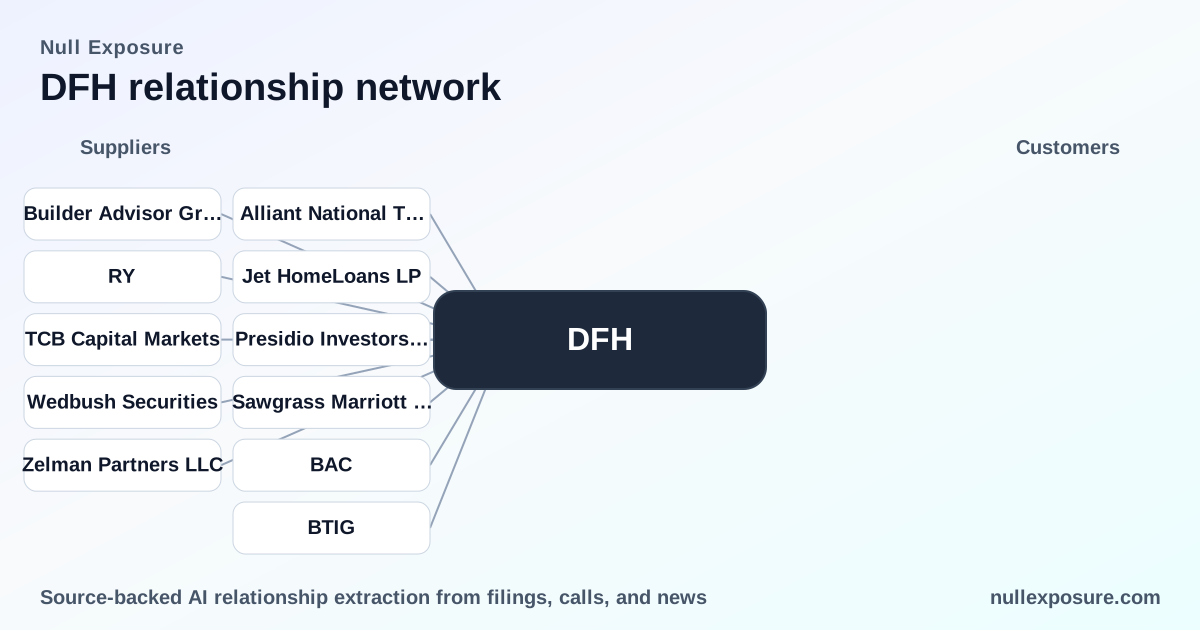
Dream Finders Homes (DFH): Customer Relationships, Commercial Posture, and What Investors Should Know
Dream Finders Homes builds and sells single‑family homes across fast‑growing U.S. markets and supplements that core revenue with mortgage and title services through wholly owned subsidiaries. The company monetizes primarily through home sale closings and related financial services fees, while opportunistically acting as a general contractor for institutional buyers; this dual revenue model generates both transactional, short‑duration cash flow and recurring finance‑adjacent income. For a quick view into our research platform and relationship tracking, visit https://nullexposure.com/.
How Dream Finders operates and where the money comes from
Dream Finders executes an asset‑light lot acquisition strategy: it acquires or controls lots, designs and constructs homes, then recognizes revenue when title and possession transfer at closing. The company also operates Jet HomeLoans and DF Title, which capture mortgage origination margins and title fees that improve per‑unit economics and customer retention. DFH reported roughly $4.22 billion in trailing twelve‑month revenue and $227 million of EBITDA, indicating material scale for a regional residential builder and an ability to cross‑sell financing and title services to buyers (company reported figures, latest-quarter FY2026).
The operating model creates two cash profiles: (1) short‑duration, transaction‑driven cash from home sales, and (2) ancillary, fee‑based income from mortgage and title services that increases lifetime value per buyer. Institutional contracting as a general contractor for landowners adds episodic, larger‑ticket revenue but the core remains retail home closings.
Customer relationships uncovered (what was found)
DFH’s tracked customer relationships in the dataset are brand and community partnerships announced in 2026. Each relationship below is summarized with source attribution.
Tampa Bay Rays
Dream Finders was named the Official Home Builder of the Tampa Bay Rays in a March 13, 2026 announcement, positioning DFH within the Rays’ community and marketing ecosystem to drive regional brand awareness and lead generation. (Reported via finance.yahoo.com and noted in a MarketBeat instant alert.)
Source: finance.yahoo.com / MarketBeat (March 13, 2026 report; MarketBeat alert referenced Jan 9, 2026).
Tampa Bay Rowdies
The company simultaneously took the Official Home Builder designation with the Tampa Bay Rowdies, tying DFH to local professional soccer marketing and fan engagement that will be used to funnel prospects into its Florida communities. (Reported via finance.yahoo.com and summarized by MarketBeat.)
Source: finance.yahoo.com / MarketBeat (March 13, 2026 report; MarketBeat alert referenced Jan 9, 2026).
What these relationships tell investors about DFH’s commercial posture
The Rays and Rowdies partnerships are marketing and lead‑generation plays, not material revenue contracts in the sense of recurring procurement from institutional buyers. The announcements signal strategic local branding investments to increase traffic into model homes and convert prospective buyers in Florida, one of DFH’s core markets.
- Not revenue‑critical but strategically relevant. These are promotional relationships that increase customer acquisition efficiency; they do not replace the core economics of home sale closings or the company’s mortgage/title operations.
- Aligned with geographic focus. The partnerships reinforce DFH’s emphasis on high‑growth U.S. markets—Florida remains a key market in the company’s operating strategy.
Company‑level constraints and what they imply for relationship risk and stability
The filings and company disclosures generate a clear set of operational constraints that frame how investor should view customer relationships and contract risk:
- Contracting posture: predominantly short‑term. The company states that a large portion of its customer contracts have an original expected duration of one year or less, which means revenue recognition and cash flows are transactional and sensitive to near‑term demand cycles.
- Primary counterparty is the individual homebuyer. DFH runs forward commitment programs and invests in mortgage rate access for buyers (SG&A included $50 million of spend on forward commitment programs for homebuyers in disclosed periods), indicating an operating model built around retail buyer economics and rate exposure.
- Institutional relationships exist but are supplementary. The company also acts as a general contractor for institutional buyers and sells to third‑party investors, which creates episodic large transactions but does not substitute for volume of retail closings.
- Geographic concentration across U.S. high‑growth markets. DFH operates in Florida, Texas, Tennessee, the Carolinas, Georgia, Colorado, Arizona and D.C. metro—diversified across Sunbelt and growth regions, but still exposed to regional housing cycle risk.
- Dual role: seller and service provider. DFH is both the homebuilder/seller and a provider of mortgage and title services (through Jet HomeLoans and DF Title), which increases per‑buyer revenue capture but concentrates operational risk (e.g., credit or origination volatility).
- Relationship maturity mix: active communities and some terminations. The company reported 242 active communities as of Dec 31, 2024, while noting a notable cancellation of a 229‑unit built‑for‑rent contract that was terminated in Q1 2024 and converted to retail—a reminder that larger institutional deals can be volatile.
These constraints collectively indicate a commercial model that generates steady transaction flows from short‑term contracts, supplements unit economics with vertically integrated services, and occasionally pursues larger institutional projects that are less predictable.
Investment implications: risks, levers, and what to watch
- Key strengths: asset‑light lot strategy improves returns on capital; vertically integrated finance/title increases revenue per sale; a nationwide footprint reduces single‑market concentration risk.
- Key risks: short contract duration exposes revenue to cyclical downturns; mortgage programs and forward commitments amplify sensitivity to interest rate moves and origination economics; occasional institutional contract terminations can create one‑off volatility.
- Metrics to monitor each quarter: active community count, cancellations, forward commitment program spend, Jet HomeLoans origination margins, and community absorption rates. These drive near‑term cash flow and earnings visibility.
For deeper relationship tracking and commercial signals on DFH and similar builders, consider our platform coverage at https://nullexposure.com/ — we aggregate relationship disclosures, filings signals, and market notices that matter to investors.
Bottom line
Dream Finders generates its cash through a high‑volume, short‑duration home sale model augmented by mortgage and title services and occasional institutional contracting. The Tampa Bay Rays and Tampa Bay Rowdies partnerships are tactical marketing relationships that support lead generation in key Florida markets but do not change the core revenue dynamics. Investors should value DFH as a transactionally oriented residential builder with vertical service capture and watch short‑term demand indicators and mortgage‑program costs as the primary drivers of near‑term performance.