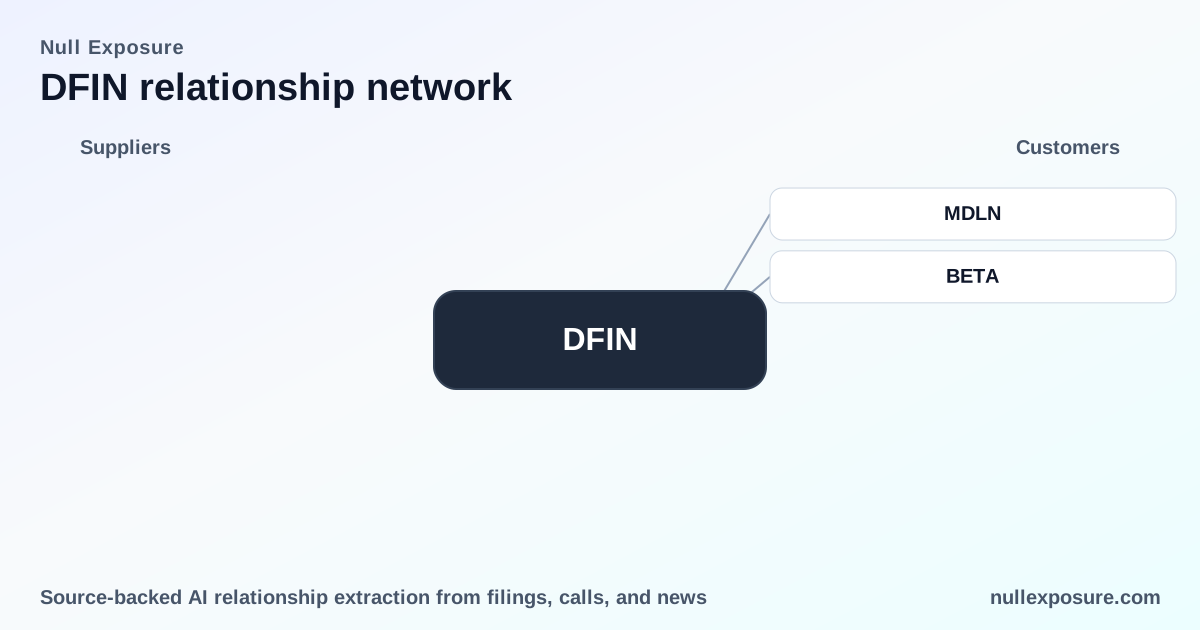
DFIN’s client footprint: regulatory infrastructure with recurring software and large-deal execution
Donnelley Financial Solutions (DFIN) operates a two‑pillar business: subscription software for regulatory, reporting and deal workflows (ActiveDisclosure, Arc Suite, Venue) and tech‑enabled services plus print & distribution to execute filings and communications. The company monetizes through recurring SaaS contracts, high‑margin service engagements for complex filings and one‑off spot billing for print/distribution and transaction support—creating a mix of predictable recurring revenue and transactional upside from capital markets activity. For a concise view of customer exposure and deal references, see Null Exposure’s coverage at https://nullexposure.com/.
Revenue mix that explains the go‑to‑market posture
DFIN’s operating model blends enterprise subscription sales with transactional services. Company disclosures show consolidated net sales of roughly $781.9 million, split across software ~$329.7m, tech‑enabled services ~$320.8m, and print & distribution ~$131.4m, which explains why DFIN sells both annual contracts and on‑demand execution work. The subscription layer creates a stable revenue base and recurring customer touchpoints; the services/distribution layer delivers higher variability but immediate cash conversion, especially during large financing or corporate transaction cycles.
DFIN’s public metrics reinforce the hybrid profile: Revenue TTM $767m; EBITDA $153.6m; operating margin ~11% (company filings and trailing financials). The subscription component supports forward visibility, while the services business acts as a high‑margin lever when capital markets are active.
Operating constraints that shape risk and upside
DFIN’s disclosures provide clear signals about how customers contract and where operational risk concentrates:
- Contracting posture — mixed subscription and spot: The company explicitly states software is “generally provided on a subscription basis” while tech‑enabled and print/distribution services “are recognized at a point in time and are primarily invoiced upon completion.” That mix supports predictability without eliminating deal‑driven revenue spikes.
- Customer concentration — broadly diversified: No single customer exceeded 10% of net sales in the years reported, a clear sign of low revenue concentration and reduced single‑counterparty risk.
- Counterparty profile — large enterprises and regulated clients: DFIN targets public and private companies, mutual funds, insurers and third‑party administrators, reflecting a client base of large, regulated enterprises that require repeatable compliance workflows.
- Geography — North America dominant with international footprint: The vast majority of business is U.S.‑based, with the company noting roughly 11% of net sales outside the U.S. and explicit support for clients in Europe and Asia.
- Role and criticality — seller and service provider: DFIN functions as both a software vendor and an execution partner that prepares, tags (iXBRL), files and distributes regulatory materials—services that are operationally critical for clients’ compliance and transaction timelines.
- Segment maturity — enterprise SaaS plus mature services: Software lines (ActiveDisclosure, Arc Suite, Venue) provide recurring economics, while tech‑enabled services and print/distribution are mature, cash‑generative businesses tied to regulatory cycles.
These constraints collectively describe a company with stable recurring revenue and episodic event‑driven upside, servicing regulated, high‑stickiness clients primarily in North America.
What the public record shows about recent client work
Below are every customer relationship captured in the public results for DFIN, presented with plain English summaries and source context.
- MDLN — The referenced deal note states that Medline raised $6,000,000,000 and that the financing was “DFIN‑supported,” indicating DFIN provided execution or filing services on a multibillion dollar capital raise (Globe and Mail / Motley Fool earnings transcript, Mar 9, 2026).
- Medline — Medline is explicitly called out for a $6 billion financing that DFIN supported, underlining DFIN’s role on large private or corporate capital transactions (Globe and Mail / Motley Fool earnings transcript, Mar 9, 2026).
- BETA — The transcript notes Beta Technologies as “one other billion‑plus deal” that DFIN supported, demonstrating the company’s capacity to handle multiple large‑ticket financings in the same period (Globe and Mail / Motley Fool earnings transcript, Mar 9, 2026).
- Beta Technologies — Beta Technologies is identified as a billion‑plus financing client for which DFIN provided support, reinforcing the company’s market role in high‑value transaction execution (Globe and Mail / Motley Fool earnings transcript, Mar 9, 2026).
Each mention comes from the same earnings transcript coverage; the repeated references highlight DFIN’s involvement in large capital market transactions during FY2026.
If you want a structured view of DFIN’s client mentions and their fiscal context, Null Exposure maintains linked coverage and searchable relationship records at https://nullexposure.com/.
Investment implications: capability versus concentration
DFIN’s public client mentions—supporting multiple billion‑dollar raises in FY2026—underscore operational capability to execute high‑value transactions, a positive for revenue volatility during active markets. However, company disclosures that no single customer exceeds 10% of sales mean these event wins are spread across many clients and do not create outsized revenue dependency.
Key investor takeaways:
- Topline stability from subscription software is complemented by transactional upside when capital markets are busy; this mix supports steady cash flow with periodic revenue bumps.
- Low customer concentration reduces downside from any single counterparty failing to re‑engage.
- Geographic concentration in North America implies sensitivity to U.S. capital markets and regulatory cycles; the international presence is meaningful but limited.
- Operational criticality—DFIN performs filing and compliance work that clients cannot easily defer, which supports retention and cross‑sell.
Bottom line: predictable base, episodic ceilings
DFIN is a regulatory infrastructure operator that monetizes through recurring enterprise software and complementary execution services. Public mentions of support on multiple billion‑dollar financings in FY2026 are evidence of the company’s ability to capture high‑value transaction flows, while disclosure of revenue splits and customer concentration signals a balanced risk profile: reliable recurring revenue plus event‑driven upside without dangerous single‑customer dependence. For granular relationship coverage and to monitor further deal mentions, see Null Exposure’s relationship tracker at https://nullexposure.com/.