Dragonfly Energy (DFLIW): Customer Relationships That Drive OEM Traction and Licensing Revenue
Dragonfly Energy manufactures and sells lithium-ion battery systems under two commercial axes: Dragonfly-branded OEM sales to vehicle and industrial manufacturers and Battle Born-branded direct-to-consumer and distributor sales, while also monetizing its brand through licensing and contract manufacturing. The company earns product revenue from hardware sales to OEMs, distributors and end users, and it derives recurring royalty and manufacturing revenue from licensing arrangements—most notably the July 2024 license tied to the Battle Born brand. For investors evaluating customer concentration and commercial durability, the relationships below map the strategic corridors where Dragonfly captures OEM wallet share and licensing upside. Learn more at https://nullexposure.com/.
How OEM partnerships and licensing fit together
Dragonfly’s go-to-market is hardware-first with brand leverage: sell battery packs into OEM channels (RV, trucking, industrial), retain a DTC channel through Battle Born, and license the Battle Born trademark and co-manufacturing rights to third parties to accelerate B2B distribution. The firm’s public communications and filings emphasize North American end markets, multi-year supply commitments with large OEMs, and a licensing program that projects material multi-year revenue.
Relationship-by-relationship: what matters to investors and operators
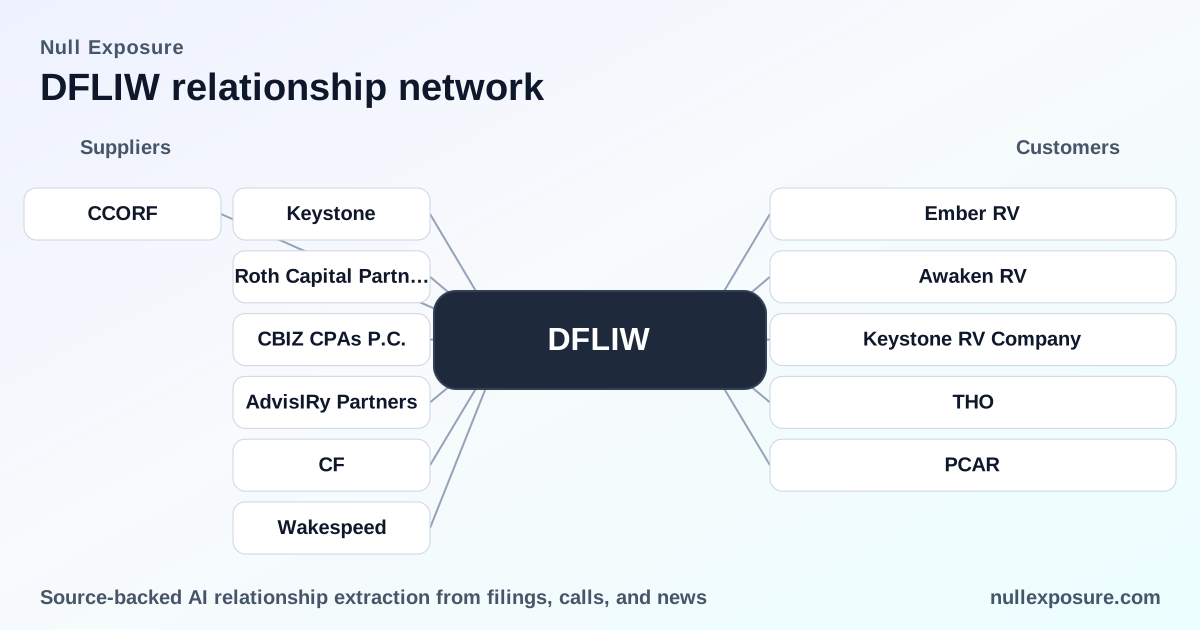
Awaken RV
Dragonfly announced in August (2025) a partnership under which Awaken RV selected Battle Born batteries as the standard lithium power solution across its debut lineup of molded fiberglass trailers, signaling new OEM placements in the premium towable RV niche (2025 Q3 earnings call).
Ember RV
In September (2025) Dragonfly expanded a long-standing relationship, making Battle Born batteries factory-standard across Ember RV’s 2026 Overland series, with factory-installed systems up to seven kilowatt-hours—evidence of sustained OEM conversion in off-grid-capable RVs (2025 Q3 earnings call).
PACCAR / PCAR
Dragonfly highlighted a collaboration with PACCAR, identifying the company as a strategic entry into commercial trucking—an important validation for the trucking and industrial battery opportunity (2025 Q3 earnings call).
THOR Industries (THO) and Keystone RV Company
Press coverage tied Dragonfly’s restructuring disclosures to the anticipated benefits of customer arrangements with THOR Industries and its affiliated brands, including Keystone, indicating material commercial exposure to one of the largest RV platform owners in North America (FY2025 news coverage, March 2026).
Airstream
Management reported momentum with Airstream, noting Battle Born batteries are standard across certain Airstream motorized models—an important premium OEM endorsement within the THOR/THO ecosystem (2025 Q3 earnings call).
Stevens Transport
A news item in April 2026 reported that Dragonfly secured an order exceeding $3 million from Stevens Transport, signaling traction in the heavy-duty trucking aftermarket and fleet segments (April 20, 2026 press report via TipRanks/CNBC aggregation).
Keystone RV Company (separate callouts)
Keystone appears repeatedly in filings and press as a key OEM customer, tied to a long-term Manufacturing Supply Agreement executed in November 2021 that underpins recurring OEM unit demand in towable RVs (contract filing and 2025 commentary).
What contractual and portfolio signals reveal about the operating model
- Brand licensing is a deliberate revenue lever. The company signed a July 29, 2024 license agreement that grants third-party rights to the Battle Born trademark and builds in an up-to-$30 million revenue expectation over seven years through royalties and manufacturing fees; an initial fee is being recognized on a straight-line basis (License Agreement, July 2024 filings).
- Long-term OEM supply relationships exist and drive predictability. Dragonfly’s November 2021 Manufacturing Supply Agreement with Keystone (a THOR affiliate) is an example of multi-year OEM commitments that create baseline demand visibility.
- North America is the primary geography. Management reports serving more than 23,000 customers in North America, which concentrates market, distribution, and supply-chain risk regionally.
- Customer concentration is meaningful but not singular. The top 10 customers represented 47.4% of 2024 revenue with only one customer exceeding 10% individually; one OEM customer contributed approximately $7.31 million (14%) of consolidated revenue for 2024 (2024 financial notes). This profile supports commercial leverage but also concentration risk.
- Segment mix is balanced between core hardware and adjacent accessories. The core product is non-toxic deep-cycle lithium-ion batteries for RV, marine, solar and industrial uses, while accessory resale supplements the offering.
- Relationship roles are multi-modal. Dragonfly functions as seller, licensor, distributor-supplier to OEMs, and contract manufacturer—creating diversified revenue streams but also operational complexity as licensing and manufacturing obligations scale.
Risks that investors should underwrite now
- Counterparty concentration risk: Nearly half of revenue flows through the top 10 customers; loss or downgrades among large OEMs (THOR/Keystone, PACCAR) would materially affect cash flow.
- Execution on licensing monetization: The licensing program projects $30 million over seven years, but realization depends on partner sell-through and royalty adoption. The July 2024 license agreement includes capped royalties and multi-year recognition mechanics.
- Regional exposure: Heavy North American focus concentrates demand and supply-chain exposure.
- Contract maturity and enforceability: Long-term supply agreements provide visibility, but OEM manufacturing cycles and inventory timing can create lumpiness in bookings and receipts.
Strategic takeaways for investors and operators
- For investors: the combination of OEM standardization wins (Airstream, Ember, Awaken) and a programmatic licensing approach is the core growth thesis—scale hardware margins while collecting brand royalties. However, monitor counterparty concentration and license revenue realization.
- For operators: prioritize supply-chain resilience for North American OEM production cadence, and ensure contract manufacturing capacity to meet Stryten-linked assembly obligations under the license framework.
Key next steps: review the November 2021 Keystone supply agreement and the July 2024 license filing for cash-flow recognition mechanics, and track quarter-to-quarter OEM order flow for signs of durable demand or customer attrition. Learn more analysis and model-ready signals at https://nullexposure.com/.
Bold final assessment: Dragonfly’s commercial profile is a hybrid of hardware OEM placements and brand monetization; the risk-reward hangs on execution of multi-year OEM contracts and the pace at which licensed partners convert brand equity into predictable royalties.