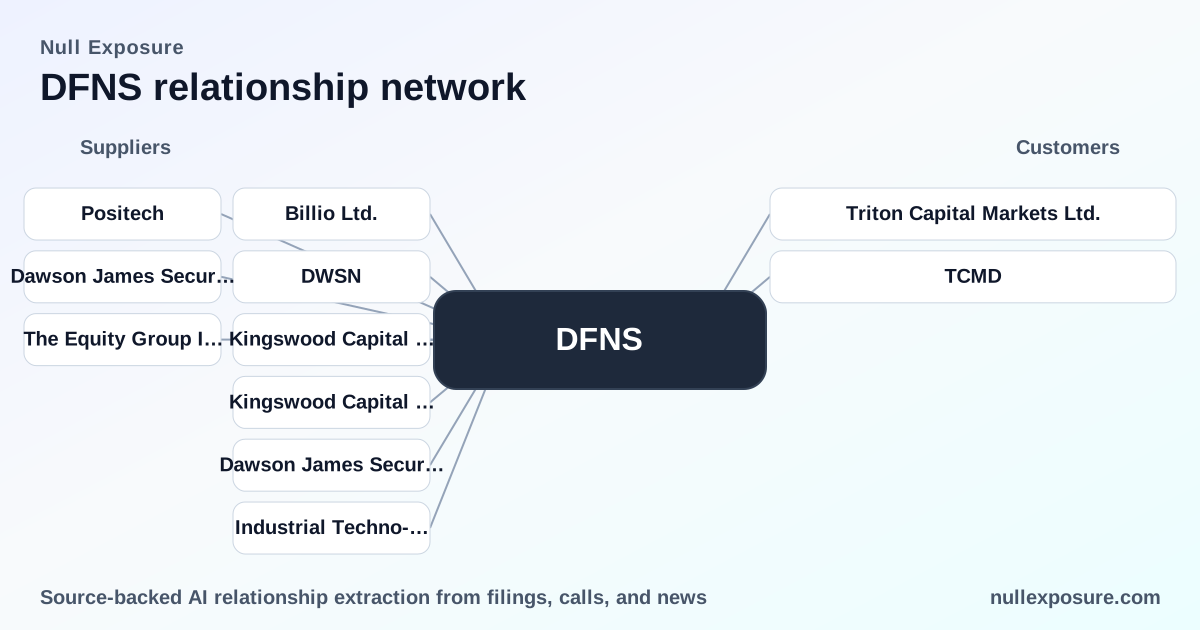
T3 Defense (DFNS) — Customer Relationships That Define Transition and Concentration Risk
T3 Defense is a small-cap company that historically monetized by providing integrated software, technology and support services to the retail foreign exchange industry and institutional payment customers, and through legacy long‑form service contracts that generated predictable monthly cash flows. The company transitioned in 2024, terminating legacy support agreements and divesting non-core assets while pivoting toward payment services and other strategic initiatives. For investors, the single overriding lens is customer concentration and contract termination: revenue was historically concentrated in one counterparty and that relationship has been materially altered. Learn more at https://nullexposure.com/.
What the customer list tells investors in one line
The revenue profile was dominated by one counterparty under a long‑running General Services Agreement; that contract represented the bulk of reported revenue through FY2024 and was terminated effective January 1, 2024, forcing a structural business reset.
Individual relationship notes (every item in the record)
-
Triton Capital Markets Ltd. — The company reports that its primary customer was Triton Capital Markets Ltd. (TCM), formerly FXDD Malta Limited, which historically accounted for the majority of revenue under the firm’s general support services. According to DFNS’s Form 10‑K for the year ended September 30, 2024, TCM was the primary customer of the company’s legacy FX operations. (DFNS 10‑K, FY2024)
-
TCM (inferred symbol TCMD) — DFNS’s filing states that the largest customer of its FX operations, TCM, provided a significant contribution to revenue and that revenues from that relationship constituted a material portion of total sales. The 10‑K explicitly describes TCM as the largest customer for the FX segment. (DFNS 10‑K, FY2024)
-
TCMD (repeat inferred symbol entry) — The 10‑K reiterates that the legacy FX operations were heavily dependent on TCM and that the customer relationship was central to the company’s historical revenue base. The filing quantifies customer reliance in the customer concentration disclosures. (DFNS 10‑K, FY2024)
-
TCM termination — A post‑reporting investor event summary noted that major legacy contracts were terminated in January 2024, including the General Services Agreement with TCM, which historically contributed over 80% of revenue. That termination is the operational inflection point driving DFNS’s pivot. (Quartr event summary covering Q4 2024, reported 2026)
-
BiomX Inc. — DFNS completed the sale of its subsidiary ZorroNet to BiomX Inc. for stock and cash consideration, representing a discrete asset disposition in the company’s restructuring and portfolio clean‑up. This transaction is disclosed in market reporting on SEC filings and news sites in 2026. (Investing.com/SEC filing summary, FY2026)
How the operating model and business model constraints read for investors
DFNS’s disclosures and public reporting produce a compact set of investor signals about how the business runs and the structural risks investors must price.
-
Contracting posture: mixed. Company‑level language describes a general pattern that customer contracts are often open‑ended and terminable at the transaction level without penalties, but DFNS historically operated under at least one bespoke long‑term General Services Agreement with definitive minimum monthly payments ($1.6M per month after amendment). This mix of terminable transactional work and a historically contractually guaranteed revenue stream explains the rapid revenue volatility when the GSA was released. (Company 10‑K excerpts, FY2024)
-
Concentration and criticality: extreme. The largest customer — TCM — represented over 80% of revenue for the year ended September 30, 2024; this places DFNS in a high single‑counterparty concentration bucket and makes any change in that counterparty relationship existential for near‑term revenue. (Company 10‑K customer concentration table, FY2024)
-
Relationship maturity and stage: historically long‑term, now terminated. The GSA with TCM dated to 2016 (amended in 2017) provided predictable cash flows but was formally released and effectively terminated as of January 1, 2024; DFNS ceased providing general support services that once underpinned its revenue base. Investors must treat the legacy revenue stream as historical, not ongoing. (Company 10‑K; Quartr event, FY2024–FY2026)
-
Geography and market focus: EMEA orientation with global implications. The firm reports a primary market focus in Israel and material revenues from Malta; the geographic disclosures show revenue tied to Malta ($4.8M) and the rest of the world (~$1.1M) for FY2024, consistent with an EMEA operational footprint. This regional focus shapes customer concentration and regulatory exposure. (Company 10‑K revenue by geography, FY2024)
-
Segment and capability mix: services and software with hardware legacy. DFNS historically operated across general support services and financial services, delivering software, technology solutions and risk‑management packages for FX clients; the company also lists hardware and specialized products sold into defense and security end markets in its broader corporate disclosure. Investors should treat the business as a services/software operator pivoting into payments. (Company 10‑K segment note; product descriptions, FY2024)
-
Spend and revenue bands: meaningful single‑client economics. The related‑party revenue line for general support services of $4.8M anchors the FY2024 revenue total of $5.913M, underscoring how a single counterparty produced recurring, material cash inflows prior to termination. (Company revenue tables, FY2024)
Investment implications and risk/reward
DFNS is a company in transition. The upside thesis requires successful replacement of legacy revenue and credible traction in payment services, while the downside is straightforward: the historical revenue engine is gone and the company’s market cap remains low, with negative EBITDA reported in recent filings.
- Key risks: high customer concentration legacy, earnings volatility post‑GSA termination, and limited institutional ownership (low percent institutions). (Company 10‑K ownership and financial metrics, FY2024)
- Key potential catalysts: monetization of non‑core assets (ZorroNet sale to BiomX), new payment services contracts, and strategic partnerships or capital to scale the post‑January‑2024 business.
Bottom line for investors
DFNS’s customer story is dominated by one large counterparty that historically provided the bulk of revenue under a long‑running GSA; that arrangement was terminated effective January 1, 2024, forcing a strategic reset. Investors should value DFNS as a restructuring play with binary outcomes tied to its ability to replace lost revenue and re‑scale its payment services offering. For a deeper look at customer signals and comparable counterparty risk profiling, visit https://nullexposure.com/.
Sources: DFNS Form 10‑K for year ended September 30, 2024 (customer concentration, GSA details, revenue by geography); Quartr event summary covering DFNS Q4 2024 (termination of legacy contracts, FY2026 reporting); investing.com / SEC filing coverage of ZorroNet sale to BiomX Inc. (transaction reporting, FY2026).