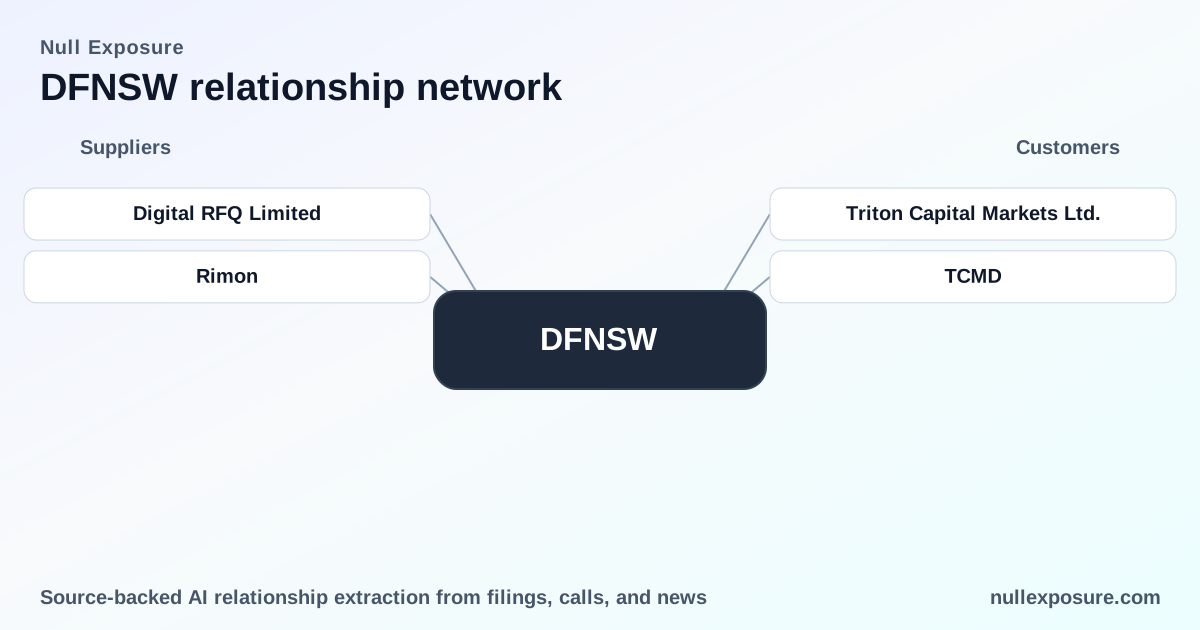
DFNSW (T3 Defense Inc.) — Customer Relationships and Investment Implications
T3 Defense Inc. operates as a holding company focused on acquiring and operating defense-related and fintech businesses. Historically the company monetized through a mix of software and hardware solutions, general support services, and transaction-level financial services where revenue is earned as usage‑based transaction fees; in FY2024 a single counterparty accounted for the large majority of reported revenue, concentrating cash flow and counterparty risk. For investors and operators evaluating DFNSW customer relationships, the core thesis is simple: the company’s commercial economics are transaction-driven but structurally concentrated, and material contract mechanics and recent terminations reframe near‑term revenue reliability.
Learn more at https://nullexposure.com/
Concentration shapes valuation and risk posture
T3 Defense’s revenue profile is dominated by a single customer. For the year ended September 30, 2024, TCM represented 81.1% of revenue, a level the company itself reports as material and critical to results. This concentration creates acute counterparty risk: a large portion of topline is dependent on the commercial health and contractual posture of one counterparty, which inflates both earnings volatility and downside exposure for equity holders. According to the company’s FY2024 10‑K, customers accounting for 10% or more of revenue are disclosed in the notes, and the largest customer’s share is explicitly flagged as material.
The largest customer relationships: what they are and what they mean
Triton Capital Markets Ltd.
Triton Capital Markets Ltd. is identified by the company as its primary customer in FY2024 disclosures; the company explicitly states Triton as the top revenue source. According to the company’s 10‑K for the year ended September 30, 2024, Triton is the primary counterparty driving the majority of reported revenue.
TCM (same counterparty reference)
The filing states that TCM represented 81.1% of revenue for the year ended September 30, 2024, making it the largest and most consequential commercial relationship in the period. This figure is reported directly in the FY2024 10‑K.
TCMD (inferred symbol)
The company’s disclosures also link the TCM reference to the inferred symbol TCMD in its relationship table, reinforcing that the same counterparty is the dominant revenue source in FY2024. The FY2024 10‑K includes this mapping and the related revenue concentration disclosure.
(Source for all three entries: company 10‑K, fiscal year ended September 30, 2024.)
Contracting posture, role, and revenue mechanics
T3 Defense describes two contrasting contract archetypes in its filings that define how it earns and risks revenue:
- Usage‑based, transaction-level fees underpin the company’s financial services segment; the company charges fees based on transaction volume and payment type, recognizing revenue when transactions complete. This revenue model drives top‑line sensitivity to transaction flows and client activity levels, as described in the FY2024 10‑K.
- Framework agreements with guaranteed minimums exist historically in the general support services business. The company discloses a General Service Agreement (GSA) with TCM under which minimum payments were contractually prescribed—this arrangement historically included monthly minimums that were later amended (the company’s disclosures recount reductions from $2.0 million to $1.6 million per month in earlier amendments). The GSA detail referencing TCM is explicitly named in the company’s filings.
At an operational level, T3 Defense has described itself alternately as a principal for general support services (contractually obliged to provide fulfillment and control supplier services via ownership structures) and as an agent in parts of its financial services flow (facilitating fiat/digital asset transfers). These role distinctions affect margin capture and legal responsibility across business lines.
Lifecycle and recent changes to the customer base
The company has actively reshaped its customer relationships in 2024. T3 Defense ceased providing general support services in January 2024 and executed release agreements on September 30, 2024 that terminated the GSA and related supplier agreements effective January 1, 2024, with the parties confirming no outstanding obligations as of September 30, 2024. Those contractual terminations signal a shift away from the legacy general support services model toward the payment/financial services focus the company now emphasizes. (Source: FY2024 10‑K release agreement language.)
Geography, segments, and counterparty profile
- Geographic footprint: The company reports revenues by customer domicile with material revenues attributed to Malta in FY2024 ($4.8 million of $5.913 million total), and describes regulatory exposure across the UK, EU, U.S., and other jurisdictions—indicating EMEA and global regulatory vectors for compliance risk. (Source: FY2024 10‑K geographic revenue table and regulatory discussion.)
- Segments: Operations are organized into general support services and financial services, and historically included hardware, software, and services elements. The firm’s pivot away from general support services in early 2024 changes segment mix and revenue predictability. (Source: FY2024 10‑K segment disclosures.)
- Counterparty types: The company positions customers as institutional and large enterprise clients for the financial services offering and notes that other product lines historically sold into government and defense entities; these descriptions are part of the company’s FY2024 disclosure set.
What the constraints tell investors about operating maturity and risk
Several documentary constraints and excerpts in the company filing collectively present a clear operating picture:
- Contracting posture: A mix of framework agreements with historical minimums (explicitly with TCM) and generally open‑ended, transaction‑level contracts that can be terminated without penalty. This mix produces episodic guaranteed cash on older framework contracts but systemic volatility once those contracts are terminated.
- Revenue mechanics and spend scale: A substantial portion of revenue is usage‑based—transaction fees collected at execution—creating top‑line sensitivity to client volumes. Historical minimum payments tied to the GSA put the prior spend band in the $1–10 million per month range before amendment; that payment structure has since been released for the GSA counterparties.
- Concentration and criticality: The company defines the largest customer as critical, with >80% revenue concentration in FY2024; this is a company‑level materiality signal that directly impacts valuation multiples and lender covenants.
- Relationship maturity: The company classifies clients as both active and terminated depending on segment and timing; the January 2024 cessation of general support services and subsequent release agreements indicate a recent contraction and strategic refocus.
- Regulatory footprint: Operating in EMEA, North America and globally exposes the company to evolving privacy, capital and payments regulation; these are presented as company‑level governance risks in the FY2024 filing.
Investment implications and primary risks
- Concentration risk is the dominant valuation driver. With a single counterparty delivering >80% of revenue in FY2024, credit or contract disruption translates directly to material topline decline.
- Revenue volatility from usage fees. The pivot to transaction‑level fees improves scalability but increases sensitivity to client activity and market cycles.
- Contract termination has been executed. The company’s termination of legacy GSAs and release agreements reduces historical guaranteed cash flows, accelerating reliance on the financial services segment for future revenue.
- Regulatory and jurisdictional complexity. Multi‑jurisdictional operations increase compliance cost and constrain product rollout speed; Malta and EMEA exposures are material in recent filings.
Bottom line and where to go next
For investors and operators, DFNSW is a story of structural concentration and a recent strategic reorientation: the company shifted away from legacy guaranteed‑minimum service agreements toward a transaction‑driven payments business while still carrying significant counterparty concentration risk. Risk‑adjusted valuation must reflect both the revenue upside of scalable transaction fees and the downside of concentrated counterparties and recent contract terminations. For ongoing monitoring and deeper relationship mapping, consult platform intelligence at https://nullexposure.com/ — the firm’s filings and customer disclosures remain the primary inputs for tracking counterparty exposure and contract evolution.