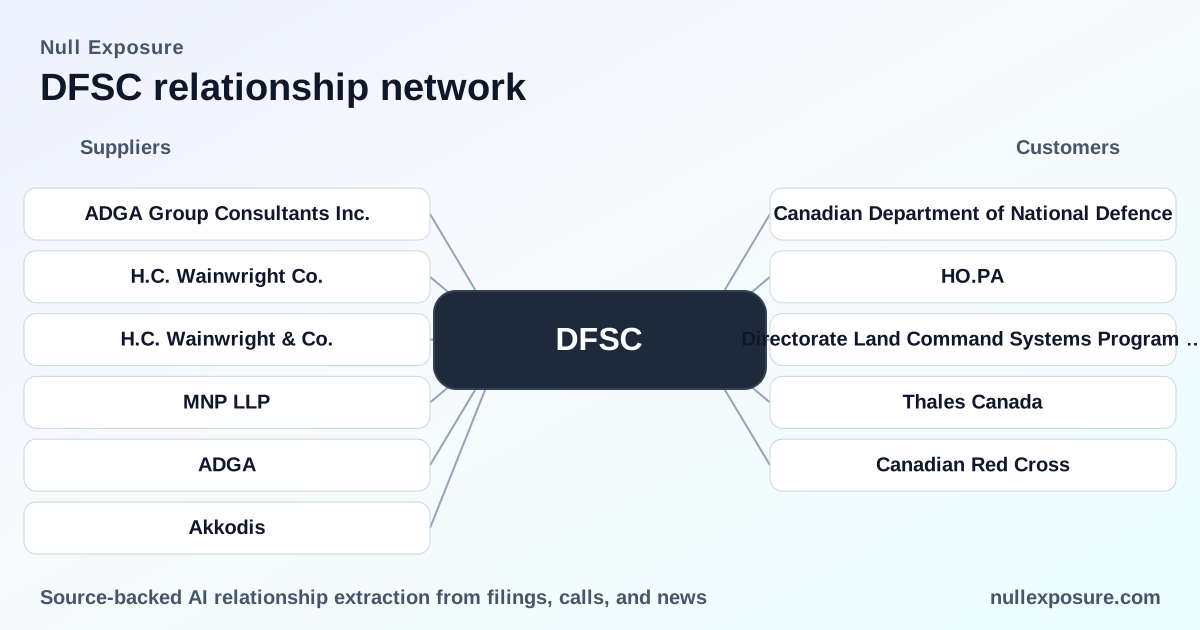
DFSC Customer Map: Where DEFSEC Turns IP into Revenue
DEFSEC Technologies (DFSC) builds and commercializes tactical software and systems for military, public safety agencies and personal defense customers, monetizing through long-term government program contracts, task orders and subcontract work plus hosted situational-awareness services sold to civilian agencies and NGOs. The company’s recent top-line growth is driven by increased task orders under legacy modernization programs for the Canadian Armed Forces and by subcontracting relationships with prime defense contractors; that commercial posture creates both revenue predictability from multi-year programs and concentration risk tied to a handful of government-driven programs. For a compact relationship dashboard and investigative services, see https://nullexposure.com/.
How DFSC gets paid: the core thesis in one line
DFSC converts intellectual property and systems engineering into recurring program task orders and subcontract revenue—selling services into government modernization programs and scaling hosted services for public-safety partners.
Key customer relationships investors need on their radar
Canadian Department of National Defence — the revenue engine
DFSC reported that much of its FY2025 and Q1 FY2026 revenue growth came from increased task orders and sub-contract task orders delivering software services to the Canadian Department of National Defence under two foundational programs: the Directorate Land Command Systems Program Management Software Engineering Facility (DSEF) and the Land C4ISR program for digital modernization of the Canadian Forces. This linkage to core defence modernization work was stated in the company’s FY2025 results and reiterated in its Q1 FY2026 release (published via Newsfile and syndicated by Reuters/TradingView in early 2026).
Source: DFSC FY2025 and Q1 FY2026 announcements syndicated on Newsfile and Reuters/TradingView (2025–2026).
Directorate Land Command Systems Program Management Software Engineering Facility (DSEF) — program-level partner
DFSC explicitly cites an expanded scope of work with the DSEF as a driver of government-services expansion and revenue growth for FY2025, signaling deeper program-level integration with the Canadian Armed Forces’ software engineering facility.
Source: Company press release carried on The Globe and Mail (FY2025 results).
Thales Canada — prime subcontract relationship and defined workshare
DFSC participates on the Land C4ISR program under a subcontract to Thales Canada, with commentary in investor materials describing a maximum DFSC workshare of approximately CAD 48 million over the initial six‑year term (excluding optional extension periods). That arrangement positions DFSC as a specialist sub-supplier to a larger prime contractor on a marquee modernization program.
Source: DFSC investor presentation and media distribution via Yahoo Finance and Newsfile (FY2025).
HO.PA (Thales public listing) — investor-facing reference to the prime
Investor materials and public disclosures reference the Land C4ISR engagement under a Thales-led contract noted in sources that also link to Thales’s market listing (HO.PA), underscoring the commercially significant prime-subcontract relationship between DFSC and the Thales industrial group in Canada.
Source: ThinkEquity investor presentation summary distributed on Yahoo Finance referencing the Thales-led Land C4ISR contract (FY2025).
Canadian Red Cross — civilian public-safety customer for hosted services
DFSC developed a TAK-enabled hosted software service (Lightning) for real-time situational awareness and notes earlier concept development work for wildfire response and ground search and rescue that involved the Canadian Red Cross and Public Safety Canada—an indicator that DFSC’s hosted offerings have practical civilian use-cases beyond defence.
Source: Company presentation and press release distributed on Newsfile (FY2025).
What the relationship map implies about DFSC’s operating model
- Contracting posture — prime-subcontract hybrid. DFSC operates primarily as a services/software provider that wins task orders both directly (via government program awards) and as a subcontractor to larger primes like Thales Canada; this structure reduces the need to compete for full prime contracts while tying DFSC’s growth to prime program award schedules.
- Revenue concentration and criticality. A disproportionate share of near-term revenue is linked to the Canadian Department of National Defence programs (DSEF and Land C4ISR). That concentration creates predictable program cashflows while amplifying execution and renewal risk if program scopes change.
- Program maturity and optionality. The Land C4ISR engagement is described as a multi‑year initial term with optional extensions, which gives DFSC multi-year revenue visibility but also locks the company into program timelines and prime-contractor dynamics.
- Commercial diversification signal. Work with the Canadian Red Cross and public-safety concepts for wildfire and search-and-rescue demonstrate product utility beyond defence, enabling a pathway to recurring hosted-service revenues for civilian agencies.
- Scale and financial posture. Given DFSC’s small market capitalization and negative EBITDA (as reported in public financials), the firm’s customer mix suggests a growth company monetizing specialist software services that still requires margin expansion and broader customer diversification to de-risk the revenue base.
These operating-model characteristics are company-level signals drawn from DFSC’s public statements about its customer workstreams and program contracts (FY2025–FY2026 disclosures).
Investment implications and risk checklist
- Positive: Multi-year program task orders provide near-term revenue visibility and validate DFSC’s product-market fit in Canadian defence modernization. The subcontract with Thales Canada gives access to prime-level program budgets and scale.
- Negative: Concentration risk around DND programs and reliance on task orders creates sensitivity to program funding cycles and prime-contractor allocation decisions. Execution under subcontract terms can compress margins and limit pricing leverage.
- Growth path: Civilian public-safety deployments (e.g., Canadian Red Cross) represent a credible avenue to diversify revenue into hosted services with different buying cycles and renewal economics.
For deeper analysis of relationship signals and program-level disclosures, visit https://nullexposure.com/.
Bottom line: where DFSC sits in the capital stack
DFSC is positioned as a specialist systems and software integrator that translates defense and public-safety requirements into recurring task-order revenue and hosted services. The company’s commercial success depends on continued task-order flow from Canadian defence modernization programs and productive subcontract partnerships with primes like Thales Canada, while civilian deployments offer a secondary growth vector. Investors should weigh program-level revenue visibility against customer concentration and subcontracting margin pressure when assessing DFSC’s path to profitable scale.