DFSCW (DEFSEC Technologies) — customer relationships that shape near-term revenue and program risk
DEFSEC Technologies develops tactical systems and hosted situational-awareness software for military and public-safety customers, monetizing through a mix of long-term software services contracts, subcontract work on major defense modernization programs, and discrete hardware deliveries. Revenue growth in FY2025 was driven by task orders under two foundational long-term contracts while discrete hardware deliveries and small commercial/public-safety engagements provide complementary revenue streams. For deeper relationship mapping and transactional context, visit https://nullexposure.com/.
Why customers matter for the investment case
DEFSEC’s commercial model mixes recurring software services (hosted, TAK-enabled situational awareness) and program-based defense work (hardware deliveries and subcontracted C4ISR services). That combination creates a revenue profile with concentration around a handful of large programs and operational criticality where contract performance and timing directly affect near-term cash flow and valuation. Financials show a small revenue base (USD 5.36m TTM) and negative EBITDA (USD -7.47m), which means customer wins and task-order flow are the primary value drivers.
- Contracting posture: Long-term foundational contracts plus subcontract roles to prime contractors.
- Concentration: FY2025 growth concentrated in two long-term Canadian Department of National Defence programs.
- Criticality: Deliverables feed national defense modernization and public-safety situational-awareness capabilities.
- Maturity: Early commercial traction but operating losses and thin revenue scale limit margin resilience.
Customer map — what DEFSEC sells to whom
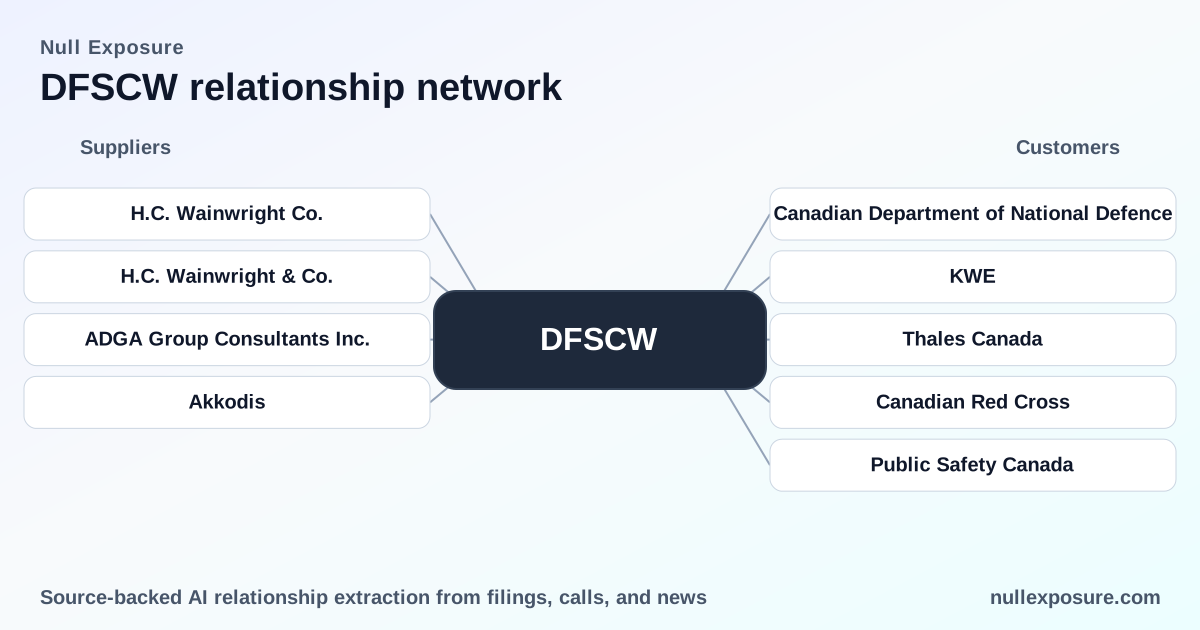
Below I list every customer relationship surfaced in available reporting and what each relationship contributes to revenue, capability validation, or program optionality.
U.S. Army
DEFSEC delivered BLDS units for a U.S. Army armored vehicle program for testing and trial activity in 2025 and is scheduled to deliver initial sample BLISS units in the coming month as the next development step. This is a direct hardware sale and test-phase engagement that validates DEFSEC’s tactical sensors on a U.S. program platform. According to a Bitget report (May 2026), the BLDS sale and upcoming BLISS deliveries follow the June 18, 2025 program announcement.
Canadian Department of National Defence
Much of DEFSEC’s FY2025 revenue growth was driven by increased task orders under two foundational long-term software services contracts with the Canadian Department of National Defence — the Directorate Land Command Systems Program Management Software Engineering Facility (DSEF) and the Land C4ISR modernization program. The company explicitly attributes increased FY2025 revenue to these task orders, as reported in a Newsfile release republished by The Globe and Mail (March 2026).
Thales Canada
DEFSEC operates as a subcontractor to Thales Canada on the Land C4ISR series, with an indicated maximum workshare of approximately USD 48 million over the initial six-year term (excluding later options). That subcontract status gives DEFSEC access to prime-led, large-scale defense modernization budgets but also ties revenue to the prime’s program schedule. The workshare figure and subcontract relationship were reported via a conference release summarized on Stocktitan (March 2026).
KWESST Micro Systems Inc. (KWE)
A December 2024 transaction shows KWESST paid a licensing/royalty amount early to DEFSEC — a private company owned by KWESST’s Executive Chairman — where a USD 200,000 payment was advanced and accepted at a USD 25,000 reduction, yielding a net USD 175,000 payment to DEFSEC. This is a related-party cash flow event that impacted working capital timing and was disclosed in KWESST’s fiscal 2024 MD&A (Newsfile Corp release, March 2026).
Canadian Red Cross
DEFSEC’s Lightning product traces back to concept work for wildfire response led by the Canadian Red Cross; that work contributed to the eventual hosted TAK-enabled Lightning situational-awareness service for multi-agency response. The company has positioned Lightning as a cross-agency communications and awareness tool initially informed by Red Cross wildfire response concepts, as summarized in a company presentation covered by Stocktitan (March 2026).
Public Safety Canada
An earlier concept developed for Ground Search and Rescue operations for Public Safety Canada directly informed Lightning’s architecture; DEFSEC now offers Lightning as a TAK-enabled hosted service that supports real-time situational awareness and interagency communications in critical incidents. That lineage — from Public Safety Canada concept work to a hosted product used by public-safety customers — is described in the same Stocktitan coverage (March 2026).
What these relationships imply for risk and upside
- Upside: The Land C4ISR subcontract to Thales and the DSEF task orders are the primary near-term revenue engines; the potential USD 48m Thales workshare provides meaningful upside if tasking and options are realized. Defense program wins and task-order renewals will drive the next re-rating.
- Risk: Revenue concentration across a small number of government contracts and a limited overall revenue base (USD 5.36m TTM) amplify the impact of any contract delays or non-renewals. The KWESST related-party payment shows occasional non-arm’s-length cash flows that deserve scrutiny in working-capital analysis.
- Validation: U.S. Army hardware deliveries for testing demonstrate cross-border exportability and platform integration capability — a significant commercial validation that supports expansion into U.S. defense programs.
Data caveats, governance signals, and next steps
No explicit contractual constraints were captured in the relationship reporting available for this review. That absence is a company-level signal rather than relationship-specific evidence — investors should treat it as incomplete reporting rather than proof of absence. Financials show negative EBITDA (USD -7.47m) and negative margins alongside growing quarter-over-quarter revenue, so liquidity and order timing are the most actionable near-term risks.
For investors and operators evaluating DFSCW exposure:
- Review the task-order schedules and option triggers for the Land C4ISR program with Thales.
- Monitor U.S. Army test outcomes for BLDS/BLISS deliveries, since platform acceptance materially expands addressable market.
- Scrutinize related-party transactions and cash-flow timing when modeling near-term liquidity.
For a deeper relationship map and ongoing monitoring, visit https://nullexposure.com/.
Bold takeaway: DEFSEC’s valuation sensitivity is dominated by a handful of government contracts — execution on the Land C4ISR subcontract and U.S. Army hardware milestones will determine whether current revenue growth converts into durable scale.