Donegal Group A (DGICA): Customer relationships and operating signals investors need
Donegal Group A Inc. is a regional property & casualty insurer that writes one‑year personal and commercial policies through a network of independent agencies, earning revenue primarily from premiums with supplemental investment income. The company’s operating model centers on underwriting a concentrated set of product lines (personal automobile, homeowners, commercial automobile, commercial multi‑peril and workers’ compensation) across 21 U.S. states, monetizing via underwriting margin and reserve management. Market data through 2026‑03‑31 shows Revenue (TTM) of $968.8M and a market capitalization of ~$603.9M, underlining a midsized insurer profile with an asset‑light distribution strategy. For a deeper dossier on counterparties and contract signals, visit https://nullexposure.com/.
Lender relationship: a simple, explicit credit facility
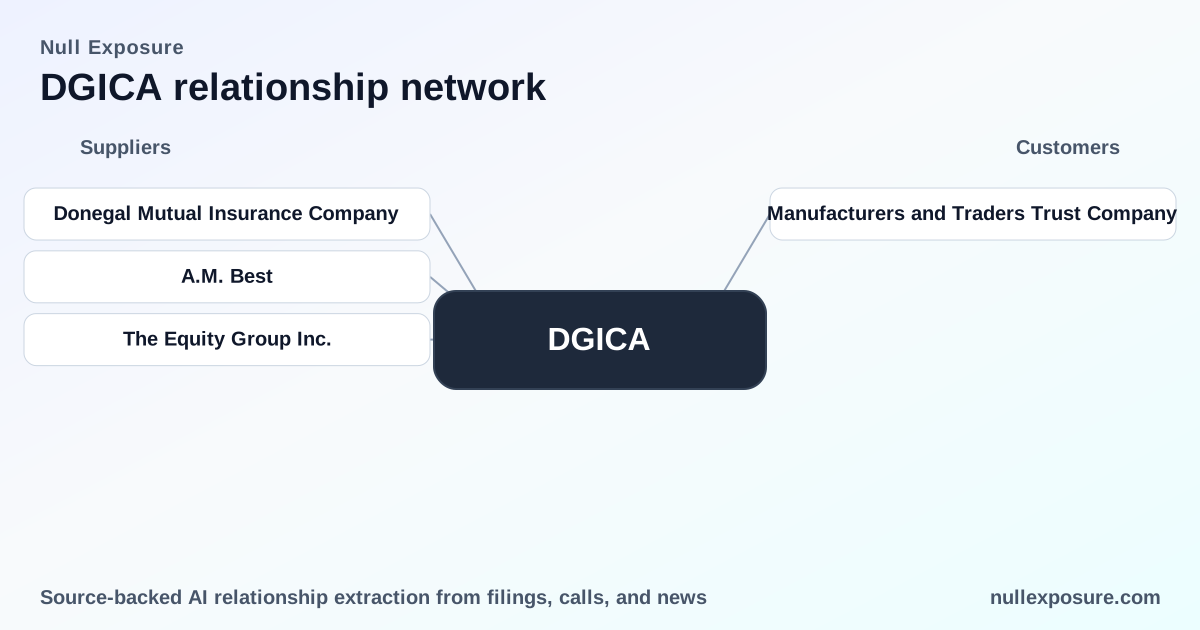
Donegal disclosed a financing arrangement with Manufacturers and Traders Trust Company (M&T): in August 2020 the company entered a credit agreement that provides a $20.0 million unsecured demand line of credit. This is a plain liquidity backstop recorded in the FY2024 10‑K and demonstrates a modest, single‑bank borrowing relationship rather than a complex syndicated or secured structure. (Source: Donegal FY2024 10‑K filing.)
What this means: the credit line is modest relative to Donegal’s revenue base and serves as a contingent funding source rather than an operational revenue relationship; it is a balance‑sheet relationship to watch for liquidity events and other contingencies. (Source: FY2024 10‑K.)
Distribution is the business: independent agents drive revenue
Donegal sells its products exclusively through roughly 2,100 independent insurance agencies. The FY2024 10‑K states the company’s insurance subsidiaries market commercial lines to small and medium businesses and personal lines to individuals using independent agents, and that the operations are concentrated in certain Mid‑Atlantic, Midwestern, Southern and Southwestern states. This agency‑centric go‑to‑market is instrumental to Donegal’s cost structure, renewal economics, and customer acquisition cadence. (Source: Donegal FY2024 10‑K.)
- The distribution posture creates scalability through agent relationships while concentrating relationship risk in channel performance and retention.
- Donegal reports no single customer or agent produces 10% or more of revenues, so counterparty concentration at the customer/agent level is immaterial even as the company relies heavily on the independent agency channel. (Source: FY2024 10‑K.)
Contracting posture and product maturity: short-duration policies with clear line focus
Donegal’s underwriting base consists of short‑duration contracts—policies of one year or less—that are recognized over the term of the policy. This gives management tight near‑term pricing leverage and frequent re‑underwriting opportunities, but also produces earnings volatility tied to loss trends and weather/catastrophe events. The company itself identifies its material lines—personal auto, homeowners, commercial auto, multi‑peril and workers’ compensation—as the core profit drivers. (Source: Donegal FY2024 10‑K.)
Concentration, criticality and maturity as operating signals
The FY2024 10‑K and related disclosures generate a number of company‑level signals that matter for investors and operators:
- Geographic concentration: Donegal writes business in 21 states, focused in Mid‑Atlantic, Midwest, Southern and Southwestern regions; operations are U.S.‑only. This regional footprint reduces global macro exposure but increases sensitivity to regional economic and loss dynamics. (Source: FY2024 10‑K.)
- Counterparty mix: Customers are individuals, small businesses and mid‑market commercial buyers served through independent agents—this yields a diversified retail book but presents underwriting heterogeneity. (Source: FY2024 10‑K.)
- Materiality of lines: The company explicitly lists its material lines; these product concentrations are critical to profitability and reserve management. (Source: FY2024 10‑K.)
- Distribution dependency: The insurer functions as a distributor/reseller model through independent agencies: channel performance is operationally critical even though no single agent dominates revenue. (Source: FY2024 10‑K.)
- Contract duration and renewal dynamics: Short‑duration policies make management’s pricing cadence a primary control lever for underwriting outcomes. (Source: FY2024 10‑K.)
- Concentration signal: While no single customer/agent is material to revenue, the company’s reliance on a finite set of states and product lines is an implicit concentration risk that investors must monitor. (Source: FY2024 10‑K.)
Explore more relationship intelligence at https://nullexposure.com/ to map these signals across peers.
The single listed relationship: clear and limited
The searchable customer relationship disclosed in public filings is limited to the M&T credit agreement noted above. The FY2024 10‑K is explicit that Donegal entered the $20.0 million unsecured demand line with Manufacturers and Traders Trust Company in August 2020; this is a funding arrangement rather than a customer or distribution partner. (Source: Donegal FY2024 10‑K.)
Investor takeaway: the disclosed third‑party relationship universe is narrow and dominated by distribution agreements with independent agents rather than large corporate customers or captive channels—liquidity relationships such as the M&T line are operational levers rather than revenue drivers. (Source: FY2024 10‑K.)
Risks and triggers operators and investors should monitor
- Underwriting volatility: Annual policies make loss trends and climate/catastrophe events immediate profit drivers; reserve adequacy and price‑to‑exposure are primary monitoring metrics. (Source: FY2024 10‑K.)
- Distribution concentration risk: The business depends on independent agencies (~2,100); retention and agency economics are critical to growth. (Source: FY2024 10‑K.)
- Regional exposure: Operating across 21 U.S. states concentrates geographic underwriting and regulatory risk regionally. (Source: FY2024 10‑K.)
- Balance‑sheet flexibility: The $20M unsecured demand line with M&T is a modest backstop; larger stress scenarios would require additional liquidity plans. (Source: FY2024 10‑K.)
- Line concentration: Heavy exposure to auto and homeowners lines ties profitability to claims frequency and severity cycles. (Source: FY2024 10‑K.)
Final assessment: a focused underwriting franchise with distribution as the lever
Donegal Group A is a focused regional P&C insurer with a clear operating model: write short‑duration policies through independent agents across a defined set of product lines and states, monetize via underwriting margins and investments, and maintain modest credit facilities for liquidity. The public filings show limited single‑counterparty concentration at the customer level and a modest lender relationship with M&T for contingent funding. For investors, the story is one of execution risk in underwriting and channel management rather than counterparty credit exposure.
If you need a mapped view of Donegal’s counterparties and operational constraints against peers or want to track changes in disclosed relationships over time, visit https://nullexposure.com/ for tailored relationship intelligence and filing‑driven analysis.