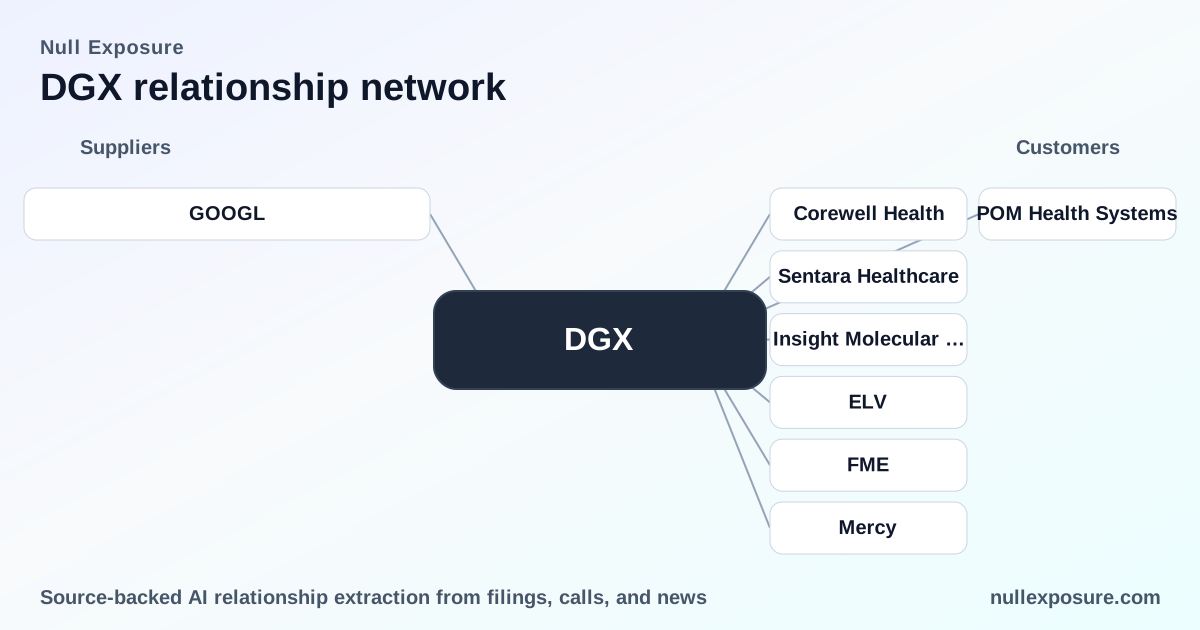
Quest Diagnostics (DGX): Customer Relationships Driving a Service‑Heavy Healthcare Franchise
Quest Diagnostics operates a high‑volume clinical laboratory business that monetizes primarily by delivering diagnostic testing and sample‑collection services to hospitals, health systems, payers and patients, supplemented by joint ventures and specimen‑collection agreements that deepen access and recurring volume. The company’s revenue mix is a blend of fee‑for‑service testing and a smaller but meaningful portion of capitated/subscription style payments from insurers, while strategic partnerships with large providers and diagnostics companies convert access into steady throughput. For deeper context on these customer ties, visit https://nullexposure.com/.
How Quest’s customer relationships shape revenue and operating risk
Quest’s operating model is service‑centric and highly transactional, with Diagnostic Information Services (DIS) accounting for the vast majority of consolidated revenue. Company filings and disclosures signal several durable characteristics that matter to investors:
- Contracting posture: Quest receives material revenue under fee‑for‑service arrangements, but it also recognizes revenue from capitated contracts; capitated arrangements contributed roughly 5% of consolidated net revenues in 2024 and represented a larger share of testing volume (around 11% in 2024), indicating a hybrid revenue stream rather than pure subscription. (Source: company disclosures cited in constraints.)
- Counterparty mix: The customer base spans government payers (~13% of net revenues), individual patients (~11% of net revenues) and large national/regional health plans, creating diversification across payers but exposure to reimbursement dynamics. (Source: company disclosures.)
- Geography and scale: Quest conducts substantially all business in the U.S., with smaller international footprints — the business is therefore sensitive to U.S. reimbursement, regulation, and provider consolidation. (Source: company disclosures.)
- Criticality and role: The DIS segment is critical, comprising over 95% of consolidated net revenues, and Quest functions primarily as a service provider to hospitals, clinics, and third‑party diagnostics companies. (Source: company disclosures.)
- Maturity and concentration: Relationships with large health systems and diagnostic firms give Quest scale and recurring volume, but they also concentrate revenue risk where large partners or payers shift networks or contracts. (Source: company disclosures.)
Collectively these signals show a highly recurring, service‑based revenue engine with both durable scale advantages and exposure to payer/provider negotiation dynamics.
What was disclosed about specific customers and partners (recent mentions)
Below I review every relationship cited in the recent coverage and filings; each entry includes a plain‑English summary and the source referenced.
- Sentara Healthcare — Quest reported it is back in network with Sentara, which management characterized as a meaningful help to access and volumes. (Source: Q4 2025 earnings call, March 2026.)
- Corewell Health (earnings call: JV) — Quest finalized a laboratory joint venture with Corewell Health and is jointly constructing a lab in Southeast Michigan planned to serve the state in 2027. (Source: Q4 2025 earnings call, March 2026.)
- Mainz Biomed (MYNZ) — Quest agreed to provide clinical trial laboratory services for Mainz Biomed’s ReconAAsense study, supporting a 15,000‑subject prospective trial across ~150 U.S. sites. (Source: Yahoo Finance report on Mainz‑Quest agreement, March 10, 2026.)
- Fresenius Medical Care (news: dialysis scale) — Quest said it serves thousands of Fresenius dialysis clinics nationwide and scaled testing to serve more than 200,000 patients at Fresenius dialysis centers in the quarter. (Source: Q4 2025 earnings call and subsequent news reports, March–May 2026.)
- Fresenius Medical Care (news: contribution to growth) — Analysts and coverage noted that Fresenius and Corewell together contributed ~7% to organic volume growth in the reported quarter, underscoring their near‑term impact on volumes. (Source: market commentary, SahmCapital summary, April 21, 2026.)
- Corewell Health (news: Co‑Lab scaling) — Media coverage reported that Quest scaled its Co‑Lab solutions across all 21 Corewell hospitals, representing the company’s largest implementation to date. (Source: TradingView / Zacks coverage, early 2026.)
- Elevance Health (ELV) — Management stated Quest returned to in‑network status with Elevance in several key states (Nevada, Colorado, Georgia, Virginia), restoring payer access in those markets. (Source: Q4 2025 earnings call, March 2026.)
- Exact Sciences (EXAS) — Exact Sciences partnered with Quest so that Quest’s ~7,000 patient access sites and mobile phlebotomy services support blood collection for Exact’s CancerGuard multi‑cancer early detection launch, improving patient access. (Source: InvestingNews report on Exact Sciences partnership, March 2026.)
- Insight Molecular Diagnostics / IMDX — Quest entered an agreement to provide professional sample collection services for Insight Molecular Diagnostics, extending Quest’s specimen collection role to emerging diagnostic firms. (Source: Bitget and MarketScreener summaries of the specimen‑collection agreement, March 2026.)
- Guardant (GH) — Quest will accept requisitions and collect blood at Quest PSCs for patients whose specimens are sent on to Guardant, aligning Quest collection capacity with Guardant’s laboratory testing. (Source: earnings call coverage at InsiderMonkey, May 2026.)
- Getlabs — Quest described arrangements under which Getlabs acquires specimens and either brings them to Quest PSCs or has them transported, while Quest continues to perform the lab testing. (Source: InsiderMonkey summary of Q1 2026 earnings call, May 2026.)
- FME (alias for Fresenius Medical Care in some extracts) — As noted above, Quest scaled testing to serve >200k patients at Fresenius dialysis centers during the quarter. (Source: Q4 2025 earnings call, March 2026.)
- Mercy — Historical reporting indicates Quest has provided women’s health and COVID‑19 testing services with Mercy, reflecting local health system collaborations. (Source: News‑Leader local coverage, referenced in March 2026 data.)
- POM Health Systems — POM engaged Quest to provide testing infrastructure for sample‑based testing included in its screening plans, extending Quest’s role in public health/screening programs. (Source: PR.com press release, March 2026.)
- GRAIL / GRALV (Galleri via Superpower) — The Galleri test is available as an add‑on through Superpower, and blood draws can be completed at Quest’s nationwide network of ~3,000+ patient access points or at home, supporting access to multi‑cancer early detection. (Source: PR Newswire on GRAIL/Superpower partnership, May 2026.)
- NEO — In a competitor’s 10‑K, Quest was listed among lab companies competing in the broader genomics profiling space, signaling competitive pressure from other profiling labs. (Source: NEO 10‑K filing, FY2024.)
- Marketscreener mention of Insight Molecular Diagnostics — Independent coverage reiterated the specimen collection agreement between Insight Molecular Diagnostics and Quest, underlining external confirmation of the partnership. (Source: MarketScreener report, March 2026.)
Operational implications from these customer ties
These relationships reveal two consistent themes that drive Quest’s near‑term outlook:
- Scale converts to durable throughput. Partnerships with large providers (Fresenius, Corewell, Sentara) and national payers (restored in‑network status with Elevance) deliver recurring volumes and meaningful organic growth — management attributed ~7% of quarterly organic volume growth to two large partners. (Source: management commentary and media summaries, April–May 2026.)
- Specimen‑collection and JV activity expands addressable access. Agreements with diagnostic innovators (Exact Sciences, Guardant, Mainz, Insight Molecular) and expansion of patient service centers extend Quest’s role as the front‑end collection and logistics provider, which supports higher testing throughput without necessarily requiring proportional incremental lab build‑out. (Sources: InvestingNews, PR Newswire, Yahoo Finance, March–May 2026.)
Counterbalancing strengths are reimbursement sensitivity (payer mix and capitated exposures) and concentration risk where large health systems and payers account for outsized volume swings. Company disclosures also show the business is overwhelmingly U.S.‑centric and service‑based, so U.S. policy or payer shifts materially affect earnings. (Source: company disclosures cited in constraints.)
For a structured view of evolving partner exposure and to monitor how these relationships affect volume and margin, see more at https://nullexposure.com/.
Investment takeaways
- Positive: Large health‑system JVs and specimen‑collection agreements scale volume and lock in front‑end access, supporting margin leverage in a high‑fixed‑cost lab model.
- Risk: Payer negotiations and network status changes (e.g., Elevance, Sentara network dynamics) and concentration with big partners create variability in throughput and reimbursement.
- Valuation posture: With DIS representing >95% of revenues, investors should treat Quest as a service‑driven healthcare platform where operational execution on large partnerships, network access and collection‑network deployment drive upside.
Bold customer wins (Corewell JV, Fresenius dialysis scale, Exact Sciences specimen access) are the most direct levers for organic growth; follow quarterly commentary for incremental volume contributions and any change in capitated revenue exposure.