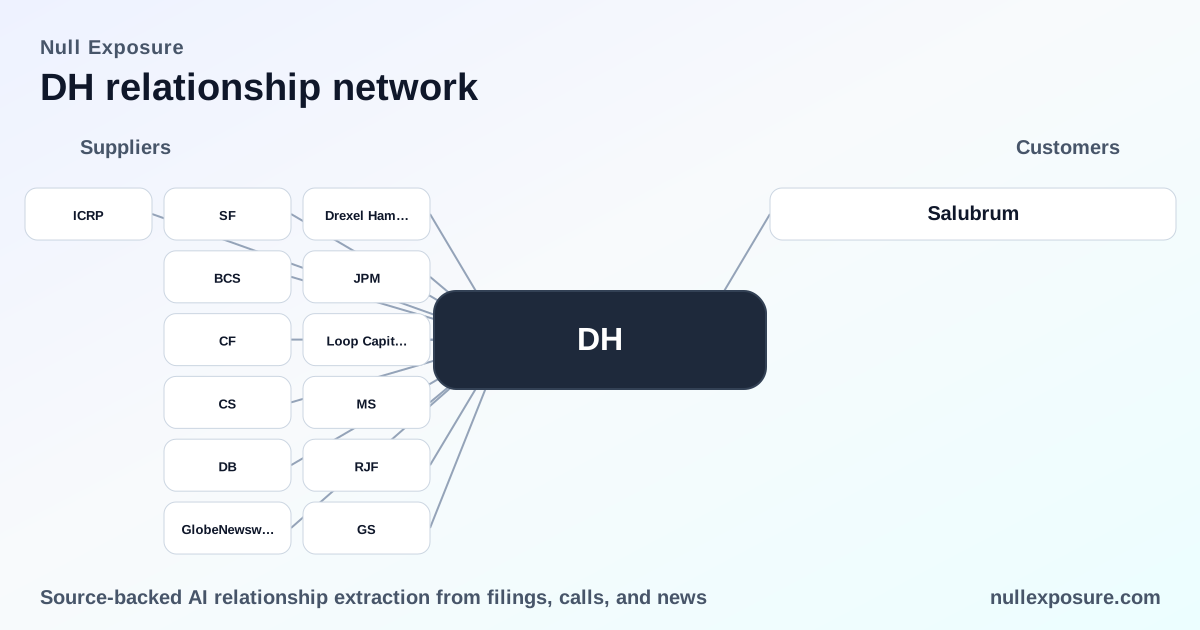
Definitive Healthcare (DH): Customer Relationships and Commercial Signals Investors Should Watch
Definitive Healthcare runs a SaaS-first commercial intelligence platform for the U.S. healthcare ecosystem, monetizing primarily through subscription license fees and ancillary professional services sold to pharmaceutical companies, payers, and healthcare providers. The company's economics are driven by recurring revenue from a concentrated base of enterprise accounts, a U.S.-centric customer footprint, and product positioning that makes its data and analytics an operational input for commercial decision-making. For a practical view of customer exposures and deal-level signals, see https://nullexposure.com/.
How DH sells value — a concise operating thesis
Definitive delivers a multi-tenant database platform combining proprietary and public sources to provide commercial intelligence across the healthcare continuum; that platform is sold almost exclusively as subscription access. For the year ended December 31, 2024, approximately 97% of revenue was subscription-based, with the remainder professional services, which underlines a predictable revenue model built on license fees and stand‑ready support. According to the company’s FY2024 disclosure, the product is the core driver of recurring revenue and client stickiness through embedded workflows and account-level support.
What the customer base looks like in plain terms
- Concentration toward enterprise buyers: As of December 31, 2024, DH reported 519 Enterprise Customers that represented roughly 68% of ARR, which signals high enterprise exposure and revenue concentration. This level of concentration amplifies the economic impact of renewals and upsells with a relatively small number of large relationships.
- Segmented go‑to‑market: The company serves enterprise, mid-market, and small-business customers, with a post‑2024 restructuring that created distinct motions for SMBs while reallocating resources to enterprise accounts, per the company’s disclosure.
- U.S.-dominated revenue mix: Revenue by geography for FY2024 shows ~96% of sales originating in the United States, reinforcing geographic concentration and sensitivity to U.S. healthcare spending trends.
- Contracting posture: The business is a seller/licensor and hosted service provider, delivering subscriptions that are typically multi-year, though a proportion of customers purchase one-year plans—this mix creates a balance of longer-term visibility and pockets of shorter renewal risk.
These points are drawn from Definitive Healthcare’s regulatory disclosures for the year ended December 31, 2024.
Commercial constraints and what they imply for operators and investors
Definitive’s customer relationships reveal several structural business-model characteristics that determine both optionality and risk:
- Predictability tied to subscription economics. With 97% of revenue from subscriptions, cash flow visibility depends heavily on renewal rates, expansion within accounts, and the health of enterprise pipelines. The company’s SaaS structure provides recurring cash but also concentrates downside in renewals.
- Concentration amplifies single-account risk. The fact that 519 enterprise customers equal ~68% of ARR means a handful of large customers drive a majority of recurring revenue, making customer-success execution and large-account retention critical for stability.
- Mixed contract tenure limits and enables flexibility. Most subscriptions are multi-year, which supports ARR visibility, but a material portion of one-year plans creates cyclical renewal events and potential near‑term volatility.
- U.S. market dependence increases regulatory and demand sensitivity. With nearly all revenue originating in the U.S., the business is tightly coupled to domestic healthcare commercialization cycles and policy shifts.
- Product is operationally important to clients. The platform is described as important to the commercial success of approximately 2,500 customers (as of Dec 31, 2024), indicating high customer-criticality for those users and a focus on retention and value expansion.
Each of these signals is grounded in company filings and investor disclosures for FY2024.
Customer relationship spotlight: Salubrum
Salubrum has entered a strategic data alliance with Definitive Healthcare, backed by Forum Ventures and supported by several industry figures; the partnership positions Salubrum to leverage DH’s healthcare intelligence for vertical AI solutions. A GlobeNewswire press release dated October 17, 2025 announced the strategic data alliance between Salubrum and Definitive Healthcare, describing it as part of Salubrum’s go‑to‑market and product strategy.
Why this matters: the Salubrum alliance is an example of DH serving as a data partner to emerging vendors building vertical solutions—an opportunity for consumption expansion and platform licensing beyond traditional pharma and provider buyers. (GlobeNewswire, Oct 17, 2025.)
All identified counterparty relationships covered
- Salubrum — Strategic data alliance announced with Definitive Healthcare; the relationship positions Salubrum to access DH intelligence in support of vertical AI healthcare products (GlobeNewswire, Oct 17, 2025).
Investment implications — what to watch next
- Renewal and expansion rates are the clearest lever for topline stability. Given the high share of subscription revenue and enterprise concentration, improvements or deterioration in enterprise renewals will drive disproportionate impact to ARR and free cash flow.
- Geographic concentration is a risk that compresses optionality. With ~96% U.S. revenue, growth outside the United States would materially diversify demand risk but is not yet a major revenue source.
- Unit economics and margin recovery will determine valuation upside. The company reports TTM revenue near $241.5M and gross profit of about $203.6M, while trailing profitability metrics remain under pressure (diluted EPS -1.37). Market multiples reflect both the growth potential and margin improvement pathway: EV/Revenue ~0.39 and Price/Revenue ~0.45 as of the latest quarter (2025‑12‑31).
- Product-led expansion into adjacent use cases is a scalable path. Relationships like the Salubrum alliance show DH’s data can be licensed into vertical AI and analytics products—these partnerships can create incremental licensing channels without proportionate sales costs.
Investors should prioritize quarterly disclosures on renewal rates, net retention, large-customer churn, ARR cadence, and progress on non-U.S. expansion when assessing upside versus execution risk.
Bottom line — a focused customer-risk view
Definitive Healthcare is a subscription-centric, U.S.-focused SaaS business with material enterprise concentration. Customer relationships are the operational control point: retention and expansion at the enterprise level will determine whether the company converts its data advantage into sustained margin and valuation expansion. Monitor renewal metrics and large-account exposure closely; strategic alliances such as the Salubrum partnership highlight demand beyond classical pharma buyers and represent a route to broaden consumption.
For a concise monitoring checklist and event-driven coverage on DH customer signals, visit https://nullexposure.com/.