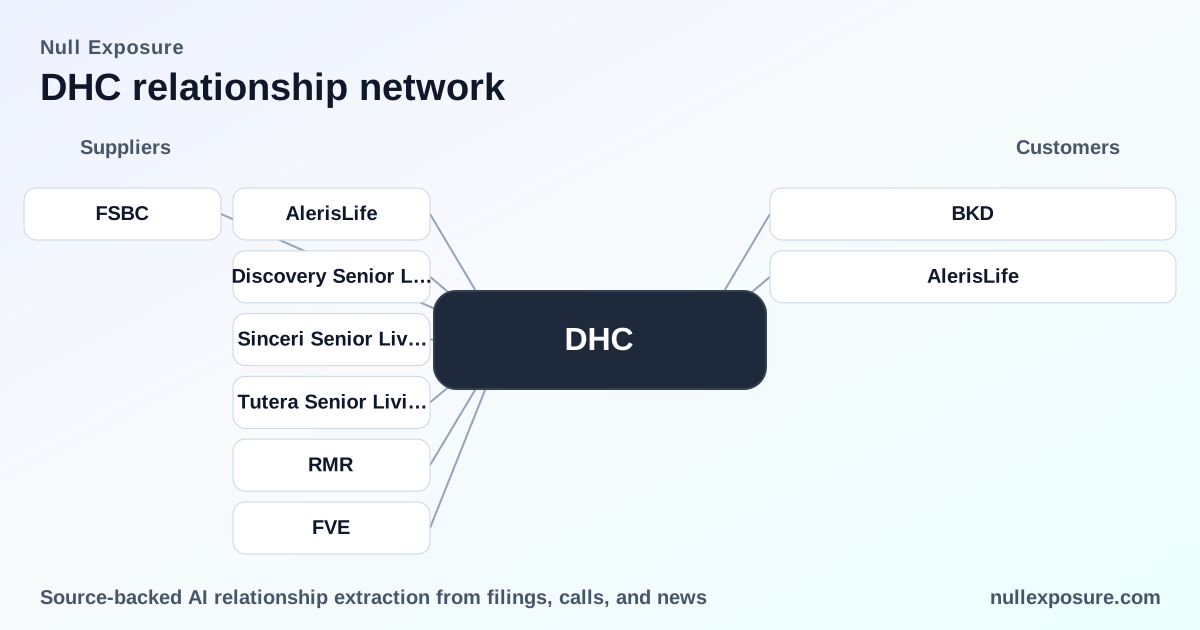
Diversified Healthcare Trust (DHC): Relationship map and implications for investors
Diversified Healthcare Trust (DHC) operates as a healthcare-focused REIT that owns and leases medical office, life science, and senior living properties across the United States and monetizes through long-duration leases, service-derived revenues from managed senior living communities, and selective asset dispositions. For investors, the key leverage is DHC’s dual revenue streams—rent from real estate leases and fee/service income from managed communities—augmented by opportunistic dispositions and liquidation proceeds that can materially boost cash flow in discrete periods. Learn more about DHC relationship intelligence at https://nullexposure.com/.
Operator deal flow: Brookdale bought a meaningful block of communities
Brookdale Senior Living (BKD) acquired 25 leased senior living communities from DHC for $135 million, a transaction that reduces DHC’s portfolio exposure to certain operating assets while converting leased community revenue into sale proceeds. This is a material portfolio reshaping event because it transfers operational risk to the operator and converts property cash flows into liquidity. Source: Senior Housing News, Sept. 30, 2024 — https://seniorhousingnews.com/2024/09/30/brookdale-senior-living-agrees-to-buy-41-leased-communities-for-610m/.
One-off cash inflows: proceeds from AlerisLife’s wind-down
DHC recorded a $27.2 million cash inflow tied to AlerisLife’s asset sale and liquidation, with commentary that an additional $3–$7 million could be expected as the wind-down completed. This payment functions as a non-recurring cash boost that strengthens near-term liquidity and can be deployed to de-lever, reinvest, or cover dividend obligations. Source: coverage captured in FY2026 via SimplyWallSt (note on received $27.2M and expected further amounts) — https://simplywall.st/stocks/us/real-estate/nasdaq-dhc/diversified-healthcare-trust/news/does-alerislife-cash-and-portfolio-shift-change-the-bull-cas; corroborated by Ad-Hoc News reporting on May 2, 2026 — https://www.ad-hoc-news.de/boerse/ueberblick/diversified-healthcare-trust-bolsters-financial-position-with-strategic/68558164.
What these relationships reveal about DHC’s operating profile
DHC’s customer and operator relationships surface several consistent business-model characteristics:
- Contracting posture is generally long-term. Company disclosures describe joint ventures and leases with very long average remaining terms (15.1 years) and extremely high occupancy in certain JV portfolios (99% leased), indicating a bias toward stable, predictable rental cash flows rather than short-cycle leasing. This is a company-level signal from DHC’s pooled portfolio disclosures, not tied to a single counterparty.
- Geographic concentration is national U.S. exposure. DHC explicitly positions its portfolio across the United States, so revenue and portfolio risk are linked to U.S. healthcare and senior-living demand cycles rather than international markets.
- Relationship roles include licensee and internal leasing to TRSs. DHC discloses leasing activity to its taxable REIT subsidiaries (TRSs) as part of portfolio reconfigurations and post-default outcomes; that points to internal tenant arrangements and occasional operational handoffs to affiliated managers.
- Revenue mix includes services-heavy segments. DHC’s SHOP segment (managed senior living) generates revenue primarily from services provided to residents, where DHC pays fees to third-party managers—this creates two-sided exposure: property-level lease economics and operating performance of service providers.
Collectively, these characteristics imply a hybrid balance sheet with durable lease roll and operational exposures: long-term leases stabilize base income while curated dispositions and liquidation proceeds provide episodic liquidity.
Risk and concentration vectors investors should track
- Operator credit and execution risk: The Brookdale sale illustrates active portfolio turnover; when DHC sells to operators or transfers operational assets, it reduces property-management risk but increases exposure to execution and pricing risk in the transaction market. Source: Senior Housing News deal coverage.
- Reliance on non-recurring inflows: The AlerisLife payment is materially positive to cash flow in the period it posts, but it is non-recurring, so investors should treat such inflows as balance-sheet remediation rather than ongoing earnings power. Source: SimplyWallSt and Ad-Hoc News FY2026 reporting.
- Portfolio and segment complexity: DHC operates across medical office, life science, and senior living; the services orientation of the SHOP segment introduces operating volatility tied to manager performance and resident demand. Company disclosures describe this service revenue model and manager-fee structure.
- Concentration on U.S. healthcare real estate: While geographic concentration reduces cross-border risk, it concentrates exposure to U.S. reimbursement, demographic, and labor market trends that affect tenant operations and occupancy.
Appendix — Relationship-by-relationship notes
-
Brookdale Senior Living / BKD — The operator purchased 25 leased communities from DHC for $135 million, a transaction that transfers operating responsibility and converts property cash flows into sale proceeds for DHC. Source: Senior Housing News, Sept. 30, 2024 — https://seniorhousingnews.com/2024/09/30/brookdale-senior-living-agrees-to-buy-41-leased-communities-for-610m/.
-
AlerisLife — DHC received $27.2 million as part of AlerisLife’s asset sale and wind-down, with commentary indicating an additional $3–$7 million could be realized as the liquidation completed; the payments were reported as strategic cash inflows bolstering DHC’s liquidity in FY2026. Sources: SimplyWallSt capture (FY2026 reporting) — https://simplywall.st/stocks/us/real-estate/nasdaq-dhc/diversified-healthcare-trust/news/does-alerislife-cash-and-portfolio-shift-change-the-bull-cas; Ad-Hoc News, May 2, 2026 — https://www.ad-hoc-news.de/boerse/ueberblick/diversified-healthcare-trust-bolsters-financial-position-with-strategic/68558164.
Bottom line for investors
DHC’s relationships show a deliberate mix of long-duration lease economics and opportunistic asset transactions. The Brookdale disposition is an example of portfolio pruning that reduces operating risk and frees capital; the AlerisLife proceeds are a liquidity event that strengthens the balance sheet but does not change recurring earnings power. Investors should value DHC as a cash-flow-oriented REIT with episodic balance-sheet levers, and monitor operator credit, manager performance in the SHOP segment, and the company’s use of one-off proceeds to reduce leverage or fund growth.
For a deeper relationship map and ongoing monitoring tools, visit https://nullexposure.com/.