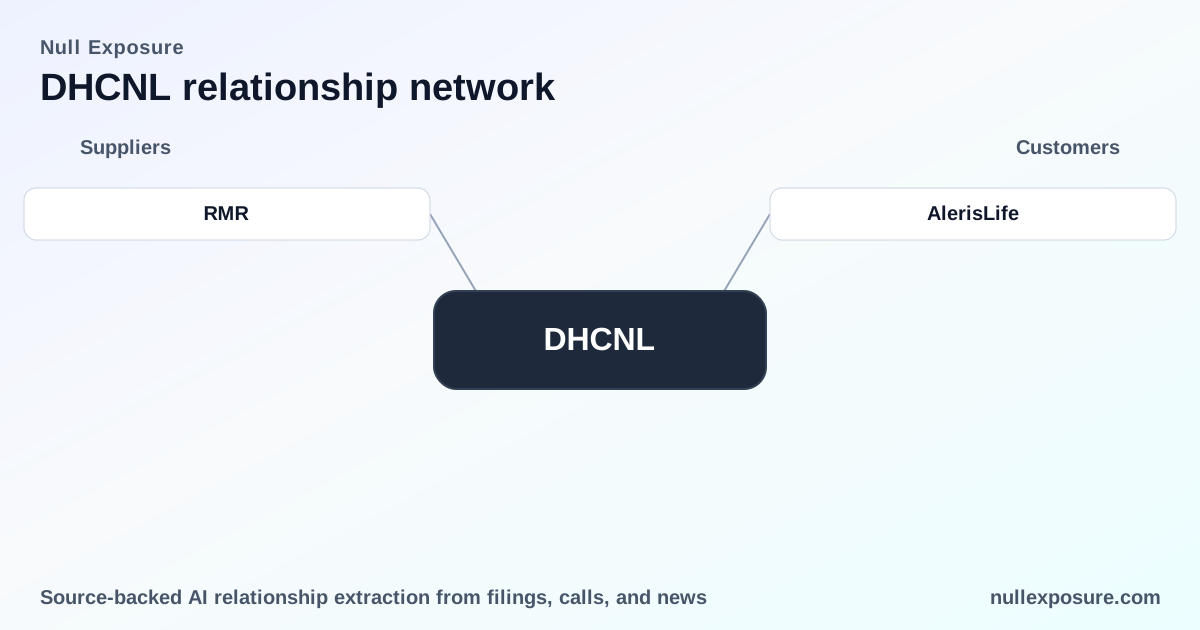
DHCNL — Operator transitions, concentrated cash recovery, and what operators tell investors about portfolio risk
Diversified Healthcare Trust (DHCNL) is a healthcare-focused REIT that owns medical office and life science assets, senior living communities and wellness properties across the United States and monetizes through long-term lease income, operator fee arrangements with its TRSs (taxable REIT subsidiaries), and asset sales when it optimizes the portfolio. Recent asset transitions from AlerisLife and a modest cash recovery from that wind‑down materially change DHC’s operating-partner mix and near-term cash flow profile. For a deeper look at the customer relationships and their implications, visit https://nullexposure.com/.
Quick investor thesis: stable cash flow profile, but operator mix and senior-living exposure create execution risk
DHC’s revenue base is anchored by long-duration leases in medical office and life science properties and recurring rent from senior living assets leased to or managed by third‑party operators. The company’s operating model combines predictable, lease-based cash flows with episodic, higher‑value events—like the AlerisLife wind-down—that temporarily inflate liquidity. Investors should treat DHC as a yield-oriented REIT where tenant/manager quality and the health of private-pay senior-living demand are primary value levers.
How the AlerisLife transition redistributed operating risk (and cash)
Senior Housing News reported that DHC finalized the transition of 116 former AlerisLife communities to seven new operating partners at the end of 2025; that reallocation significantly reshapes DHC’s operator concentration and gives new managers the opportunity to drive performance improvements. Simply Wall Street reported that DHC received US$27.2 million from AlerisLife’s asset sale and wind‑down and expected an additional US$3–7 million, a non‑recurring cash inflow that supported a small quarterly distribution in early 2026. (Senior Housing News, April 30, 2026; Simply Wall Street, March 9, 2026).
Who took the properties — operator-by-operator breakdown
Below are plain-English summaries of every operating relationship mentioned in the reporting, each with the original reporting source.
-
AlerisLife — DHC completed the transition of 116 AlerisLife communities to new operators and collected a $27.2 million cash payment from AlerisLife’s asset sale and wind‑down, with an additional $3–7 million expected; the transaction both reduced DHC’s exposure to a single operator and provided near-term liquidity. Source: Senior Housing News (April 30, 2026) and Simply Wall Street (March 9, 2026), https://seniorhousingnews.com/2026/04/30/dhc-ceo-after-alerislife-transitions-new-operating-partners-have-unique-opportunities-to-drive-performance/ and https://simplywall.st/stocks/us/real-estate/nasdaq-dhc/diversified-healthcare-trust/news/does-alerislife-cash-and-portfolio-shift-change-the-bull-cas/amp
-
Discovery Senior Living — Discovery assumed operations of 44 properties, becoming the single largest new operator in the AlerisLife transition and significantly increasing its footprint within DHC’s senior-living portfolio. Source: Senior Housing News (April 30, 2026), https://seniorhousingnews.com/2026/04/30/dhc-ceo-after-alerislife-transitions-new-operating-partners-have-unique-opportunities-to-drive-performance/
-
Sinceri Senior Living — Sinceri took responsibility for 38 communities, representing another concentration point for DHC’s newly reallocated senior-living operating base. Source: Senior Housing News (April 30, 2026), https://seniorhousingnews.com/2026/04/30/dhc-ceo-after-alerislife-transitions-new-operating-partners-have-unique-opportunities-to-drive-performance/
-
Tutera Senior Living — Tutera assumed operations for 19 communities, adding a mid‑sized operator to DHC’s manager mix and creating room for operational uplift through focused management. Source: Senior Housing News (April 30, 2026), https://seniorhousingnews.com/2026/04/30/dhc-ceo-after-alerislife-transitions-new-operating-partners-have-unique-opportunities-to-drive-performance/
-
Stellar Senior Living — Stellar took on six communities totaling 1,032 units, representing a clustered increase in operator exposure but still a smaller share relative to the largest operators. Source: Senior Housing News (April 30, 2026), https://seniorhousingnews.com/2026/04/30/dhc-ceo-after-alerislife-transitions-new-operating-partners-have-unique-opportunities-to-drive-performance/
-
WellQuest Living — WellQuest assumed five communities (796 units), representing a moderate new presence in DHC’s portfolio and an opportunity to scale operational practices across those assets. Source: Senior Housing News (April 30, 2026), https://seniorhousingnews.com/2026/04/30/dhc-ceo-after-alerislife-transitions-new-operating-partners-have-unique-opportunities-to-drive-performance/
-
Phoenix Senior Living — Phoenix took control of three communities (366 units), giving it a small but strategically meaningful foothold in the reallocated set. Source: Senior Housing News (April 30, 2026), https://seniorhousingnews.com/2026/04/30/dhc-ceo-after-alerislife-transitions-new-operating-partners-have-unique-opportunities-to-drive-performance/
-
Ciel Senior Living — Ciel manages a single 308‑unit property from the transition, a concentrated assignment but one that could be material at a property level. Source: Senior Housing News (April 30, 2026), https://seniorhousingnews.com/2026/04/30/dhc-ceo-after-alerislife-transitions-new-operating-partners-have-unique-opportunities-to-drive-performance/
Company-level constraints and what they imply for investors
The company’s filings and portfolio disclosures provide clear signals about DHC’s operating model:
-
Long-term leasing posture: As of December 31, 2024, DHC held assets with an average remaining lease term of roughly 15 years on certain lab/medical office holdings, indicating a core book of long-duration, lease‑based cash flow that supports valuation stability. (Company filing, Dec. 31, 2024).
-
Large-enterprise counterparty exposure in medical office assets: Major tenants across the medical office and life-science portfolio include Merck, Medtronic, AbbVie and HCA, signaling high-quality, creditworthy rent streams in that segment that offset some senior-living revenue volatility. (Company filing, Dec. 31, 2024).
-
National footprint: DHC owned 367 properties across 36 states and D.C. as of year-end 2024, giving diversified geographic risk but also exposure to different state-level reimbursement and demographic dynamics. (Company filing, Dec. 31, 2024).
-
Material senior-living exposure that is private-pay reliant: Substantially all NOI from senior-living communities is generated where a majority of revenues derive from private resources rather than government payors, which increases sensitivity to consumer affordability and local market demand. (Company filing, Dec. 31, 2024).
-
Mixed relationship roles: DHC functions as lessor, seller of assets, licensor to TRSs, and buyer in certain repositioning transactions—an operating model that combines passive ground-rent economics with active portfolio management and operator oversight.
These signals imply stability in the MO/LS portfolio balanced against execution and demand risk in senior living, and they explain why DHC both pursues operator changes (to restore occupancy/margins) and occasional asset sales to crystallize value.
Investment implications and risk checklist
- Upside: Operator transitions can unlock operational improvements and rent-indexing opportunities; cash proceeds from AlerisLife reduced near-term liquidity strain.
- Downside: Senior-living cash flow remains sensitive to private-pay trends and operator execution; reassigning 116 communities concentrates risk in a handful of new operators until performance stabilizes.
- Credit consideration: Long-term leases in medical office and life‑science assets with large enterprise tenants are a stabilizer for overall cash flow.
- Catalysts to monitor: occupancy trajectory under new operators, collection of the remaining AlerisLife wind-down proceeds, and disclosure of any material changes to lease structures with TRSs.
For a practical operational and counterparty map that investors use to prioritize diligence, see https://nullexposure.com/ for detailed relationship monitoring and alerts.
Bottom line
DHCNL’s repositioning after AlerisLife’s exit is a classic REIT tradeoff: portfolio stability through long-term medical-office leases and large enterprise tenants, versus active operational risk concentrated in the senior-living segment as new managers scale. Investors should focus on occupancy and cash-collection trends under the new operators, the timing of remaining wind-down proceeds, and whether operator performance drives durable NOI recovery or requires further capital actions.