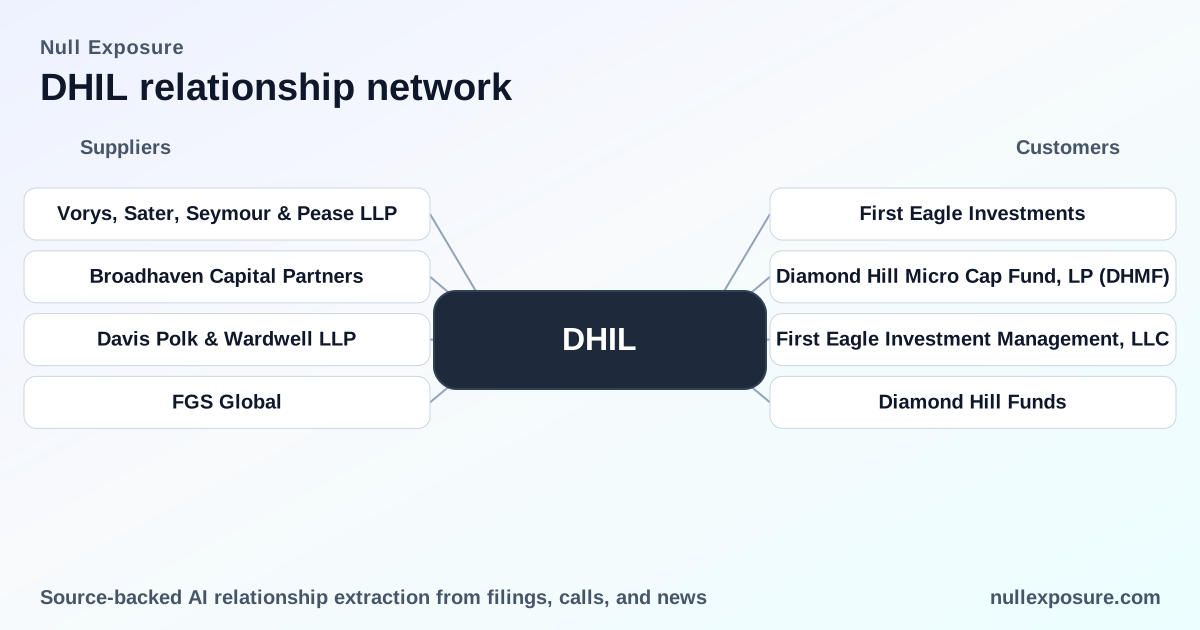
Diamond Hill (DHIL) — Customer Relationships, Concentration and the Post‑Sale Reset
Diamond Hill operates as an investment adviser and fund administrator through its subsidiary Diamond Hill Capital Management (DHCM), monetizing primarily via advisory and administration fees charged to mutual funds, private funds, separately managed accounts and related vehicles. Revenue is highly concentrated in the Diamond Hill Funds, which historically generated roughly two‑thirds of consolidated revenue, and the company’s customer footprint is compact, US‑centric, and service‑oriented — a profile that shaped the strategic outcome of the First Eagle acquisition. For an independent view of counterparties and deal signals, visit https://nullexposure.com/.
The strategic move: First Eagle completes the buyer’s role
First Eagle executed a full acquisition of Diamond Hill, completing a transaction that consolidated the firm’s ownership and took the company private. The bid cited in regulatory notices and press releases priced the transaction in the low‑hundreds per share, with contemporaneous reporting putting the enterprise consideration in the high hundreds of millions. The acquisition changes Diamond Hill’s counterparty landscape from public equity holders to a single strategic buyer, shifting governance and exit timing risk to First Eagle.
What this means operationally for customers and revenue
- Concentration equals vulnerability and predictability. DHCM’s economics depend on a small number of fund relationships that are contractual and cash‑flow driven; those contracts are typically service arrangements that can be renewed, amended, or terminated under defined notice provisions.
- US revenue base and employee alignment. Substantially all revenue is US‑sourced, and the company uses employee purchase plans and share‑based compensation that place a small internal equity stake in employees’ hands — small in absolute spend but relevant to retention.
- From public to private ownership. Under First Eagle, clients (the funds and institutional accounts) continue to be the primary cash generators; ownership consolidation reduces public disclosure cadence and lifts short‑term market liquidity pressures.
If you want a structured list of counterparties and sourced notes, see the relationship roll‑call below. You can also run targeted searches and export a consolidated view at https://nullexposure.com/.
Operating constraints that shape customer risk and renewal dynamics
- Contract tenor and termination posture: DHCM’s client agreements commonly include short‑term termination mechanics; several advisory/administration agreements are terminable on roughly 60 days’ notice without penalty, which means revenue retention is renewal‑dependent rather than duration‑locked (company filing language describing termination provisions).
- Spot/one‑off contract activity exists: DHCM executed an asset sale in 2021 that transferred high‑yield advisory contracts to Brandywine Global, establishing precedent for executing discrete, non‑recurring contract exits rather than long‑tail holdouts.
- Customer type and spend scale: The firm serves institutional and retail pooled vehicles; employee purchase plan activity represents individual counterparty interactions with limited spend (ESPP purchases totaled ~$0.3M in 2024).
- Geographic concentration: Substantially all revenue and long‑lived assets are U.S.‑based, focusing regulatory, distribution and client servicing risk within the U.S. market.
- Material dependence on in‑house fund relationships: DHCM generated approximately 66% of 2024 revenues (68% in 2023 and 71% in 2022) from advisory and administration agreements with the Diamond Hill Funds; that relationship is critical to consolidated performance and cash generation (company disclosures).
- Service provider posture: DHCM acts principally as an adviser/administrator across mutual funds, private funds (including DHMF), SMAs, CITs and model programs — revenue drivers are fee schedules and asset performance rather than transactional product sales.
- Relationship maturity with flagship funds: Management states it maintains mature, long‑standing relationships with the Diamond Hill Funds and their trustees and expects contract renewals under ordinary course practices (company disclosures).
The relationship roll‑call (sourced, concise)
-
First Eagle Investments — Diamond Hill was sold to First Eagle at a transaction price reported as $175.00 per share in multiple filings and alerts; litigation and shareholder inquiries followed the announcement as groups probed process and price adequacy. — GlobeNewswire (Dec 2025); PR Newswire (Mar 2026).
-
First Eagle Investments — Additional reporting and investor notices described the sale consideration and shareholder outreach tied to the offer, underscoring the acquisition’s market impact and attention from plaintiff firms. — PR Newswire / Halper Sadeh press releases (Dec 2025 – Mar 2026).
-
First Eagle Investment Management, LLC — First Eagle completed the acquisition of Diamond Hill and filed the requisite HSR and regulatory notices; closing activity was reported in April 2026, marking the operational transfer of ownership and consolidation of governance. — MarketScreener reporting of the April 22, 2026 closing.
-
First Eagle Investment Management, LLC — Regulatory filings noted that the Federal Trade Commission granted early termination of the HSR waiting period in connection with First Eagle’s pending acquisition, clearing a routine antitrust step prior to closing. — SEC/8‑K reporting summarized on StockTitan (March 2026).
-
Diamond Hill Micro Cap Fund, LP (DHMF) — DHCM provides investment advisory and related services to DHMF as a private vehicle, illustrating the firm’s multi‑product servicing model that spans open‑end funds and private limited partnerships. — MarketScreener / company fund descriptions (FY2025 reporting).
-
Diamond Hill Funds — DHCM is the investment adviser and administrator for the Diamond Hill Funds, a suite of open‑end mutual funds that generated approximately 66% of consolidated revenue in 2024, making this relationship the company’s critical revenue spine. — MarketScreener and company filings (FY2025–FY2024 disclosures).
Key investor takeaways and risk framing
- Concentration is the central investment thesis and risk: With two‑thirds of revenue coming from the Diamond Hill Funds, any change in advisory fee structure, contract renewal decisions, or asset outflows would materially affect consolidated profitability.
- Short notice termination features increase renewal risk: Contract clauses that allow termination on roughly 60 days’ notice make revenue streams sensitive to client sentiment and short‑term performance.
- Ownership change resets governance but not client economics: First Eagle’s acquisition reduces public market volatility for DHIL equity but does not intrinsically alter fee arrangements with funds; client renewals and AUM performance remain the principal drivers of future cash flows.
- Operational footprint is US‑centric and service‑intensive: That focus concentrates regulatory, distribution and talent risks domestically while simplifying custody and compliance complexity relative to global managers.
For a tailored report on DHIL counterparties, contract posture, and renewal timelines, analysts can request a custom extract at https://nullexposure.com/.
Bold operational signals and the consolidation under First Eagle reposition Diamond Hill from a publicly traded advisory group into a privately owned, fee‑dependent service provider; investors and operators should prioritize client retention dynamics, fee renegotiation risk, and AUM sensitivity when modeling post‑acquisition performance.