DHT Holdings: Freighted income from crude tanker services backed by trading-house demand
DHT Holdings operates and monetizes a fleet of crude oil tankers by deploying vessels into the freight market and charter markets, generating revenue from charter hire and voyage freight while returning cash to shareholders through a substantial dividend. The company's economics are asset-backed, exposure to tanker freight rates is the primary earnings driver, and commercial relationships with large commodity traders anchor cargo flow and counterparty credit. For a concise mapping of DHT’s customer exposure, visit https://nullexposure.com/.
Why commodity traders matter to a tanker owner
DHT is an owner-operator of crude tankers; that simple fact determines its commercial posture. Revenues come from putting ships to work under short-term spot voyages or longer charters, and counterparties that contract for cargo liftings—often the large trading houses that buy, sell and take title to oil—drive utilization and cash flow. Large trading houses provide both demand stability and concentrated counterparty exposure; the relationship is commercially critical but concentrated, which shapes underwriting, chartering strategy and liquidity planning.
Who’s on the customer list (what the records show)
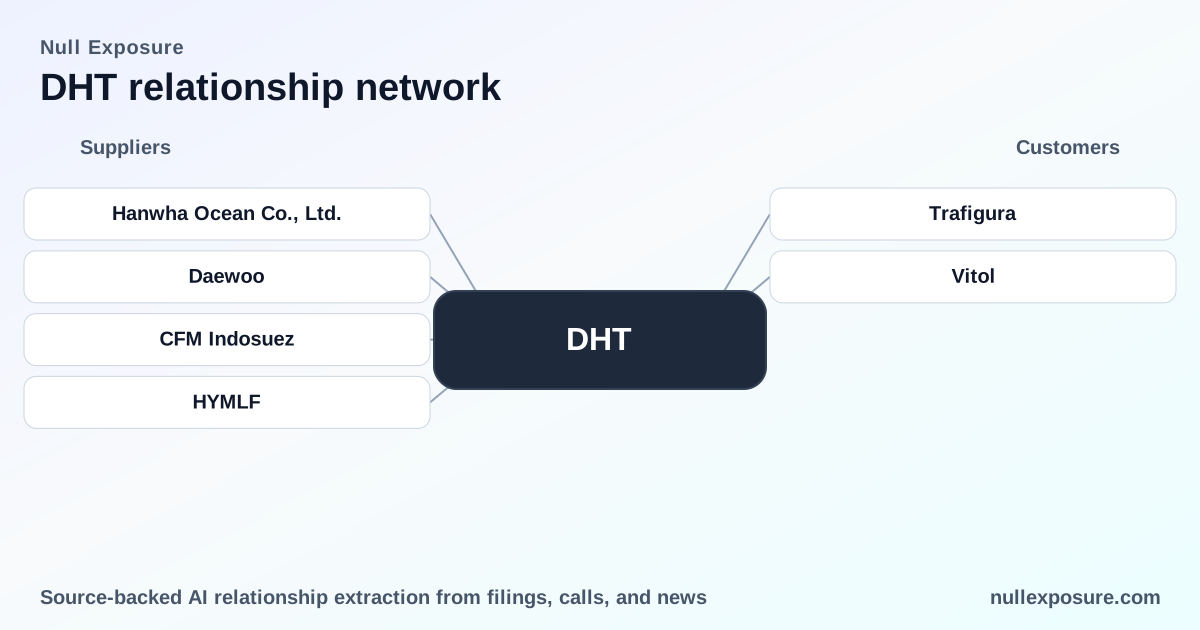
DHT’s publicly recorded customer relationships in the reviewed sources include two major trading houses. Each relationship is logged in a Q4 2025 earnings call transcript referenced below.
Trafigura
Trafigura is identified by management as a commercial buyer and holder of title to cargoes transported on DHT tonnage, effectively functioning as a chartering customer for those voyages. According to the Q4 2025 earnings call transcript published by InsiderMonkey on March 9, 2026, management explicitly cited Trafigura as one of the parties that would sell and hold title to oil cargoes and thus act as a customer. (InsiderMonkey, Q4 2025 earnings call transcript, published 2026-03-09)
Vitol
Vitol is likewise named as a commercial counterparty that will take title to, and market, cargoes moved by DHT vessels—placing it in the role of a chartering customer for relevant voyages. Management referenced Vitol in the same Q4 2025 earnings call transcript published by InsiderMonkey on March 9, 2026. (InsiderMonkey, Q4 2025 earnings call transcript, published 2026-03-09)
Company-level operating signals and constraints investors should weigh
There are no separate constraint excerpts catalogued in the record set; the following observations are company-level signals derived from DHT’s profile and public filings:
- Contracting posture — commercial flexibility: DHT operates in a market that mixes short-term spot voyages and time charters; this delivers revenue upside when rates recover and exposes earnings to freight-rate cycles. Management’s explicit references to trading houses as cargo counterparties are consistent with a commercial model that relies on transactional charter activity rather than captive industrial long-term offtakes.
- Counterparty concentration — commercial concentration risk: The customer universe includes major trading houses. Concentration of cargo demand to a small set of large traders increases revenue predictability when those traders are active, but raises single-counterparty exposure and negotiation leverage.
- Criticality — operational reliance on charter flows: For DHT a handful of large commodity traders are commercially important because they provide cargoes and take title; those relationships are operationally critical to utilization and short-term revenue.
- Maturity and financial profile — stable cash generation: DHT reports a trailing revenue of approximately $551m and EBITDA of about $321m (TTM), with a robust profit margin (38.3%) and an attractive dividend yield around 8.7%, indicating a mature, cash-returning business. These financials support the company’s ability to monetize its fleet and distribute cash to shareholders.
- Credit and market cyclicality — earnings sensitivity to freight rates: The business is inherently cyclical; even with strong current margins and a dividend, earnings track spot markets and charter rates, which creates upside in tight markets and downside when tanker supply outpaces demand.
What these customer ties mean for risk-adjusted returns
Relationships with Trafigura and Vitol are a positive commercial signal: these counterparties are large, creditworthy market participants that source, trade, and take title to crude—their business provides cargo volume and payment capacity, which underpins vessel utilization. For investors, the combination of asset-backed balance sheet metrics, high profit margins and a generous dividend yield frames DHT as a cash-oriented play on tanker market cycles.
At the same time, the concentration of chartering counterparties elevates idiosyncratic back-book risk: if trading flows pivot or counterparties reallocate volumes, short-term utilization can shift materially. Investors should therefore price in freight-rate volatility and maintain a view on chartering terms cadence and counterparty credit lines.
Tactical takeaways for allocators and analysts
- Positive: asset backing + strong cash generation. DHT’s balance of high EBITDA margins and an established dividend makes it attractive to income-focused investors wanting tanker-market exposure.
- Watch: counterparty concentration and spot-rate sensitivity. The identified customer relationships are advantageous for demand, but concentration increases commercial exposure to decisions by a small set of trading houses.
- Action: monitor chartering disclosures and voyage-level counterparties. Management commentary—like the Q4 2025 earnings call that named Trafigura and Vitol—serves as an actionable signal of who is underpinning short-term cargo volumes and where leverage sits in the freight chain.
For a fuller mapping of DHT’s customer exposures and comparable company relationships, see our coverage at https://nullexposure.com/.
Bottom line
DHT is a classic asset-owner in the crude tanker segment: its earnings and dividend are driven by freight-market dynamics and anchored by commercial relationships with major trading houses such as Trafigura and Vitol. Those relationships increase revenue visibility when trading flows are strong but concentrate commercial exposure into a small set of counterparties. Investors should balance the company’s attractive cash generation metrics against freight cyclicality and counterparty concentration when sizing positions.