Dine Brands Global (DIN): Franchise economics, concentrated revenue streams, and the partner map that matters to investors
Thesis: Dine Brands Global runs a capital-light franchisor model built on two large concepts—Applebee’s and IHOP—monetizing through royalties, advertising fees and franchise-related services; steady recurring revenue from long-term franchise agreements and concentrated domestic exposure drive cash flow predictability while bankruptcy and operator stress are the primary system-level risks. For a focused view of how Dine Brands’ customer relationships support and stress that model, read on. For data-driven diligence and ongoing monitoring, see https://nullexposure.com/.
How Dine Brands actually makes money — the operating model in one paragraph
Dine Brands licenses and franchises restaurant concepts and collects royalties, advertising contributions and service fees from franchisees, while retaining limited company-operated units. Its contracts are structural: franchise agreements that grant long tenors, intellectual property licenses, and enforcement rights that allow Dine to assume control of units under certain default scenarios. The result is a high-margin, recurring-fee services business that is materially concentrated in Applebee’s and IHOP and predominantly domestic.
What the constraints tell investors about the business model
- Contracting posture — long-term: Dine’s standard Applebee’s franchise agreement provides an initial 20‑year term with renewal options, which creates durable revenue streams and gives the company leverage over system continuity. (Company filing language cited in Dine Brands’ disclosures, fiscal 2024–2025.)
- Geographic footprint — primarily North America with global scale: Most revenue is domestic (about 83% of 2024 revenues from Applebee’s and IHOP segments), but the company reports over 3,500 restaurants worldwide, supporting modest international diversification. (Fiscal 2024 disclosures.)
- Concentration and criticality — material: Approximately 89% of franchise segment revenue in 2024 came from Applebee’s, IHOP and Fuzzy’s—underlining the reliance on a small number of concepts. (Fiscal 2024 disclosures.)
- Role complexity — licensor and service provider: Dine both licenses IP to franchisees and retains contractual rights to step in on defaulted restaurants; it also provides franchising, distribution and operational services to securitization and other internal entities. (Company filings.)
- Maturity and stage — an active, mature franchising system: As of year-end 2024 the substantial majority of ~3,555 restaurants were franchised, implying a mature, cash-generative platform with limited company-operated expansion risk. (Fiscal 2024 disclosures.)
These constraints combine to produce predictable royalty streams but real sensitivity to system health, since franchisee distress can convert a stable income stream into asset and lease exposure.
The relationship map — what each partner reference means for investors
Below I cover every relationship returned in available signals. Each entry is a concise operational takeaway followed by the source.
-
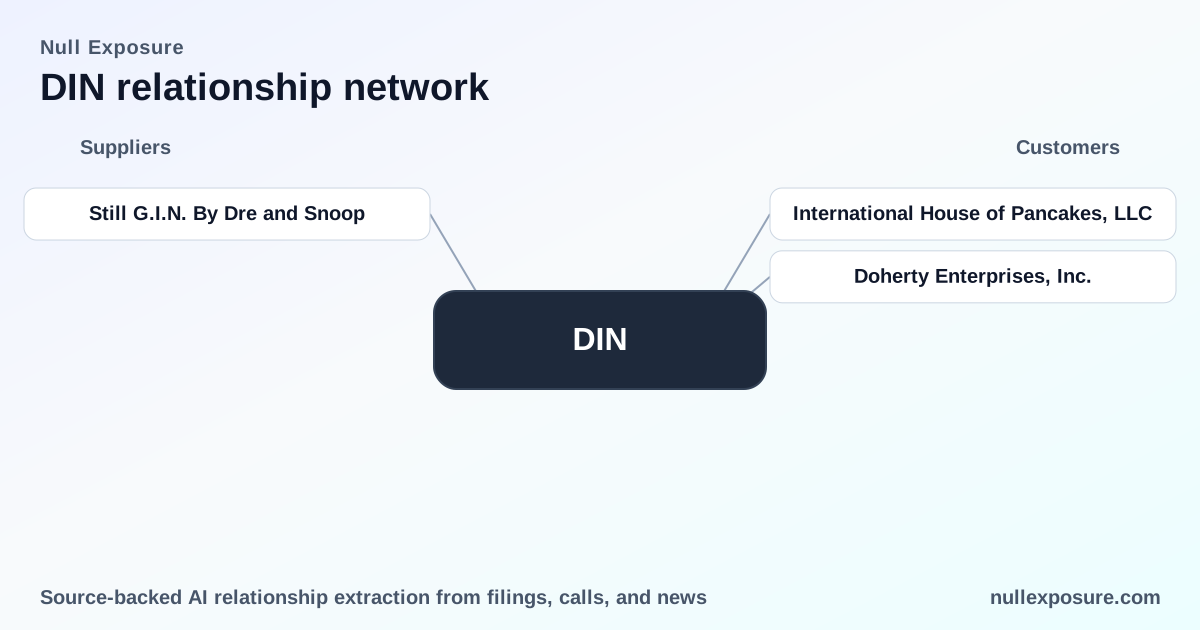
International House of Pancakes, LLC
Dine Brands franchises IHOP restaurants through affiliated franchisees, making IHOP one of the two revenue pillars in the company’s franchise operations. According to a StockTitan news post (March 9, 2026), IHOP restaurants are franchised by affiliates of Dine Brands Global. (StockTitan, March 9, 2026: https://www.stocktitan.net/news/DIN/ihop-acknowledges-third-time-franchisee-of-the-year-recipient-susan-vf6ztgdrhf42.html) -
TANNI (TravelCenters of America reference — FY2022)
TravelCenters has been executing a strategy to add IHOP locations within its travel plazas, which creates a strategic distribution channel and incremental franchise volume for Dine Brands. CStoreDive reported TA's investments—including adding more IHOP locations—during the company’s earnings call (reported May 4, 2026). (CStoreDive, May 4, 2026: https://www.cstoredive.com/news/travelcenters-of-america-to-open-new-proprietary-restaurant-brand/635614/) -
TANNI (TravelCenters of America reference — FY2023)
A separate CStoreDive item reiterated that TA’s foodservice investment included adding IHOP locations, confirming this is a multi-year execution plan that supports Dine’s expansion footprint in travel-oriented real estate. (CStoreDive, May 4, 2026: https://www.cstoredive.com/news/travelcenters-of-america-franchise-acquisition-growth/640487/) -
Applebee’s (RestaurantNews mention)
Applebee’s is franchised by subsidiaries of Dine Brands and remains a core royalty and advertising revenue driver for the company; RestaurantNews noted Dine Brands’ role when covering Applebee’s promotions (May 2, 2026). Applebee’s remains central to system economics and to potential downside if operator stress rises. (RestaurantNews, May 2, 2026: https://www.restaurantnews.com/applebees-free-boneless-wings-nfl-draft-042126/) -
Applebee’s (StockInvestor historical company data mention)
Historical footprint data cited by StockInvestor recalls the scale of Applebee’s and IHOP franchised units (figures as of Dec 31, 2018), underscoring that the company’s economics are driven by thousands of franchised locations. (StockInvestor, May 2, 2026: https://www.stockinvestor.com/dine-brands-global-inc-serves-shareholders-appetizing-capital-growth-din/amp/) -
IHOP (StockInvestor historical reference)
The same StockInvestor piece cites IHOP unit counts alongside Applebee’s, reinforcing that IHOP contributes meaningfully to franchise royalties and advertising income given its larger unit base. (StockInvestor, May 2, 2026: https://www.stockinvestor.com/dine-brands-global-inc-serves-shareholders-appetizing-capital-growth-din/amp/) -
Neighborhood Restaurant Partners Florida (bankruptcy filing)
A Chapter 11 filing by Neighborhood Restaurant Partners Florida, which operated over 50 Applebee’s locations, demonstrates operator-level credit stress that can create lease and operational exposure for Dine; Dine indicated plans to act as a stalking-horse bidder to acquire remaining restaurants and leases to preserve system health. (Intellectia/press aggregation, May 2026: https://intellectia.ai/news/stock/bankruptcy-of-applebees-franchisee-affects-parent-dine-brands-global) -
Doherty Enterprises, Inc.
Doherty opened its first dual-brand Applebee’s | IHOP restaurant in New York, highlighting that franchisees continue to pursue co-branded footprints—an operational dynamic that can improve unit profitability and system density. DigitalJournal covered the grand opening announcement (March 9, 2026). (DigitalJournal/PR Underground, March 9, 2026: https://www.digitaljournal.com/pr/news/prunderground/doherty-enterprises-open-its-first-1347420086.html) -
TANNL (TravelCenters of America — TA/IHOP pact)
CSNews referenced TravelCenters’ 2019 pact with IHOP to open up to 94 IHOP locations across TA and Petro sites, a signed development pipeline that supports multi-year unit growth for Dine Brands in travel retail locations. (CSNews, May 4, 2026: https://csnews.com/travelcenters-america-rethinks-its-approach-foodservice) -
TANNZ (TruckingDive reference to TA investments)
TruckingDive reported on TravelCenters’ investments in full-service restaurant operations and specifically called out the addition of IHOP locations, confirming cross-industry acknowledgement of the partnership’s pipeline. (TruckingDive, May 4, 2026: https://www.truckingdive.com/news/travelcenters-of-america-adds-relay-cardless-payment/806966/)
Investment implications — what to watch
- Credit and operator health: Franchisee bankruptcies can force Dine to step into leases or assume assets; the Neighborhood Restaurant Partners Florida case demonstrates this risk and the company’s willingness to act as a stalking-horse bidder to stabilize the system.
- Concentration risk: With nearly 90% of franchise revenue tied to Applebee’s, IHOP and Fuzzy’s, sector shocks to casual dining or concentrated operational failures will have outsized earnings impact.
- Growth vectors: Partner pipelines like TravelCenters’ IHOP rollouts and dual-brand franchise experiments (e.g., Doherty) provide organic unit growth without heavy corporate capital expenditure.
- Contract durability: Long-term franchise tenors and IP licensing rights provide cash-flow visibility and enforcement options that reduce volatility in revenue recognition.
If you want continuous monitoring of these partner signals and how they feed into franchise economics, visit our research hub at https://nullexposure.com/.
Bottom line
Dine Brands is a mature franchisor with durable contractual revenue and concentrated exposure to two large concepts. Operator distress is the principal threat to that stability, while strategic distribution partners and co-branding opportunities offer incremental upside to system growth and per-unit economics. Investors should balance the predictability of recurring royalties against execution risk at the operator level and track franchisee credit developments closely.