HF Sinclair (DINO): Retail JV Expands Captive Demand, Strengthens Regional Takeaway
HF Sinclair is an independent energy company that generates cash from refining, branded retail marketing, midstream tariffs, renewable diesel sales and lubricant exports. The business monetizes through product sales into a nationwide Sinclair-branded retail network (over 1,600 branded sites and licensing at 300+ locations), fee-based midstream services that do not take commodity ownership, and targeted joint ventures that lock in offtake from proximate refineries. The recent Green Trail Fuels JV with U‑Pop Holdings represents a strategic push to convert regional refinery output into higher-margin branded retail sales in the Rockies and Southwest. Learn more about related customer relationships at https://nullexposure.com/.
What the Green Trail JV means for DINO’s marketing franchise
HF Sinclair announced the formation of Green Trail Fuels LLC, a joint venture with U‑Pop Holdings in which HF Sinclair will hold a 50% nonoperating economic interest and supply fuel from its regional refineries to more than 30 retail sites across Colorado and New Mexico. This transaction directly increases HF Sinclair’s branded throughput in the Rocky Mountain and Southwest corridors and creates incremental, regional demand for refinery output. According to the Q4 2025 earnings call transcript published on InsiderMonkey (March 9, 2026), the JV is structured to strengthen HF Sinclair’s branded marketing footprint in those states. (InsiderMonkey, Q4 2025 earnings call transcript, Mar 9, 2026: https://www.insidermonkey.com/blog/hf-sinclair-corporation-nysedino-q4-2025-earnings-call-transcript-1702976/)
U‑Pop Holdings: the local operator partner
U‑Pop Holdings will operate the retail network side of Green Trail Fuels while HF Sinclair acts as the fueling supplier and economic partner; HF Sinclair’s position is nonoperating economically but strategically material for branded supply relationships in the region. The same Q4 2025 earnings call transcript describes U‑Pop as the co‑venturer in the JV and the operator of the retail locations that will carry Sinclair fuel. (InsiderMonkey, Q4 2025 earnings call transcript, Mar 9, 2026: https://www.insidermonkey.com/blog/hf-sinclair-corporation-nysedino-q4-2025-earnings-call-transcript-1702976/)
Complete list of customer relationships noted in the results
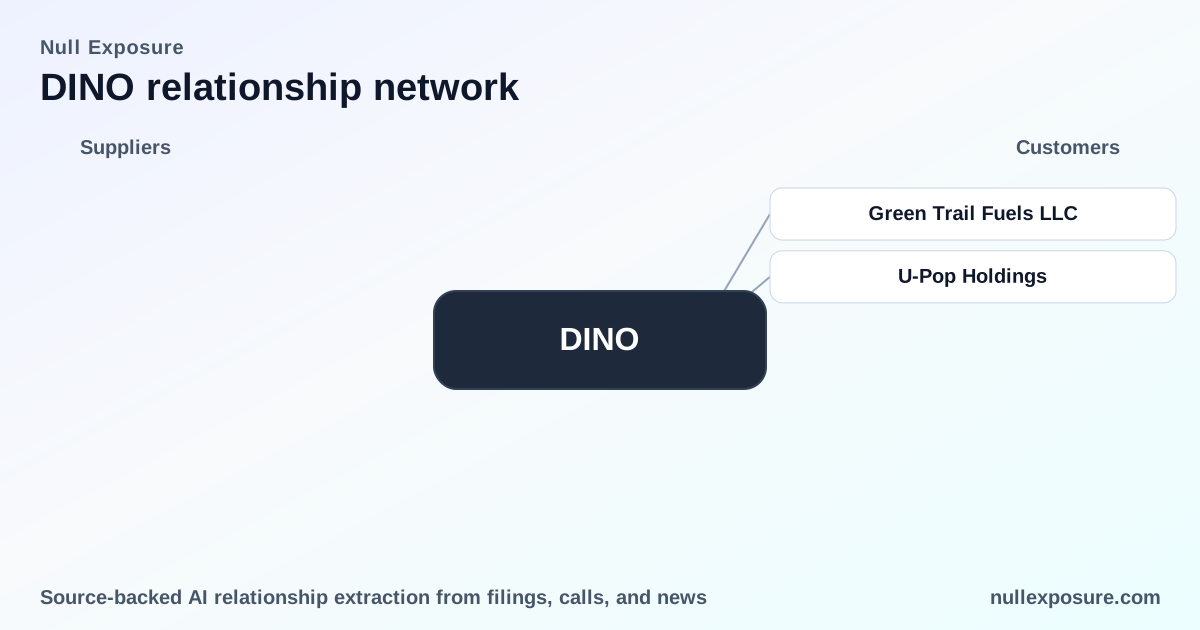
- Green Trail Fuels LLC — HF Sinclair will hold a 50% nonoperating economic interest and supply fuel to a network of over 30 retail sites in Colorado and New Mexico, expanding branded sales in the Rockies and Southwest. (InsiderMonkey, Q4 2025 earnings call transcript, Mar 9, 2026: https://www.insidermonkey.com/blog/hf-sinclair-corporation-nysedino-q4-2025-earnings-call-transcript-1702976/)
- U‑Pop Holdings — Partner and operator in the Green Trail Fuels JV that will run the retail sites while HF Sinclair supplies fuel and takes an economic stake. (InsiderMonkey, Q4 2025 earnings call transcript, Mar 9, 2026: https://www.insidermonkey.com/blog/hf-sinclair-corporation-nysedino-q4-2025-earnings-call-transcript-1702976/)
How HF Sinclair’s operating model shapes customer economics
HF Sinclair’s revenue mix and contracting posture create a hybrid of commodity and fee-based cash flows:
- Branded product sales and licensing: The company sells gasoline, diesel, jet fuel, renewable diesel and lubricants through a branded network and charges licensing fees—this gives HF Sinclair direct exposure to refined product margins when it supplies retail sites. Company disclosures note marketing to over 1,600 branded stations and licensing at 300+ additional locations.
- Midstream fee-based services: HF Sinclair’s midstream operations generate revenue by charging tariffs, terminalling and storage fees, and do not take ownership of the products transported—this creates a predictable toll-like cash stream that reduces direct commodity price exposure.
- Joint ventures and economic stakes: The Green Trail JV exemplifies a model where HF Sinclair secures regional demand through nonoperating economic interests, aligning refinery supply with branded retail offtake without taking on front-line retail operating risk.
- Export and lubricant channels: HF Sinclair’s subsidiaries produce and market base oils and specialty lubricants in the United States, Canada and the Netherlands and export products to more than 80 countries, providing a global revenue layer beyond North American refined products.
These characteristics produce diversified monetization across spot/refined product sales, predictable midstream fees, licensing income and JV economics.
Key operational constraints and company-level signals for investors
HF Sinclair’s filings and corporate disclosures convey a mix of geographic breadth, concentration points and role diversity that shape counterparty risk:
- Geographic footprint: The company markets refined products principally in the Southwest, Rocky Mountains and neighboring Plains states, while specialty lubricants are sold globally to 80+ countries. This creates regional concentration for refined product demand with global reach in specialty segments.
- Customer concentration: For the years ended Dec 31, 2024, 2023 and 2022, Shell and certain affiliates represented roughly 11–15% of annual revenues, which signals a material single‑customer exposure at the company level (Note 4, Revenues, HF Sinclair filings).
- Distribution reliance: HF Sinclair notes reliance on key distributors and independent retail operators for outlet access; the loss of such distributors would reduce revenue in affected regions.
- Role diversity: Company disclosures classify HF Sinclair as seller, licensor, distributor and service provider across different lines—retail fuel sales, brand licensing, lubricant distribution and fee-based midstream services—meaning counterparty terms and contractual risk vary by business line.
- Midstream contracting posture: Midstream services are toll-fee based and do not take ownership of commodities, which reduces direct exposure to commodity price volatility for that segment.
Taken together, these signals imply a business that balances commodity exposure with contractual, fee-based revenues and brand licensing—concentration in a few large customers and dependency on third‑party retail operators are the principal structural risks.
Investment implications: why the Green Trail JV matters
The Green Trail JV is strategically additive: it converts local refinery output into branded retail throughput, strengthens local pricing integrity for Sinclair products and captures margin across the value chain without fully integrating retail operations. For investors, this JV increases visible demand for regional refinery capacity and marginally improves the predictability of branded sales volumes in Colorado and New Mexico.
At the corporate level, metrics show HF Sinclair with TTM revenue of $27.6B, EBITDA of $2.18B and a market capitalization near $12.9B, indicating scale to execute such localized strategic partnerships while maintaining a mix of fee-based and commodity-exposed revenues. The company’s forward P/E (~8.7) and EV/EBITDA (~5.4) reflect market expectations of continued cash generation from these integrated channels.
Key takeaway: Green Trail expands captive demand for HF Sinclair’s refineries and deepens the Sinclair brand in strategically important regional corridors, while existing concentration and distributor reliance remain watchpoints for portfolio risk managers.
If you want a concise mapping of HF Sinclair’s customer relationships and how they affect refinery takeaway and branded margins, explore our detailed relationship dashboards at https://nullexposure.com/.
Bottom line
HF Sinclair executes a pragmatic monetization strategy: combine refining throughput with branded marketing, midstream fee revenue, lubricant exports and selective JVs to lock regional demand. The Green Trail JV and partner relationship with U‑Pop deliver immediate, localized demand uplift and reinforce HF Sinclair’s regional supply‑to‑retail strategy, while corporate filings underscore material customer concentration and distributor dependence that investors must monitor alongside execution of JV rollouts.