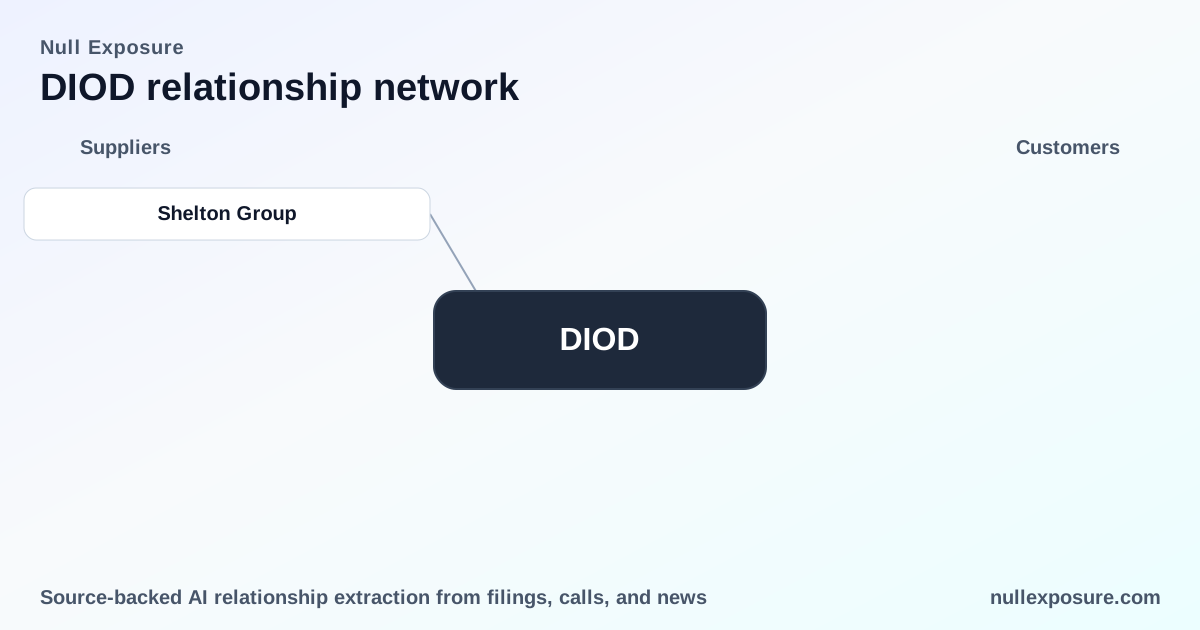
DIOD: Distributor Relationships and Customer Footprint — What Investors Need to Know
Diodes Incorporated is a standard‑products semiconductor company that designs, manufactures and sells discrete, logic, analog and mixed‑signal components primarily through a global distribution network and direct OEM/EMS customers. The business monetizes through point‑of‑sale product revenue, relying on a mix of short‑term, fixed‑price orders and distributor channels to convert inventory into cash rapidly. For an investor, the critical lens is how distributor partnerships and short contract tenors shape revenue volatility, margin consistency, and geographic exposure. For related research and signal feeds visit https://nullexposure.com/.
A compact financial frame that informs customer risk
Diodes is a mid‑cap semiconductor supplier with meaningful scale: $1.482 billion revenue (TTM) and a market capitalization around $5.0 billion. Margins are skinny by semiconductor growth standards — gross profit of $462 million and operating margin roughly 3.35% (TTM) — while the stock trades at a forward multiple (Forward PE ~12.5) that reflects assumed earnings improvement versus a trailing PE near 76. The company reports serving over 50,000 customers worldwide, which dilutes single‑customer concentration but increases reliance on distribution throughput and inventory turns to sustain growth.
These numbers matter for customer analysis because low operating margin and spot revenue recognition increase sensitivity to order cadence and distributor inventory cycles. Institutional ownership is high, which raises expectations for predictable execution and discipline around distributor channel management.
How Diodes organizes customer relationships in practice
Public disclosures and evidence summarize a consistent operating posture:
- Contracting posture: short‑term and fixed‑price — most arrangements are short term, commonly from days to several months, and the majority of revenue is recognized at a point in time. This creates an operating model driven by order flows rather than long, recurring contracts.
- Revenue realization: point‑in‑time (spot) sales — the business predominantly recognizes revenue when control of product transfers, reinforcing the transactional nature of customer relationships.
- Counterparty profile: large enterprises and EMS providers plus a broad distributor network — customers include major OEMs, electronic manufacturing services companies, and an extensive slate of distributors who resell products into multiple end markets.
- Geographic footprint: global distribution with material APAC, EMEA and North America exposure — sales are executed across Asia, the Americas and Europe, giving the company exposure to regional demand cycles.
- Business maturity: single reporting segment focused on standard semiconductor products — the firm operates as a single segment, which concentrates operating leverage and execution risk around core product lines.
These characteristics mean Diodes is fundamentally a volume‑led, distribution‑dependent semiconductor supplier, where execution of distribution partnerships and inventory management determine near‑term revenue and margin outcomes.
The public customer signals: who’s named and why it matters
Future Electronics — a recognized European distributor partner
Diodes awarded Future Electronics the “Best Distributor of the Year 2025 — Europe” in recognition of strong growth, analog performance and a collaborative regional partnership; the announcement was published in early May 2026. According to an OpenPR news release dated May 2, 2026, the award highlights Future Electronics’ contribution to Diodes’ distribution throughput in Europe for FY2026. This public recognition signals an active and high‑performing distributor relationship in a strategically important region.
What these relationships and constraints imply for investors
- Revenue sensitivity to distributor dynamics is high. The combination of point‑in‑time recognition and short contract tenors means revenue tracks order flow and inventory positioning at distributors rather than contractual recurring streams. Monitor distributor inventories and regional stocking behavior for leading indicators of Diodes’ sales momentum.
- Geographic diversification reduces single‑market risk but raises exposure to regional cycles. With meaningful operations in APAC, EMEA and the Americas, the company benefits from a broad addressable market, but it is also exposed to cyclicality across automotive, industrial and consumer electronics verticals.
- Channel concentration is structural, not accidental. The majority of customers are served through distributors; awards like the Future Electronics recognition validate high‑quality partnerships that can accelerate penetration in key markets. However, distribution dependence concentrates credit and logistics risk within a smaller set of channel partners.
- Counterparty profile is enterprise‑grade but transactional. Serving large OEMs and EMS providers supports product credibility and scale, while the short‑term, fixed‑price nature of contracts keeps relationships transactional rather than contractually locked‑in. This dynamic favors operational flexibility but limits long‑term revenue visibility.
- Single‑segment focus increases operational leverage. Operating as a single segment of standard semiconductor products concentrates outcomes: product cycles and supply chain execution directly drive consolidated financial performance.
Key investor takeaways: monitor distributor awards and regional sales trends as early signals, prioritize checks on distributor inventory levels and payment terms, and watch margins for signs of improved leverage as the product mix or pricing gains momentum.
Practical next steps for due diligence
- Track quarterly disclosures for any revenue by channel or region detail and watch for changes in distributor mix or concentration.
- Monitor industry press for distributor recognitions and logistics announcements; these public signals, like the Future Electronics award, presage regional sales performance.
- Review working capital trends — days sales outstanding, inventory days, and payable cycles — to infer how distributor stocking behavior and order cadence impact cash conversion.
- Revisit gross and operating margin trajectories relative to product mix changes and regional demand shifts to assess whether the company is converting distributor throughput into durable profitability.
For more structured signals and to integrate distributor event markers into investment workflows, visit https://nullexposure.com/.
Bottom line
Diodes is a distribution‑centric semiconductor supplier whose short‑tenor contracts and point‑in‑time revenue model make distributor execution the central operational lever. Public signals like the Future Electronics award confirm the company’s active engagement with high‑quality distributors in Europe, but investors must focus on distributor inventory cycles, regional demand, and working capital trends to anticipate revenue and margin inflection points. Keep distributor performance and regional sales momentum at the top of the monitoring checklist for DIOD.