Delek US (DK) — Customer Relationships and Counterparty Risk Brief
Delek US operates an integrated downstream energy platform that refines crude, manufactures transportation fuels and sells those products through wholesale, logistics and retail channels. The company monetizes through refining margins, wholesale product sales, logistics fees and downstream retail agreements; FY TTM revenue is roughly $10.7B with EBITDA near $717M, highlighting a capital‑intensive business with margin sensitivity to commodity prices. For investors evaluating counterparty risk, the critical signals are long‑term supply agreements with large retailers, ongoing affiliate purchases, and a wholesale book that spans major companies, independents and government customers. For a concise counterparty map and ongoing monitoring, visit https://nullexposure.com/.
Why these customer links matter for valuation and risk
Delek’s cash flows are driven by two disproportionate levers: refining margins and stable offtake relationships that convert production to cash. Long‑term supply contracts reduce downstream price exposure but introduce concentration and counterparty credit risk; wholesale sales and logistics fees diversify revenue but are cyclical. As a result, investors should value Delek not only on refinery throughput and crude spreads, but also on the credit quality and contract structure of counterparties who purchase fuel, lease terminal capacity, or buy biofuels and wholesale volumes.
Customer relationships documented in filings and press (each entry covered)
-
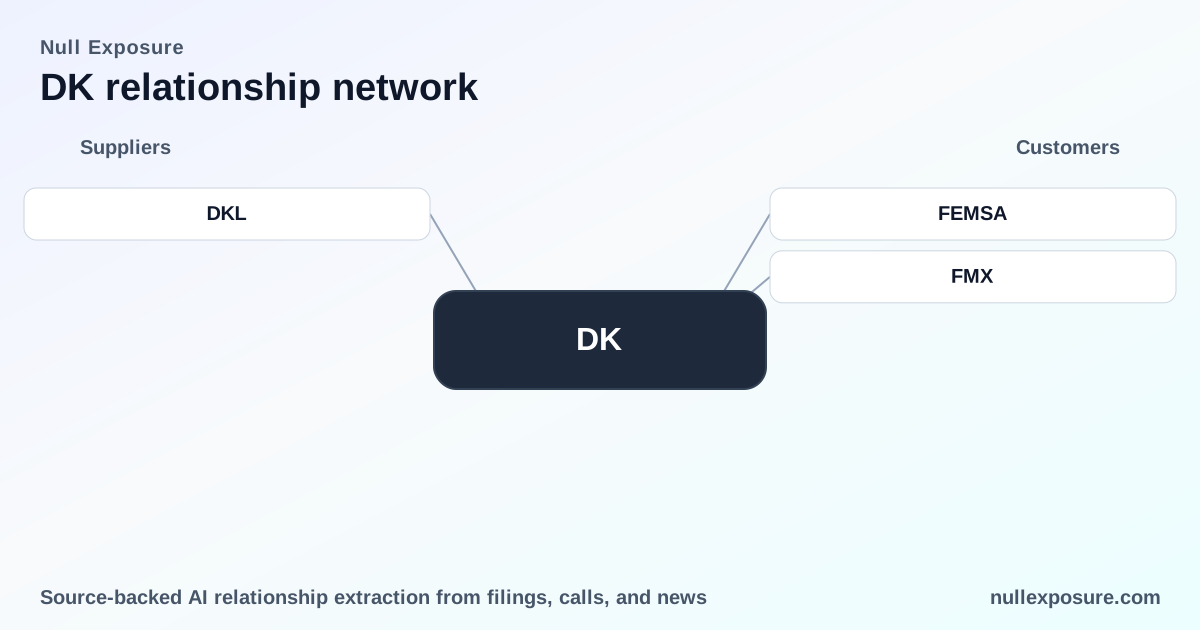
According to Delek US’s 2024 Form 10‑K, the company entered a long‑term retail supply agreement to sell motor fuel products to FEMSA for use at retail stores. This is a contractual sales relationship supporting retail supply continuity. (Delek US 2024 Form 10‑K)
-
A March 2026 filing from Delek Holdings (DKL) states that DKL purchases refined products and bulk biofuels from Delek Holdings, with those costs recorded in cost of materials and other‑affiliate—documenting an affiliate upstream/downstream supply relationship and intercompany flows. (DKL SEC filing, 2026 Q1)
-
CSP Daily reported in March 2026 that Fomento Económico Mexicano (FMX/FEMSA) celebrated the one‑year anniversary of acquiring 249 convenience stores originally owned by Delek US, a transaction that removed a portion of Delek’s retail footprint but preserved commercial linkages. (CSP Daily, March 2026)
-
CSP Daily also noted that FEMSA purchased 249 convenience stores from Delek US in October 2024, marking FEMSA’s entry into the U.S. retail market and indicating the timing and scale of the disposition. (CSP Daily, company news, March 2026)
-
SlashGear reported that after the ownership change the stores continued to source fuel from Delek, signaling that the sale included or was followed by ongoing supply arrangements rather than an abrupt commercial severing. (SlashGear, March 2026)
-
CSP Daily published a second item reiterating that FEMSA acquired 249 Delek stores and is rebranding them as part of its Oxxo rollout, corroborating the integration and rebranding activity tied to the transaction. (CSP Daily, March 2026)
-
SlashGear’s coverage of the FEMSA entry into U.S. retail again emphasized that FEMSA continued to purchase fuel from Delek after acquiring the stores, reinforcing the existence of post‑sale supply continuity. (SlashGear, March 2026)
-
InsiderMonkey noted that FEMSA paid approximately $385 million for the 249 Delek stores in late 2024 and began rebranding sites to Oxxo, placing a value on the divested retail package and implying transitional commercial arrangements. (InsiderMonkey, March 2026)
-
A Delek 10‑K passage describing customers lists the U.S. government among buyers of transportation fuels, along with major oil companies, independent refiners, jobbers and distributors, which indicates a broad buyer base including public sector contracts. (Delek US 2024 Form 10‑K)
Each of the above items is drawn from Delek filings or contemporary press coverage and collectively outlines a mix of long‑term retail supply contracts, affiliate purchases and a broad wholesale customer base.
What the relationship set implies about operating posture
-
Contracting posture — defensive and structural. Long‑term retail supply agreements (explicit with FEMSA) function as structural revenue anchors that smooth refinery sales despite cyclical margins. The recorded affiliate purchases in the DKL filing show integrated internal flows that stabilize volumes but can obscure consolidated margin transmission.
-
Concentration and counterparty diversity. The customer list includes major oil companies, independent refiners, jobbers, distributors, utilities and the U.S. government. That breadth reduces single‑counterparty concentration risk, yet the loss of 249 retail locations reduces direct retail exposure while preserving supply ties, shifting mix toward wholesale and logistics revenue.
-
Criticality of relationships. Fuel supply contracts with large retail acquirers such as FEMSA and ongoing affiliate flows are operationally critical: disruptions would quickly affect refinery throughput, terminal utilization and cash conversion.
-
Maturity and stability. The existence of long‑term agreements and continued purchases post‑divestiture indicate mature commercial arrangements rather than ad‑hoc spot sales, which supports predictable midcycle cash flows.
These elements combine into a company‑level profile: integrated downstream operations supported by long‑term commercial contracts and affiliate flows, with moderate counterparty diversification but concentrated operational risk in refinery throughput and logistics assets.
Investor implications and risks to monitor
-
Credit risk of large retail buyers — long‑term supply contracts are positive for volumes but expose Delek to the counterparty’s credit and commercial strategy; the FEMSA transaction demonstrates both disposition of assets and a retained commercial relationship. Monitor FEMSA’s rebranding and working capital terms.
-
Affiliate flow opacity — intercompany purchases recorded in affiliate cost lines (as noted in the DKL filing) complicate margin analysis; investors should track transfer pricing disclosures and related‑party settlement terms.
-
Refining margin sensitivity — despite stable buyers, Delek’s earnings remain tied to crude differentials and crack spreads; logistics fees partially hedge that exposure but do not eliminate cycle risk.
-
Regulatory and government demand — sales to the U.S. government and compliance with EPA fuel standards are recurring operational demands; compliance costs and contract renewals are material factors for downside scenarios.
Bottom line and action items
Delek’s commercial footprint is characterized by a mix of long‑term retail supply contracts, affiliate purchases and a broad wholesale base, which together support volume stability while leaving earnings exposed to commodity cycles and counterparty credit dynamics. For analysts modeling Delek, build sensitivity to retail counterparty credit and transfer pricing between affiliates, and track any changes to the post‑sale supply arrangements with FEMSA.
For a deeper counterparty map and continuous monitoring tools, explore our profile hub at https://nullexposure.com/.
Bold takeaway: Delek converts refining throughput to cash through contractual retail and affiliate relationships that stabilize volumes but transfer credit and operational concentration risks to the balance sheet.