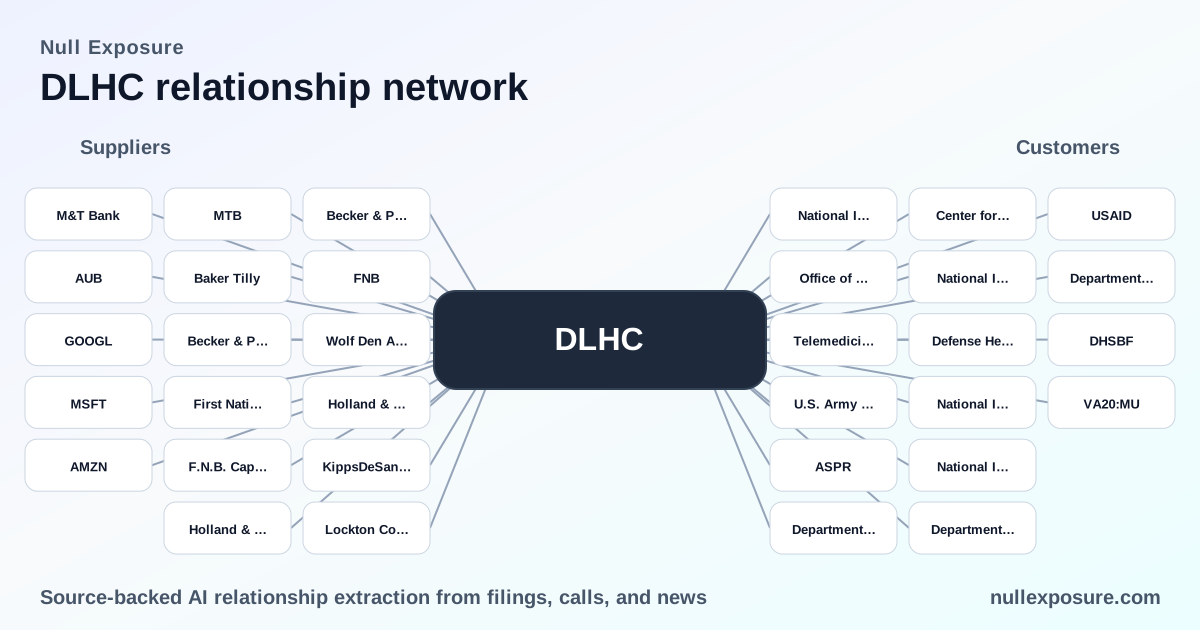
DLH Holdings (DLHC): Federal Revenue Engine — customer map, contract posture and operational constraints
DLH Holdings monetizes by selling technology-enabled services and medical logistics primarily to U.S. federal agencies, operating largely as a prime government contractor across IT modernization, cybersecurity, R&D support and pharmacy logistics; revenue is generated through a mix of task orders, IDIQs and multi-year service agreements. For investors evaluating exposure and sustainability, the question is not whether DLH works for government, but how concentrated, long-dated and contractually framed those government relationships are. For a deeper organizational view, visit https://nullexposure.com/.
Executive takeaway: what matters to investors and operators
DLH is a government-centric services firm: roughly all revenue is from U.S. federal agencies, and management runs the business to win and perform on prime contracts and task orders. That leads to four investment-relevant characteristics:
- Concentration and materiality: management states that a small set of major federal customers account for a significant portion of revenue, so loss or scale‑down at any one customer would be a material financial event.
- Framework and long-term posture: DLH holds framework-style vehicles (IDIQs and task-order programs) that create recurring ordering opportunities rather than single fixed-scope projects.
- Contract criticality and operational lock‑in: CMOP pharmacy and logistics work historically represent nine-figure revenue bands, indicating both scale and operational complexity that are difficult for competitors to replicate quickly.
- Maturity and recognized amortization: customer contracts and related relationships are amortized over multi-year horizons (weighted-average remaining period ~6.5 years), which signals contractual life and revenue visibility above spot task-order work.
These characteristics create a business that is stable when contract wins and extensions proceed on plan, and discrete downside when major awards are lost or wind down.
Detailed relationship log — every customer mention in the public results
Below are the discrete customer references found in public reporting and news items; each entry is a plain-English summary with the reporting source and the fiscal period cited.
National Institutes of Health (NIH)
DLH won a task order valued at up to $46.9 million to deliver enterprise IT, cybersecurity, cloud and software services to the NIH’s IT organization. Reported in HitConsultant covering the FY2025 award (HitConsultant, Aug 2025).
Office of Information Technology (OIT)
The NIH’s Office of Information Technology is the specific NIH organizational buyer for the $46.9M task order where DLH will provide ongoing IT services and support. This was noted in the same HitConsultant coverage of the FY2025 award (HitConsultant, Aug 2025).
National Institutes of Health (earnings transcript reference)
DLH’s management referenced NIH wins during an investor-facing earnings transcript as part of its FY2025–FY2026 commentary on capabilities and awards. This appears in an Investing.com transcript of DLH’s earnings call (Investing.com, Q4 FY2025 transcript).
Telemedicine and Advanced Technology Research Center (TATRC)
DLH secured a potential five-year, $37.7 million task order under a government omnibus vehicle to provide R&D and advanced technology services to TATRC. ExecutiveBiz reported the award and scope in FY2025 coverage (ExecutiveBiz, Mar 2026 report referencing the FY2025 award).
U.S. Army Medical Research and Development Command (MRDC)
DLH will support MRDC efforts through work with TATRC, delivering software engineering, AI modeling, bioengineering and cybersecurity as part of the five‑year task order. ExecutiveBiz covered the MRDC/TATRC framing in the same announcement (ExecutiveBiz, Mar 2026).
ASPR (Administration for Strategic Preparedness and Response)
DLH management listed ASPR among federal customers when discussing the company’s federal footprint on its FY2026 investor call, indicating ASPR is a referenced buyer within the health and emergency response portfolio (InsiderMonkey transcript, FY2026).
Center for Disease Control (CDC)
The CDC was cited by management as part of the roster of health‑sector federal clients DLH serves, reflecting the company’s public-health IT and science services positioning (InsiderMonkey earnings call transcript, FY2026).
USAID
Management noted a small international USAID engagement that closed in January 2025 and contributed to top-line roll-offs; USAID is therefore a past, smaller customer in DLH’s government mix (InsiderMonkey transcript and The Globe and Mail earnings coverage, FY2026 commentary).
Defense Health Agency (DHA)
DLH reported doing work with the Defense Health Agency as part of its federal defense-health services, referenced on the FY2026 earnings call as part of the government customer base (InsiderMonkey transcript, FY2026).
Department of War (as quoted)
Management used the term “Department of War” when describing customer trends toward commercial vehicles; the reference signals DLH’s commentary about defense-sector procurement evolution rather than a discrete contract (InsiderMonkey transcript, FY2026).
Department of Veterans Affairs (VA) — general reference
DLH has ongoing logistics and pharmaceutical distribution work with the VA, including extensions of IDIQ contracts to continue medical logistics services at regional distribution centers. That relationship was discussed in DLH’s FY2025/FY2026 disclosures and investor materials (Investing.com transcript and TipRanks, FY2025–FY2026 references).
Veteran Affairs (press headline)
Press reports highlighted a $90 million contract award headline for services with the VA, underscoring VA’s outsized role in DLH’s historical revenue base (TipRanks news brief, FY2025 reporting).
Department of Veterans Affairs Consolidated Mail Outpatient Pharmacy (CMOP)
DLH’s CMOP pharmacy and logistics services historically generated ~$116M of revenue in FY2025 (and ~$140M in FY2024), indicating a high‑value, operationally intensive relationship with the VA’s CMOP program (company financial disclosures cited in WashingtonExec and GovConWire FY2021 and FY2025 reporting).
Department of Veterans Affairs (plant closure notice)
Local reporting noted DLH Solutions closed a Dallas‑area plant after losing a contract with the Department of Veterans Affairs, illustrating operational sensitivity to contract transitions at a site level (WFAA local news report, March 2026).
National Institutes of Health’s Office of Information Technology (variant)
Multiple outlets repeated the NIH/OIT task order framing when reporting DLH’s $46.9M award, confirming the NIH OIT as a named organizational buyer (WashingtonExec and QuiverQuant reporting of the FY2025 award).
National Institute of Health (spelling variant)
Management references to the National Institute of Health are interchangeable with NIH mentions in earnings call materials and press summaries; these citations appear in investor call transcripts and press reports referencing the same NIH OIT award (InsiderMonkey and The Globe and Mail, FY2026).
DHS (Department of Homeland Security)
DHS was mentioned by management alongside ASPR and other federal clients during the FY2026 investor call, indicating DHS is within the company’s federal account mix (InsiderMonkey transcript, FY2026).
VA (ticker/inferred-symbol variants)
Investor transcripts and earnings summaries reference “VA” multiple times in describing extension activity and transition support, emphasizing ongoing IDIQ performance and transition assistance at VA mail-order centers (Investing.com and InsiderMonkey transcripts, FY2025–FY2026).
VA20:MU (reported inferred symbol variant)
Certain news aggregators produced ancillary notations for VA references using market tickers; these are alternative indexing labels used by reporting services but reflect the same VA contract context discussed above (InsiderMonkey transcript and related press indexing, FY2026).
GovConWire VA follow‑on award (historical)
A GovConWire item documented a follow‑on contract award to DLH potentially worth $202 million over five years to support VA medical logistics, showing that VA work has been both large scale and multi‑year historically (GovConWire, FY2021 coverage).
Operating constraints and what they signal about DLH’s model
The public record and company disclosures together present company-level constraints that shape investment risk and upside:
- Contractual framework bias: DLH holds IDIQ/framework vehicles (company disclosure of an IDIQ effective Oct 28, 2025 with a $90M ceiling), showing a preference and capability for winning indefinite-delivery vehicles that drive recurring task orders.
- Government-only geography: The revenue base is concentrated in the U.S. federal government, which limits commercial diversification but provides predictable procurement pathways and backlog potential.
- Materiality and concentration risk: Management explicitly acknowledges dependence on a few major federal customers; loss or scale-down at any of them would materially affect cash flow and results.
- Maturity of revenue: Customer contracts and related relationships are amortized over multi-year horizons (weighted-average remaining amortization ~6.5 years), implying built‑in revenue recognition stability when awards remain active.
- Service-provider posture and scale economics: DLH operates primarily as a prime service provider delivering labor- and operations-intensive programs (e.g., CMOP logistics), which creates high switching costs for customers but also operational leverage and execution risk.
For a concise institutional briefing and ongoing monitoring of these customer dynamics, visit https://nullexposure.com/.
Bottom line
DLH’s value proposition is execution on federal prime contracts, concentrated in health and logistics plus IT modernization and defense research support. That model delivers visible revenue when contract awards continue, but creates meaningful downside if large IDIQ/task‑order relationships roll off or transfer to alternate vendors. Investors should watch award cadence, VA and NIH task order renewals, and signs of contract consolidation or unbundling in defense and health procurement as the principal drivers of near-term performance.