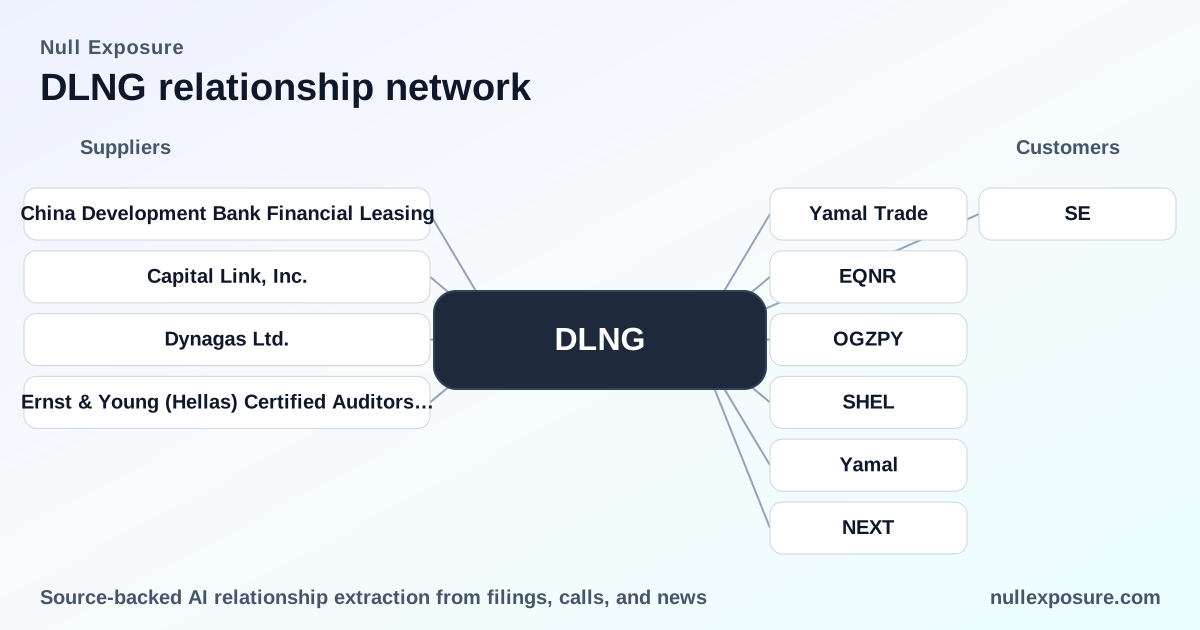
Dynagas LNG Partners (DLNG): customer roster, contract profile, and what investors should know
Dynagas LNG Partners operates a small, modern fleet of ice-class and conventional LNG carriers and monetizes through time and forward charters with large gas offtakers and project sponsors. The business model generates predictable cash flow from multi-year charters, and DLNG’s revenue and distribution capacity are driven by charter tenor, charter counterparties’ credit quality, and fleet deployment into higher-priced niche trades such as Arctic and project-based runs.
For a quick company overview and data-driven signals, visit https://nullexposure.com/.
How the company actually contracts and collects revenue
DLNG uses a classic shipping master-lease model: the partnership owns vessels and signs time/forward charters that deliver fixed daily hire over contract terms. Public disclosures and press reporting repeatedly reference multi-year charters and forward-charter activity, which creates fixed-rate cash flows and lowers spot exposure compared with pure tramp shipping. The fleet’s average age of about 6.6 years and referenced long average remaining charter term (the firm noted ~10.6 years as a historical metric) signal a relatively mature, contract-heavy revenue base rather than a high-turnover spot play (company excerpts aggregated across filings and public releases).
Operational characteristics that matter to investors:
- Contracting posture: predominantly multi-year time charters and forward charters that transfer voyage economics to counterparties and create stable dispatch schedules.
- Concentration and counterparty mix: DLNG’s counterparties are major energy companies and project sponsors, concentrating credit exposure on a limited set of large gas buyers.
- Criticality: vessels are often deployed on project or ice-class trades that are critical to customer supply chains, increasing the stickiness of relationships.
- Maturity: fleet age around mid-single digits (years) supports lower maintenance downtime and market competitiveness.
Customer relationships — what every named counterparty tells us
Below I cover every relationship extracted from DLNG’s public mentions and news sources. Each entry is a concise, plain-English takeaway with a source reference.
Equinor / EQNR
DLNG has executed time charter agreements for ice-class LNG carriers with Equinor, including employment of the Arctic Aurora, demonstrating strategic access to Arctic and Northern Hemisphere trade lanes. A VesselFinder notice and MarineLog coverage reported a time charter party with Equinor (reported FY2021 and FY2022 respectively).
Source: VesselFinder news (FY2021) and MarineLog coverage (FY2022) describing the Arctic Aurora charter.
Yamal Trade
Yamal Trade is named among DLNG’s charter customers on earnings calls, indicating participation in liquefaction-to-transport chains tied to Russian Arctic production. DLNG listed Yamal Trade alongside other major gas companies in its Q2 2024 earnings call remarks.
Source: DLNG Q2 2024 earnings call (company remarks).
Yamal (project/region)
DLNG’s fleet disclosures reference charters relating to the Yenisei River and the Lena River with Yamal, positioning the partnership as a contracted carrier into project-oriented northern routing. MarketScreener reporting referenced the company’s fleet being contracted with Yamal in a wider list of long-term charters.
Source: MarketScreener company announcement (reported FY2026 summary referencing historical charter portfolio).
Rio Grande LLC (NextDecade subsidiary)
DLNG’s management disclosed forward-charter arrangements with Rio Grande LLC, a NextDecade subsidiary, for vessels including Clean Energy and Arctic Aurora, signaling tie-ups with U.S. Gulf export project sponsors. The Q2 2024 earnings call named Rio Grande LLC as a forward-charter counterparty.
Source: DLNG Q2 2024 earnings call (company statement).
NEXT (NextDecade)
NextDecade (ticker references as NEXT) appears in DLNG’s earnings narrative through its project subsidiary arrangements; these forward charters reflect participation in new-build export volumes and project ramp-up schedules. Management specifically cited NextDecade in the context of forward-chartered vessels.
Source: DLNG Q2 2024 earnings call (company statement).
Rio Grande LNG (project-level mention)
Public reporting separately notes a vessel charter agreement between DLNG and Rio Grande LNG, confirming engagement not only with the project sponsor entity but also at the project-offtake level. Industry news outlets reported the charter agreement in FY2026 coverage.
Source: Bitget / industry news article (reported FY2026).
SEFE / SEFER.PAR / SE
DLNG referenced SEFE among its portfolio of charter customers in earnings remarks; additionally, market reporting compared rental rates across agreements and noted the daily rate under a new deal exceeded previously executed terms with SEFE. This indicates that DLNG can re-price assets when moving between counterparties and trade types.
Source: DLNG Q2 2024 earnings call (company remarks) and industry news coverage (Bitget report, FY2026).
Shell / SHEL
Shell is listed within DLNG’s historic charter roster reported by the company, establishing DLNG’s exposure to integrated energy majors and long-duration commercial commitments. MarketScreener referenced Shell as one of the multi-year counterparties in fleet disclosures.
Source: MarketScreener company announcement (reported FY2026).
Gazprom / OGZPY
Gazprom is named in DLNG’s public fleet-charter summary as a long-term counterparty, reflecting historical deep integration with Russian gas supply chains. MarketScreener’s announcement listed Gazprom among DLNG’s multi-year charter counterparties.
Source: MarketScreener company announcement (reported FY2026).
Statoil
Statoil (referenced in filings alongside other majors) appears in DLNG’s charters list, indicating relationships with legacy North Sea and Arctic-focused suppliers. MarketScreener included Statoil in its roster of contracted counterparties.
Source: MarketScreener company announcement (reported FY2026).
Key takeaways for investors
- High contract coverage with blue‑chip counterparties creates a revenue profile built on secured daily hire rather than spot volatility; DLNG’s charter roster reads like a project- and major-customer-focused shipping operator.
- Concentration risk is real but mitigated by counterparty scale. The partnership depends on a relatively small number of large energy firms and project sponsors; these counterparties reduce commercial risk but raise concentration exposure.
- Contract tenor and fleet age strengthen predictability. Public excerpts highlight multi-year employment and a mid‑age fleet that supports sustained utilization and lower capex-driven downtime.
- Transactional upside through re-pricing: industry reporting shows that new hires in FY2026 commanded higher daily rates than previous agreements, indicating DLNG captures pricing advantages when demand or trade specificity allows.
For an executive summary of DLNG’s commercial profile and to monitor relationship evolution, visit https://nullexposure.com/.
This review synthesizes DLNG’s stated customers and public trades; investors should weigh charter tenure, counterparty credit, and fleet deployment when modeling cash flow and valuation.