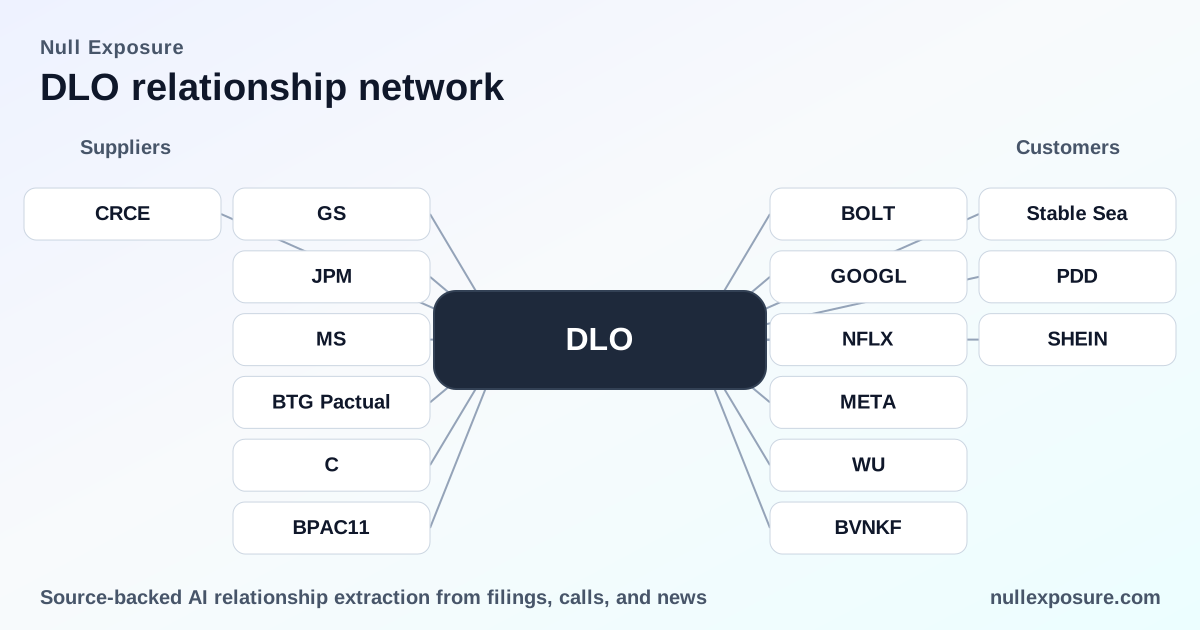
DLocal Ltd (DLO): Customer Map and Commercial Signals for Investors
DLocal operates a cross-border payments platform that monetizes through transaction fees, FX spreads and integration services for global merchants and fintechs seeking access to emerging markets; the business generated roughly $1.09B in trailing revenue with an 18% profit margin and a material merchant roster that drives both volume and pricing leverage. For investors evaluating DLO’s customer relationships, the critical questions are client concentration, degree of strategic partnership versus tactical integration, and how payment rails and regulatory frictions across markets translate into revenue durability or episodic volatility. For a quick company overview, visit https://nullexposure.com/.
Quick takeaways for investors
- Enterprise-grade clients dominate the headline roster, signaling large-ticket volume and sticky integrations but also concentration risk.
- DLocal operates both pay‑in (merchant acquisition) and pay‑out (local settlement) rails, including stablecoin off‑ramp partnerships that broaden product scope beyond card rails.
- Regulatory and tax events are operationally relevant — merchant flows have previously been affected by cross-border tax treatments in specific countries.
- Strategic alliances with legacy money-movers and cloud/tech giants increase reach but introduce multi-party execution risk.
If you want a consolidated view of DLocal’s commercial footprint, see the company portal at https://nullexposure.com/.
Customer relationships, one by one
Bolt — ride-hailing checkout expansion across emerging markets
DLocal expanded checkout options for Bolt across Africa, Asia and Latin America, positioning DLocal as Bolt’s local payments partner for multiple regions and channels. This was mentioned explicitly on DLocal’s 2025 Q3 earnings call (transcript dated March 7, 2026).
Google (AP2 agent payments) — protocol partnership
DLocal is partnering with Google on an agent payments protocol called AP2, indicating collaboration on off‑platform agent disbursements and local payout flows. Management referenced this partnership on the 2025 Q3 earnings call (March 7, 2026).
Netflix — tax and cross‑border cash flow sensitivity
Management discussed intra‑quarter news that affected Netflix flows and tax treatment for funds expected outside of Brazil, signalling that large digital content merchants’ flows can be materially affected by country‑level tax and remittance rules. This was disclosed in the 2025 Q3 earnings call (March 7, 2026) and corroborated by FXCIntel reporting on DLocal merchant tiers (March 9, 2026).
Spotify — listed as a marquee global client
Third‑party commentary on TradingView and other market writeups identified Spotify as part of DLocal’s roster of large global players relying on its payment solutions to reach emerging market consumers. See TradingView idea coverage (May 2, 2026) and related market notes.
Amazon — enterprise merchant access to emerging consumers
Market commentary lists Amazon among global merchants using DLocal to access emerging market payments rails, reinforcing DLocal’s role as a gateway for major e‑commerce platforms. This observation appears in TradingView market ideas (May 2, 2026).
Microsoft — cloud and digital sales flows into local markets
Microsoft is cited alongside other large tech clients that leverage DLocal to process payments and reach consumers in underbanked markets, as reported in TradingView commentary (May 2, 2026).
Western Union — strategic alliance for digital pay‑in and local rails
DLocal announced work supporting Western Union’s pay‑ins and a strategic alliance to bring local and alternative payment methods (bank transfers, cards, e‑wallets) into Western Union’s online platforms in Latin America. Management referenced this collaboration on the 2025 Q3 earnings call (March 7, 2026), and further detail was reported in StockTitan and company commentary (March 9, 2026).
BVNK — stablecoin off‑ramp and fiat conversion
DLocal provides the off‑ramp for stablecoin players such as BVNK, converting received stablecoins into local fiat for end customers in markets like South Africa, which extends DLocal’s product set into crypto‑on/off‑ramp services. This capability is described in FXCIntel reporting on DLocal’s Q2 2025 comments (March 9, 2026).
Stable Sea — B2B cross‑border stablecoin rails partnership
DLocal announced a strategic partnership with Stable Sea to enable low‑cost, high‑speed B2B cross‑border payments using stablecoin rails combined with DLocal’s local payout infrastructure across 40+ countries, expanding its institutional rails for business payments. This partnership was reported on StockTitan (March 9, 2026).
SHEIN — Tier‑0 merchant classification
DLocal management has classified SHEIN as a Tier‑0 merchant — one of the very large, well‑known global digital brands that generate significant volumes through DLocal’s rails — as noted in FXCIntel coverage of executive commentary (March 9, 2026).
Temu / PDD — large marketplace merchant engagement
Temu (owner PDD) is likewise listed among Tier‑0 merchants, demonstrating DLocal’s penetration into large cross‑border marketplace flows and the reliance of high‑volume merchants on its regional routing and settlement capabilities. This was covered in FXCIntel reporting summarizing management statements (March 9, 2026).
Meta — headline digital advertising and platform payments client
Meta is named in management commentary as part of the Tier‑0 merchant set, reinforcing that DLocal services extend to digital platform revenue channels where precise settlement and tax handling are important. See FXCIntel coverage of executive remarks (March 9, 2026).
What these relationships imply about DLocal’s operating model
- Contracting posture: DLocal operates as a strategic integrator for Tier‑0 merchants and a technical enabler for fintechs, signing alliance agreements (e.g., Western Union, Stable Sea) that go beyond standard merchant onboarding and require co‑developed product features.
- Concentration and commercial leverage: The prominence of large global clients delivers meaningful volume per relationship, producing scale economics, while concentration risk is elevated because a handful of Tier‑0 merchants drive a disproportionate share of processed volume.
- Criticality to customers: For merchants seeking access to underbanked and regulatory‑fragmented markets, DLocal is mission‑critical — it provides both pay‑in and local pay‑out rails, including fiat conversion services for stablecoins, which increases stickiness.
- Maturity and diversification: The client list spans legacy financial services (Western Union), cloud/tech giants (Google, Microsoft, Amazon), streaming/media (Netflix, Spotify), and marketplaces (SHEIN, Temu), demonstrating broad product fit across industries while the company continues to expand into stablecoin and agent‑payment protocols.
- Operational and regulatory sensitivity: Merchant flows have been affected by country tax treatment (example: Netflix and Brazil), underscoring operational exposure to local regulatory shifts that can compress revenue or re‑route volumes.
Key risks and what to watch next
- Concentration event risk: Continued reliance on a small number of Tier‑0 merchants creates outsized revenue sensitivity to churn or contractual repricing.
- Regulatory and tax volatility: Country‑specific tax rulings and remittance rules can produce quarter‑level revenue swings; monitor merchant commentary and local regulatory updates.
- Execution on newer rails: Stablecoin partnerships and protocol work (AP2, Stable Sea, BVNK) expand addressable market but require operational discipline to scale without margin erosion.
For investors who want continuous updates on DLocal’s commercial relationships and how they map to revenue exposure, explore more corporate signals and investor intelligence at https://nullexposure.com/.
Bold conclusion: DLocal’s customer base is both its primary value driver and its principal operational risk — large global merchants and strategic financial partners create high‑margin payment volume, but concentration and cross‑border regulatory complexity will determine whether that value is durable or episodic.