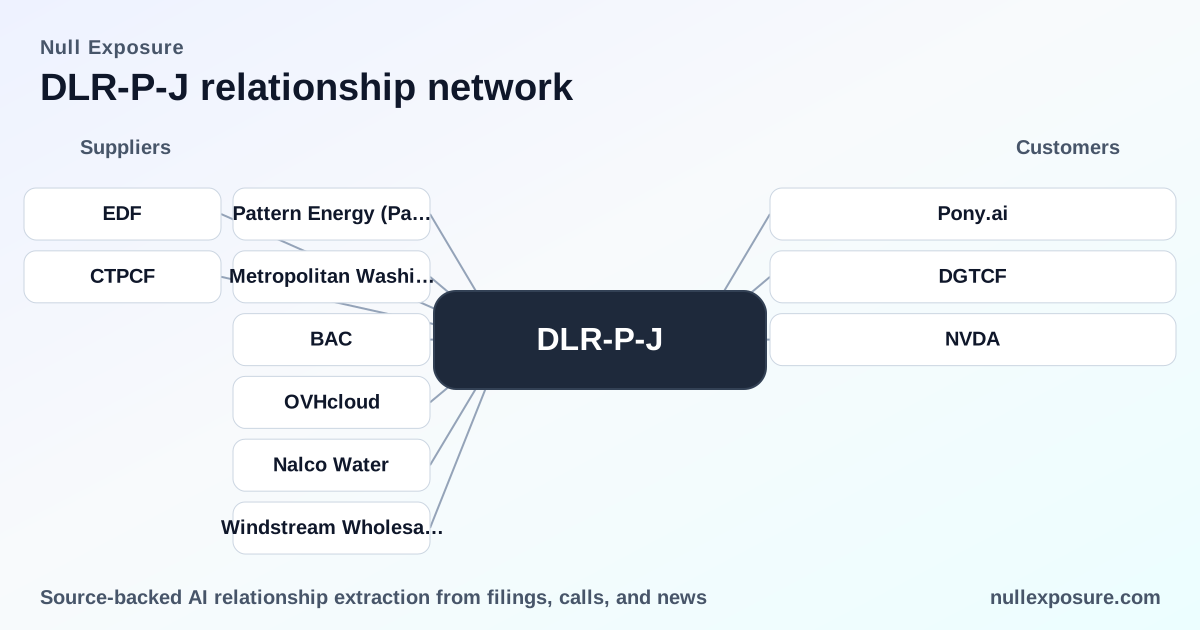
Digital Realty (DLR-P-J) — Customer Map and Strategic Implications
Digital Realty is a global real estate investment trust that owns and operates carrier‑neutral data centers and monetizes through long‑term colocation leases, power and connectivity contracts, and selective asset monetization to capital partners. Its business model delivers recurring cash flow from large enterprise and hyperscale tenants while enabling portfolio recycling—selling or joint‑venturing assets with sponsors—to fund growth and de‑risk development exposure. For investors evaluating DLR‑P‑J preferred stock, the commercial relationships described below illuminate customer concentration, criticality of facilities to hyperscalers and telecoms, and the company's dual role as landlord and sponsor counterparty. For an at‑a‑glance industry intelligence view, visit the Null Exposure homepage: https://nullexposure.com/.
Why customers define valuation more than brick-and-mortar
Digital Realty’s value derives from leased capacity and power contracts that are often large, contractual, and sticky. Hyperscalers, cloud providers and telecom carriers command high utilization, long contract tenures, and significant build‑outs, so the health of those relationships materially affects occupancy, pricing power and capex cadence. Asset recycling through sponsor vehicles further demonstrates a sophisticated capital posture—balancing leverage, liquidity and development risk.
Below I catalog every customer relationship surfaced in the available reporting and explain the investment implications for DLR’s operating model.
Hyperscalers and technology giants — backbone customers
Oracle
Digital Realty lists Oracle among its large customers, illustrating ongoing demand from enterprise software and cloud providers for colocation and connectivity services. According to CFO Dive coverage from FY2023, Digital Realty serves big name customers including Oracle, underscoring its placement among primary data center landlords for technology firms. (CFO Dive, May 2026)
Facebook (Meta)
Facebook (Meta) is named as a major tenant, indicating exposure to hyperscaler leasing profiles that deliver scale but can concentrate revenue. CFO Dive’s company profile referenced Digital Realty serving Facebook in FY2023, reinforcing the firm’s hyperscaler customer mix. (CFO Dive, May 2026)
IBM
IBM appears in the customer roster, showing that Digital Realty serves both cloud-native and legacy enterprise technology providers that require colocation and interconnection. CFO Dive listed IBM among Digital Realty’s clients in FY2023. (CFO Dive, May 2026)
JPMorgan
JPMorgan is cited as a customer, representing financial services demand for secure, resilient data center space and connectivity. CFO Dive named JPMorgan among Digital Realty’s major tenants in FY2023. (CFO Dive, May 2026)
- Takeaway: The presence of hyperscalers and large enterprises signals high criticality for Digital Realty’s sites and supports stable, long‑dated revenue, but also creates customer concentration risk when a handful of tenants drive meaningful portions of revenue.
Strategic alliances, asset sales and sponsor relationships
Digital Core REIT / DGTCF
Digital Core REIT (listed as DGTCF in reporting) is a sponsored vehicle that will acquire majority stakes in two data centers from Digital Realty, highlighting the company’s active use of sponsor sales and joint ventures to recycle capital. DatacenterDyanmics reported the transaction as part of Digital Core REIT acquiring assets from its founder and sponsor in FY2022. (DatacenterDyanmics, March 2026)
DGTCF (duplicate listing)
A second listing for DGTCF references the same acquisition plan; this duplicate reinforces that asset‑level monetization to sponsor vehicles is a recurring operational lever for Digital Realty. (DatacenterDyanmics, March 2026)
- Takeaway: Asset sales to sponsors are a deliberate capital‑management strategy—maturing the portfolio and lowering development exposure—and are a company‑level operational signal rather than a single‑tenant phenomenon.
Emerging markets and telecom carriers — growth channels
Jio
Digital Realty has expressed interest in Indian mobile carriers as customers during its India expansion discussions; Jio is named among the top Indian mobile operators Digital Realty views as target customers as 5G rollout increases colocation demand. DatacenterKnowledge covered Digital Realty and Brookfield’s India initiatives and cited Jio as a principal carrier of interest in FY2021. (DatacenterKnowledge, May 2026)
Bharti Airtel
Bharti Airtel is identified as a target for colocation demand as carriers offload core network functions to third‑party data centers amid 5G build‑outs. DatacenterKnowledge referenced Airtel in the India buildout context (FY2021). (DatacenterKnowledge, May 2026)
Vodafone Idea
Vodafone Idea is also mentioned as an Indian carrier potentially looking to offload data centers to pay down debt, making it an addressable customer for Digital Realty’s India strategy. DatacenterKnowledge included Vodafone Idea in its FY2021 coverage of the company’s market targeting. (DatacenterKnowledge, May 2026)
- Takeaway: Expansion into India and targeting major mobile carriers signals growth diversification into telco‑centric colocation, which can broaden revenue mix but requires local execution and commercial contracting tailored to carrier needs.
AI infrastructure and strategic vendor collaborations
NVIDIA / NVDA
Digital Realty public communications highlight collaboration with NVIDIA to support AI infrastructure initiatives, including NVIDIA’s AI Factory Research Center and DSX Blueprint, demonstrating the REIT’s positioning for high‑density GPU deployments. A FY2025 PR Newswire release described Digital Realty advancing AI infrastructure innovation in support of NVIDIA initiatives. (PR Newswire, March 2026)
NVDA (duplicate listing)
The dataset contains a duplicate entry for NVDA, reinforcing the strategic emphasis on AI‑optimized facilities and vendor collaboration as a recurring theme in company communications. (PR Newswire, March 2026)
- Takeaway: Partnerships with GPU vendors like NVIDIA indicate product evolution toward high‑power, high‑density deployments that command premium pricing but increase infrastructure complexity and capital intensity.
Litigation and tenant disputes
Pony.ai
A tenant dispute with autonomous vehicle developer Pony.ai surfaced when Pony.ai sued Digital Realty seeking refunds of payments it alleges were made under duress related to a late‑2019 service order for space, power, and equipment at a Santa Clara site. DatacenterDyanmics covered the litigation in FY2022, signaling that large bespoke orders—especially for edge and specialized facilities—can produce contractual disputes. (DatacenterDyanmics, March 2026)
- Takeaway: Litigation underscores contract enforcement and counterparty risk—important considerations for lease underwriting and legal provisions in large, bespoke tenant orders.
Company‑level operating model signals and investor implications
- Contracting posture: Digital Realty operates predominantly under long‑term leases and service orders with large tenants while retaining the flexibility to monetize assets through sponsor sales and joint ventures.
- Concentration: Revenue is materially affected by a relatively small set of hyperscalers, cloud providers and carriers; this concentration drives revenue stability but elevates single‑tenant exposure.
- Criticality: Tenants such as hyperscalers, major software firms, financial institutions and telcos make Digital Realty’s facilities operationally critical, supporting premium pricing and occupancy durability.
- Maturity and capital posture: Use of sponsored vehicles to sell majority stakes (e.g., Digital Core REIT/DGTCF) is indicative of a mature capital strategy focused on recycling capital and managing development risk.
Risks, readthroughs and what to watch next
- Monitor occupancy and tenancy mix—loss or expansion decisions by hyperscalers materially move cash flows.
- Track asset sales to sponsor vehicles as a source of non‑organic liquidity and a signal of development cycle management.
- Watch AI deployments and vendor partnerships (e.g., NVIDIA) for changes in capex intensity and pricing power tied to high‑density hosting.
For a consolidated view of counterparty exposure and to explore the primary sources used in this analysis, visit Null Exposure: https://nullexposure.com/.