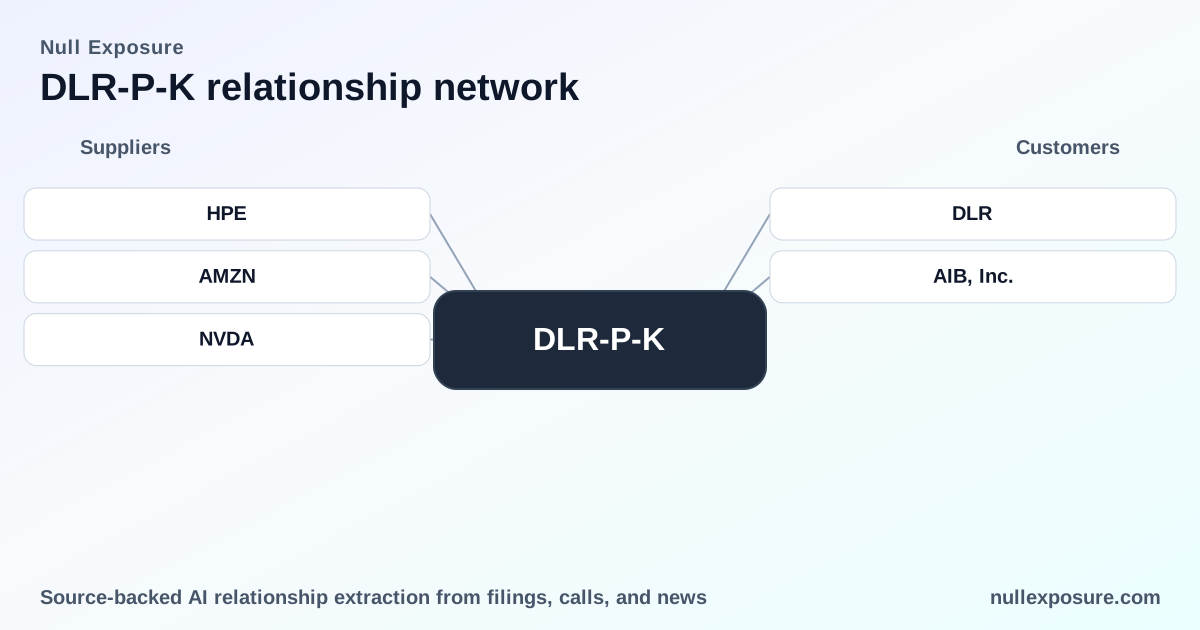
Digital Realty (DLR-P-K) — Customer Relationships and What They Mean for Investors
Digital Realty operates and monetizes a global portfolio of carrier‑neutral data centers through long‑term leases, interconnection services, and platform-level connectivity products under PlatformDIGITAL®. For holders of the 5850 Series K cumulative preferred, the relevant commercial signals are how Digital Realty converts its real estate footprint into predictable cash flows via institutional leases, wholesale transactions and platform services that attract enterprise and wholesale customers. For deeper company intelligence, visit the Null Exposure research hub: https://nullexposure.com/
Why customers matter for preferred holders: steady rents, platform fees, and balance‑sheet optionality
Digital Realty’s business model is built on three revenue levers: long‑dated real estate leases that underpin base rent, higher‑margin interconnection and network services that drive incremental revenue, and asset transactions that unlock capital and adjust portfolio risk. These dynamics influence the stability of distributions to preferred holders because asset sales and large wholesale lease deals affect both near‑term cash generation and long‑term portfolio composition.
If you want an overview of related customers and transactions, see the Null Exposure coverage at https://nullexposure.com/ — the platform aggregates customer signals and public reporting to help underwrite counterparty and concentration risk.
Transactions and customers called out in the public record
Mapletree — a large portfolio buyer of data center assets
Mapletree purchased a portfolio of data centers, including a package of 10 Digital Realty facilities for $1.4 billion, reflecting a trend of institutional capital acquiring stabilized data center assets from operators like Digital Realty. According to DatacenterDyanmics reporting (March 9, 2026), Mapletree’s acquisition activity included that $1.4 billion purchase as part of a broader portfolio buildout. https://www.datacenterdynamics.com/en/news/sila-realty-trust-completes-sale-of-29-data-centers-to-mapletree-for-13bn/
DLR — seller of assets to institutional landlords
The same DatacenterDyanmics article highlights Digital Realty as the seller of the 10 facilities that generated the $1.4 billion transaction, demonstrating Digital Realty’s use of asset sales to recycle capital and manage portfolio risk. DatacenterDyanmics reported the transaction on March 9, 2026, and classified it among larger market movements in the data‑center ownership landscape. https://www.datacenterdynamics.com/en/news/sila-realty-trust-completes-sale-of-29-data-centers-to-mapletree-for-13bn/
AIB, Inc. — an enterprise customer using PlatformDIGITAL® and AWS Direct Connect
AIB, Inc., an automotive industry data‑management firm with roughly 1,600 end customers, deployed a physical Network Hub on PlatformDIGITAL® with virtual direct interconnection to AWS, leveraging Digital Realty’s connectivity capabilities to support hybrid IT architectures. Digital Realty announced availability of AWS Direct Connect 100G dedicated connections on PlatformDIGITAL® in Seattle and Dublin in a press release (PR Newswire, 2026), noting AIB’s deployment as an example of PlatformDIGITAL® demand. https://www.prnewswire.com/news-releases/digital-realty-announces-availability-of-aws-direct-connect-100g-dedicated-connections-on-platformdigital-in-seattle-and-dublin-301304923.html
What the relationship set implies about Digital Realty’s operating model
These items collectively illustrate several core characteristics of Digital Realty’s operating model relevant to investors in the preferred:
- Contracting posture: Digital Realty balances long‑term anchor leases with wholesale sales and platform services. Long leases drive base rent stability, while platform connectivity contracts create higher‑margin, shorter‑tenor revenue. The Mapletree sale indicates an active strategy of selective divestiture to institutional buyers, converting real estate into liquidity without disrupting platform customers.
- Concentration and counterparty posture: The presence of large institutional buyers like Mapletree and large enterprise customers such as AIB highlights a two‑sided concentration: a wholesale secondary market for assets and a set of enterprise/wholesale tenants that require robust interconnection. Concentration risk is real but managed through diversified product offerings and active capital recycling.
- Criticality to customers: PlatformDIGITAL® and AWS Direct Connect integrations demonstrate that Digital Realty provides strategic connectivity that enterprise customers treat as mission‑critical, which supports retention and upsell potential for interconnection services.
- Maturity of relationships: Transactions with institutional buyers and deployments with global cloud partners reflect a mature, market‑level relationship set, combining stabilized leases, recurring platform revenue, and occasional large transactions that reconfigure portfolio exposures.
Note: the relationship records provided include no constraint entries; the absence of explicit constraints in the reviewed reporting is itself a company‑level signal that public sources did not flag contractual encumbrances or limitations in these customer interactions at the time of reporting.
Investment implications for preferred‑stock holders
- Stability through base rent: The prevalence of long‑dated leases to large enterprise and wholesale tenants supports predictable cash flows that underpin preferred distributions. Long lease structures remain the strongest protective factor for preferred holders.
- Upward pressure on platform revenue: Customers like AIB who adopt PlatformDIGITAL® and AWS Direct Connect drive higher‑margin, sticky revenue that enhances cash flow per square foot beyond base rent.
- Balance‑sheet flexibility from asset sales: The Mapletree transaction shows that Digital Realty uses asset sales to raise capital; this preserves dividend capacity for preferred holders if sales are executed at accretive prices and redeployed efficiently.
- Counterparty and concentration risk: Large wholesale dispositions and large enterprise customers reduce operational complexity but introduce reliance on institutional buyers and hyperscale/cloud ecosystems; monitor concentration of major tenants and the cadence of asset sales as leading indicators of earnings stability.
Key takeaways for analysts and operators
- Asset recycling is an explicit capital‑management tool for Digital Realty; transactions with buyers like Mapletree convert real estate into liquidity while leaving platform services to support enterprise customers.
- Platform connectivity represents a durable and higher‑margin revenue stream, exemplified by AIB’s deployment of PlatformDIGITAL® with AWS Direct Connect 100G.
- Preferred holders benefit from rent stability but must monitor execution risk in asset sales and the cadence of interconnection adoption to anticipate changes in distributable cash flow.
For a consolidated view of customer linkage and transaction flow that informs credit and counterparty analysis, explore Null Exposure’s research offerings: https://nullexposure.com/
Conclusion: Digital Realty’s public customer signals show a mature commercial model combining stable leases, growing platform services, and active capital recycling. For DLR‑P‑K holders, the primary credit supports remain the predictability of base rents and the company’s ability to monetize real estate selectively while expanding connectivity revenue streams.