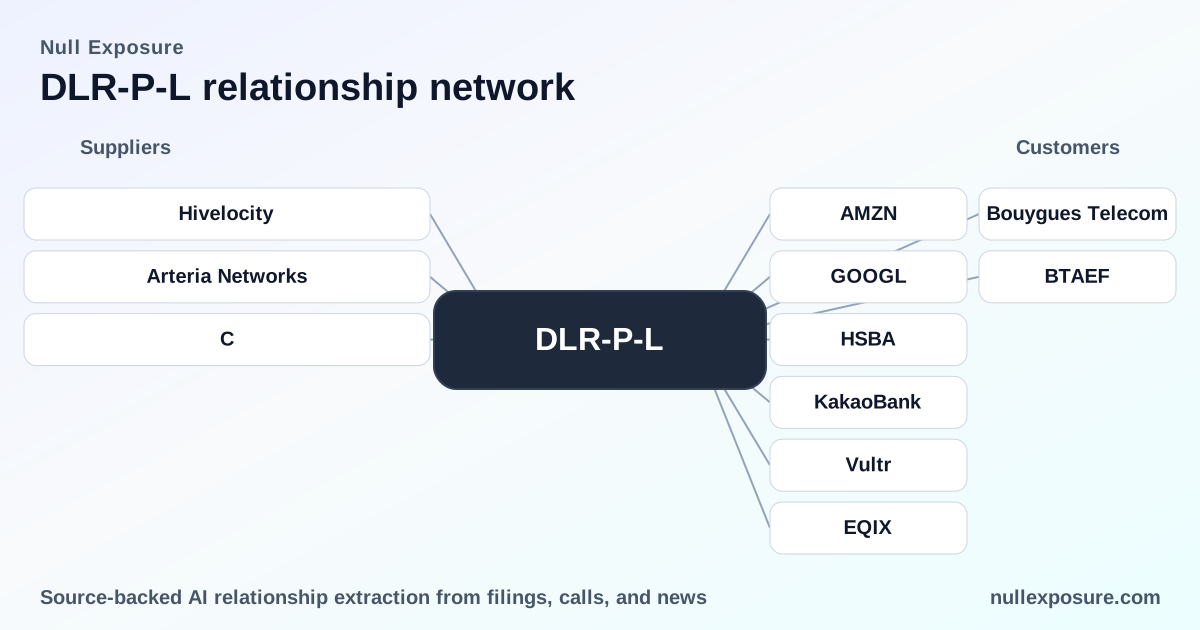
Digital Realty (DLR-P-L): Hyperscalers, Telcos and Critical Colocation — Customer Map and Investment Signals
Digital Realty is a global REIT that owns and operates carrier‑neutral data centers and monetizes through long-term real estate leases, colocation and interconnection services, and value‑added platform offerings for cloud and AI workloads. Its revenue base combines predictable, lease-like cash flows from large anchor tenants with higher‑margin, consumption and services revenue from colocation and PlatformDigital customers. For investors, the core investment thesis is exposure to stable real‑estate cashflows augmented by structural demand from hyperscalers, cloud providers and telecoms. Learn more at https://nullexposure.com/.
How Digital Realty actually earns money and why customers matter
Digital Realty’s model is simple and capital‑intensive: acquire or build large, energy‑dense facilities, secure anchor tenants under long leases, and sell additional space, power and cross‑connect services to a broader set of customers inside those campuses. Monetization levers include long‑dated leases that stabilize occupancy and rental revenue, plus incremental, higher‑frequency fees for power, bandwidth and interconnection that grow faster with customer usage. The presence of hyperscalers and large enterprises increases utilization and supports pricing power for incremental capacity.
Operating posture, concentration and criticality — practical constraints investors should track
These characteristics drive valuation sensitivity and operational risk:
- Contracting posture: Predominantly long‑term, lease‑style agreements with anchor tenants reduce churn but create lock‑in risk if a tenant consolidates or scales down.
- Concentration: The business benefits from large anchor relationships (hyperscalers and major cloud providers) that occupy significant footprint; this concentration amplifies revenue stability but raises tenant‑specific risk.
- Criticality: Data centers are core infrastructure for customers’ cloud and AI operations, giving Digital Realty high switching costs and pricing leverage for services and interconnection.
- Maturity and scale: Digital Realty operates at scale and is a mature REIT, which favors capital access but requires disciplined capital allocation to preserve yield.
These company‑level signals shape credit and equity investor viewpoints and should guide due diligence around tenant composition, contractual terms and capital expenditure cadence. Explore deeper portfolio signals at https://nullexposure.com/.
Customer relationships identified in public sources (complete coverage)
Below I list every customer relationship flagged in the available results with a concise plain‑English summary and the source.
AMZN (Amazon) — hyperscaler anchor
Digital Realty was an early builder of the large-scale facilities that host hyperscalers, and Amazon is identified among those anchor customers supporting cloud infrastructure growth through large footprints and long-term tenancy. According to a REIT.com retrospective covering Digital Realty’s FY2025 position, Amazon is listed as one of the major hyperscaler customers. (REIT.com, article on Digital Realty’s growth — https://www.reit.com/news/articles/digital-realty-rides-secular-waves-of-growth-in-its-first-20-years, FY2025)
Amazon — duplicate entry from the same source
The same REIT.com piece reiterates Digital Realty’s role as an early host for hyperscalers, explicitly naming Amazon in the firm’s historical customer mix and growth narrative. (REIT.com, FY2025 — https://www.reit.com/news/articles/digital-realty-rides-secular-waves-of-growth-in-its-first-20-years)
AMZN (alternate inferred symbol) — additional match
An additional index match for AMZN underlines the same point: Amazon is recognized in coverage as a key hyperscaler customer that drove demand for Digital Realty’s large data centers. (REIT.com, FY2025 — https://www.reit.com/news/articles/digital-realty-rides-secular-waves-of-growth-in-its-first-20-years)
Google (GOOGL) — major cloud tenant
Digital Realty’s customer list includes Google as another hyperscaler that requires large, energy‑dense campus capacity; this strengthens Digital Realty’s position in providing core cloud infrastructure. REIT.com cites Google among the early hyperscaler relationships that underpinned the company’s expansion. (REIT.com, FY2025 — https://www.reit.com/news/articles/digital-realty-rides-secular-waves-of-growth-in-its-first-20-years)
HSBC (HSBA/HSBA) — financial services colocation tenant
DatacenterDyanmics reported that a portfolio sale process identified HSBC as a customer in a set of European facilities, indicating that Digital Realty’s tenant roster includes major financial institutions requiring secure colocation services. (DatacenterDyanmics, reporting on the 2021 Ascendas REIT transaction — https://www.datacenterdynamics.com/en/news/ascendas-reit-buy-11-european-data-centers-digital-realty-678-million/, FY2021)
Equinix (EQIX) — interconnection and carrier relationship
DatacenterDyanmics noted Equinix among customers in a European portfolio sold by Digital Realty subsidiaries, underscoring the company’s role in the carrier and interconnection ecosystem even when assets trade hands. (DatacenterDyanmics, FY2021 — https://www.datacenterdynamics.com/en/news/ascendas-reit-buy-11-european-data-centers-digital-realty-678-million/)
Bouygues Telecom — regional telco customer
Bouygues Telecom was named in the reporting on Digital Realty’s European asset disposition as a customer of those facilities, which highlights the company’s relationships with national telecom operators in Europe. (DatacenterDyanmics, FY2021 — https://www.datacenterdynamics.com/en/news/ascendas-reit-buy-11-european-data-centers-digital-realty-678-million/)
BT (BTAEF) — UK telecom tenancy
BT appears in the same reporting as a listed customer for the portfolio of European data centers, confirming Digital Realty’s exposure to major telco tenants in the UK market. (DatacenterDyanmics, FY2021 — https://www.datacenterdynamics.com/en/news/ascendas-reit-buy-11-european-data-centers-digital-realty-678-million/)
KakaoBank — AI lab and platform customer in Seoul
Digital Realty hosted KakaoBank’s AI lab at its ICN10 facility in Seoul, demonstrating the company’s ability to attract innovative, high‑growth enterprise users for AI and GPU workloads in Asia. PR Newswire covered the FY2024 announcement of KakaoBank’s AI lab at ICN10. (PR Newswire, announcement on KakaoBank at ICN10 — https://www.prnewswire.com/in/news-releases/kakaobank-powers-ai-innovation-at-digital-realtys-icn10-data-center-302049774.html, FY2024)
Vultr — PlatformDigital GPU offering partnership
DatacenterDyanmics reported that Vultr has deployed high‑density GPU clusters on Digital Realty’s PlatformDigital offering, showing the company’s strategy of capturing cloud‑native and GPU‑heavy workloads through platform services. (DatacenterDyanmics, FY2025 — https://www.datacenterdynamics.com/en/news/digital-realty-acquires-colo-biz-of-hivelocity-in-chicago-and-miami-partners-with-vultr/)
Key takeaways for investors
- Hyperscaler demand drives scale economics and occupancy stability. The presence of Amazon and Google in Digital Realty’s customer mix supports long-term cash flow visibility.
- Telcos and financial institutions diversify revenue streams but concentrate operational risk regionally. Customers such as BT, Bouygues Telecom and HSBC show a mix of enterprise and carrier demand that stabilizes utilization across markets.
- PlatformDigital and AI/GPU adoption create upside to base rent through higher‑margin services. Partnerships like Vultr and customer use cases such as KakaoBank’s AI lab highlight a growth path beyond fixed rent.
What to watch next
Monitor tenant concentration metrics, the split between lease‑style revenue and consumption services, and capital deployment into energy‑dense capacity for AI workloads. For a structured view of tenant mix, contractual terms and portfolio impacts, visit https://nullexposure.com/ for ongoing signals and verified linkages.
Overall, Digital Realty’s customer profile is consistent with a large, mature data‑center REIT: stable lease cash flows anchored by hyperscalers, supplemented by growth opportunities in interconnection and AI platform services, and meaningful counterparty exposure among telcos and financial firms that requires active monitoring.