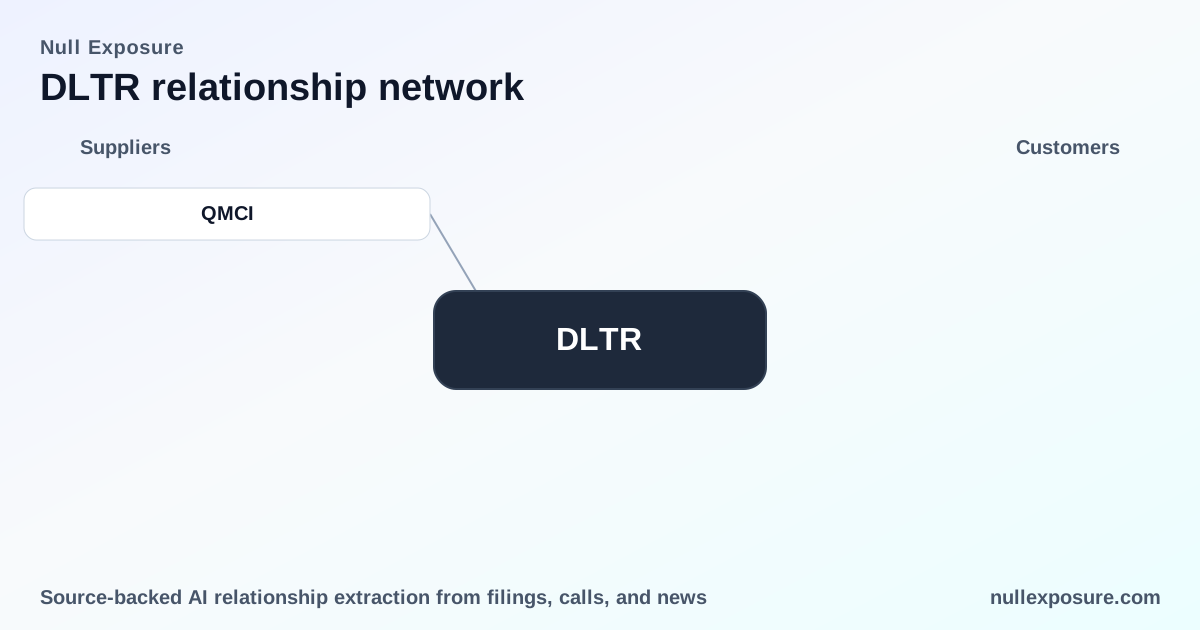
Dollar Tree (DLTR): Customer Relationships and Operational Implications
Dollar Tree operates a high-volume, low-price retail model across multiple store banners and monetizes by selling merchandise at the point of sale; revenue is recognized when products are transferred to customers at checkout. The company’s scale — roughly $19.4 billion in trailing twelve-month revenue and a market capitalization near $18.6 billion — makes third-party distribution and payment partnerships strategically important for incremental reach and SNAP/EBT accessibility. Learn more at https://nullexposure.com/.
Quick read: thesis for investors
Dollar Tree’s economic engine is transactional retail: broad geographic reach and dense store count generate predictable same-store traffic and margin leverage. Partnerships that extend payment options or delivery rails translate directly into incremental traffic and basket lift rather than long-term contractual revenue streams, because the company recognizes sales at a point in time under ASC 606 and does not depend on recurring service contracts for core monetization.
How the DoorDash–Family Dollar move connects to Dollar Tree
- DoorDash is adding SNAP/EBT payment support for grocery orders from nearly 7,000 Family Dollar stores on its platform, effectively enabling government food benefits for digital grocery purchases at those stores. A Sahm Capital news report covering the April 3, 2026 announcement documents the rollout and its scope on DoorDash’s marketplace (FY2026 coverage).
Source: Sahm Capital news report on DoorDash and Family Dollar (April 3, 2026), https://www.sahmcapital.com/news/content/doordash-snap-partnership-with-family-dollar-expands-everyday-commerce-role-2026-04-03
Why this matters for DLTR: Family Dollar is an operating banner within the Dollar Tree enterprise, so enabling SNAP/EBT on a major delivery marketplace opens an additional channel for SNAP-dependent customers to transact with DLTR-managed stores and increases the addressable digital grocery population for the company.
Relationship snapshots: what the coverage shows
Below I cover each relationship surfaced in the dataset and state its immediate practical implication for Dollar Tree.
- DoorDash (DASH): DoorDash will accept SNAP/EBT payments for grocery orders from nearly 7,000 Family Dollar stores on DoorDash’s platform, expanding digital access for EBT beneficiaries to these store locations. This development broadens the digital commerce footprint available to customers who use food assistance benefits and creates a new route-to-market for DLTR’s grocery assortments. Source: Sahm Capital report on DoorDash–Family Dollar (FY2026).
Company-level operating constraints and what they signal for partner risk
The data returns two company-level signals that frame how to evaluate DLTR’s customer relationships.
-
Geography and footprint drive bargaining dynamics. According to Dollar Tree’s filing for the period ending February 1, 2025, the company operated 8,628 stores across 48 U.S. states and 253 stores across five Canadian provinces. This large, distributed footprint reduces counterparty concentration risk and gives Dollar Tree negotiating leverage with logistics and delivery partners, because partners scale rapidly only if they support many stores across many local markets. Source: Dollar Tree company filing excerpts (Feb 1, 2025).
-
Contracting posture is transactional and point-in-time. The company recognizes revenue under ASC Topic 606: merchandise sales are a single performance obligation recognized when control transfers to the customer at the register (point in time). This limits long-term contractual lock-in with digital partners and positions third-party integrations (payment acceptance, delivery marketplaces) as channels for traffic and conversion rather than durable revenue contracts. Source: Dollar Tree revenue recognition disclosure (ASC 606).
From these signals, investors should read the following operational characteristics into DLTR’s partner exposure:
- Concentration: Low single-partner concentration because the company’s broad retail footprint dilutes the impact of any single distribution partner loss.
- Criticality: Third-party delivery and payments are strategically important for incremental growth — especially for grocery and SNAP-reliant customers — but they are not core to revenue recognition mechanics.
- Contract maturity and stickiness: Partnerships are channel- and execution-focused; revenue locked into longer-duration contracts is not typical for point-of-sale merchandise sales.
- Contracting posture: Dollar Tree negotiates as a large, retail counterpart with many local stores versus as a software/service buyer, so terms will favor scale and operational integration rather than revenue sharing that replaces in-store sales.
Investor implications and risk checklist
-
Upside: Expanded payment acceptance (SNAP/EBT) on marketplace partners converts a latent demand pool into measurable orders, improving sales per store in lower-income trade areas; digital grocery orders can raise average ticket and frequency for participating stores. The company’s scale means modest unit gains across thousands of locations can be material to same-store sales metrics. Dollar Tree reported roughly $19.4 billion in trailing revenue and healthy operating margins that can amplify incremental sales. Source: company financials (latest quarter ended 2026-01-31).
-
Execution risk: Integration with delivery providers requires store-level readiness (inventory mix, pick/pack processes, staff training). Because revenue is recognized at point of sale, failure at execution reduces realized benefit rather than creating contractual liability for the company.
-
Channel displacement: Third-party delivery can cannibalize in-store foot traffic if not managed tactically; however, in lower-price retail formats, the net effect typically favors expanded reach and higher total transactions when payment accessibility is improved.
What operators should prioritize
- Standardize in-store processes for digital order fulfillment to ensure margin capture on marketplace transactions.
- Monitor SNAP/EBT order economics by store to verify basket uplift and incremental margin after delivery fees and marketplace commissions.
- Use marketplace partnerships to test assortment adjustments tailored to digital grocery demand in SNAP-heavy trade areas.
For a concise, investor-ready monitoring framework and alerts tied to DLTR’s partner activity, visit our research hub at https://nullexposure.com/.
Bottom line
The DoorDash rollout for Family Dollar SNAP/EBT transactions is a clear, immediately actionable channel expansion for Dollar Tree’s banners: it converts under-served government-benefit shoppers into digital customers while leveraging Dollar Tree’s broad physical footprint. This is a channel play, not a change in Dollar Tree’s monetization model; the company will continue to monetize at point-of-sale, while partners drive incremental traffic and convenience for consumers. Investors should watch order economics and store-level execution as the primary signals that determine whether the partnership produces sustainable same-store sales improvement.