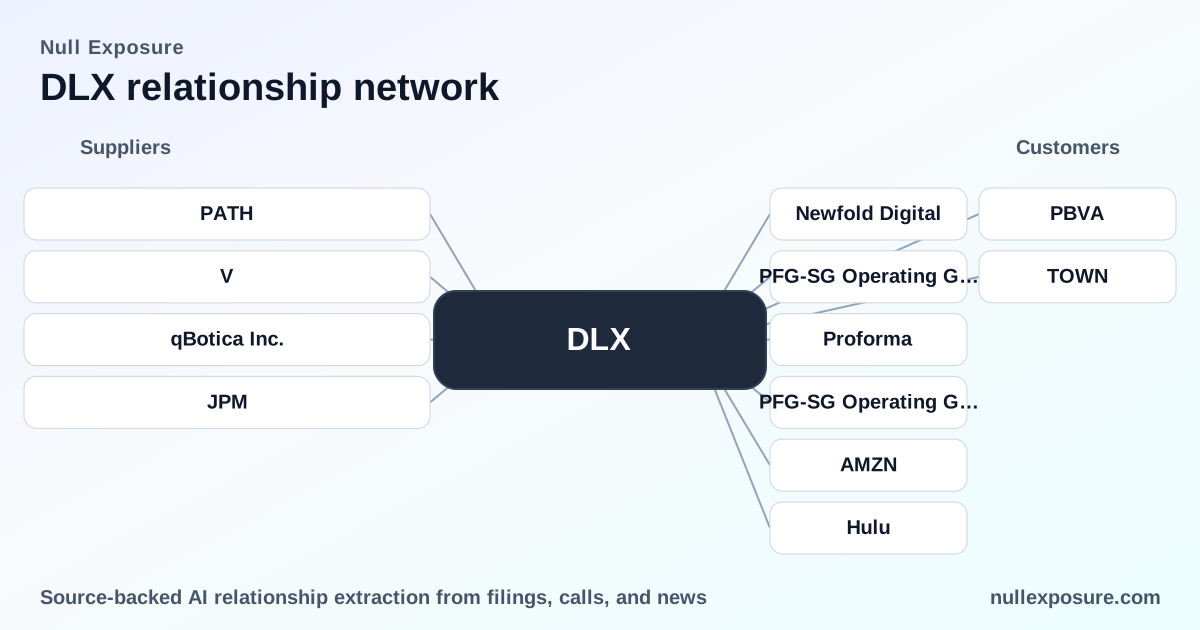
Deluxe (DLX) customer relationships — what investors need to know
Deluxe is a hybrid products-and-services company that monetizes through a mix of manufactured goods (checks and print) and recurring payments and data services, with merchant-fee economics underpinning its growth. The company sells physical products through distribution channels while generating ongoing, usage‑based revenue from payment processing and B2B services to banks and small-to-mid market merchants; management is actively reshaping the portfolio through targeted divestitures to focus capital on Payments and Data. For a concise map of the relationships driving that strategy, see more at https://nullexposure.com/.
High-level investor thesis: recurring fees, portfolio pruning, and channel reach
Deluxe’s business model combines durable manufacturing margins from its Print segment with highly scalable, transaction-linked margins from Merchant Services and B2B Payments. The balance produces recurring revenue with usage volatility — merchant fees rise and fall with transaction volumes, while print revenue is steadier but structurally declining. Management is actively pruning non-core assets (e.g., Safeguard and international hosting operations) and redeploying capital toward payments partnerships and embedded processing relationships that extend Deluxe’s channel reach into banks and mid-market clients.
How the company operates (contracting posture and customer mix)
- Contracting posture: Deluxe records long-lived intangible and contract-related items amortized over multiple years, indicating long-term commercial arrangements and capitalized investments in customer relationships; merchant services are predominantly usage-based, producing variable revenue tied to transaction value and volume.
- Customer concentration and criticality: The client base is deliberately broad — small businesses, financial institutions, nonprofits, government, individual consumers, and very large enterprises — which reduces single-client concentration but creates exposure to macro-driven transaction cycles.
- Maturity and segmentation: Deluxe’s Print/manufacturing franchise is a mature, capital-intensive business; Payments and Data are higher-growth, service-led segments where Deluxe acts as a service provider to banks and merchants and as the principal on distributor channels.
- Lifecycle signals: Recent divestitures and completed exits (e.g., payroll/HCM transitions reported through 2024) show management is shifting from legacy services toward recurring payments and data monetization.
Detailed relationship roster (each reported partner and what it means for DLX)
Proforma
Deluxe agreed to sell its Safeguard business and distributor network to Proforma as part of a portfolio optimization move announced in March 2026; Deluxe will continue to supply checks and printed offerings to Proforma, ensuring continuity for end customers. Multiple press reports in March 2026 (Intellectia, Finviz, StockTitan) covered the transaction and transition mechanics.
PFG‑SG Operating Group / PFG‑SG Operating Group LLC
In March 2026 Deluxe entered an Asset Purchase Agreement with PFG‑SG Operating Group to sell specified assets of its Safeguard and Safeguard Business Systems operations, with MarketScreener reporting a $25 million price for the Safeguard Business Systems assets. These asset sales represent focused exits that accelerate Deluxe’s pivot away from legacy check-distribution units.
Newfold Digital
Deluxe sold Hostopia Australia (its Australian web hosting business) to Newfold Digital for about $23 million in a transaction reported in 2022, illustrating earlier strategic moves to divest non-core international hosting assets and simplify the company’s geographic footprint. (TCB Magazine, FY2022)
MRI Software
Deluxe was named the official processing partner for MRI Software’s rent payment solution in 2026, positioning Deluxe as the back-end processor for enterprise property-management payments and expanding its payments footprint into vertical SaaS channels. (Investing.com, May 2026)
Washington Trust Bank (WASH)
Washington Trust Bank selected Deluxe to support its merchant services program in April 2026, leveraging Deluxe’s payments platform and service model to serve merchant clients — a bank-distribution win that validates Deluxe’s channel-first merchant strategy. (SimplyWallSt, April 2026)
Peoples Bank / PEBK (PBVA)
Deluxe expanded a multidivisional engagement with Peoples Bank to include Merchant Services after placing portions of promotional and check business earlier in the year; the deepening relationship signals cross-sell traction inside regional banks and recurring revenue capture through bank-branded merchant programs. (Intellectia and an earnings-call transcript reported on InsiderMonkey, FY2025–FY2026)
TowneBank (TOWN)
In 2025 TowneBank announced it would work with Deluxe to offer its merchant services to the bank’s clients, reflecting Deluxe’s strategy to embed payment processing inside community bank channels and scale via partner distribution. (Digital Transactions, FY2025)
Hulu and Amazon Prime / AMZN
Deluxe uses branded media partnerships — notably launching Season 5 of its Small Business Revolution on Hulu and Amazon Prime in 2020 — as a marketing and SMB acquisition channel, supporting the company’s small-business positioning and lead flow into its payments and marketing services. (TCB Magazine, FY2020)
What these relationships collectively imply for investors
- Strategic shift toward payments: The mix of bank partnerships (Washington Trust, Peoples Bank, TowneBank) and platform integrations (MRI Software) confirms management’s priority to grow recurring, usage-based merchant revenue and scale via financial institution distribution.
- Portfolio optimization reduces structural drag: The Safeguard divestitures (Proforma and PFG‑SG transactions) and the earlier sale of Hostopia Australia reduce exposure to lower-growth, capital‑intensive lines and free capital for payments initiatives.
- Diversified counterparty base limits single-client risk: Serving small businesses, banks, nonprofits, government, and large brands provides demand-side diversification, but the firm remains sensitive to transaction-volume cycles because a significant portion of revenue is usage-based.
- Commercial posture is mixed but predictable: Long-term amortization schedules alongside usage-based merchant fees produce a revenue base that combines durability (from long-term contracts and capitalized relationships) with variability (transaction exposure).
Investment risks and monitoring checklist
- Track incremental revenue from recently announced bank partnerships and the MRI integration for evidence of successful platform monetization.
- Monitor the financial impact and customer-transition progress from the Safeguard divestitures to ensure no material customer attrition or short-term revenue gaps.
- Watch quarterly merchant-volume metrics and rate compression trends to assess margin sensitivity from usage-based contracts.
For a structured view of customer-level signals and to dive deeper into these partner relationships, visit https://nullexposure.com/.
Bold conclusion: Deluxe is executing a strategic pivot from legacy print manufacturing toward higher-margin, usage-based payments and embedded processing via bank and software partnerships; the recently closed and announced transactions materially accelerate that repositioning while reducing exposure to non-core international operations.