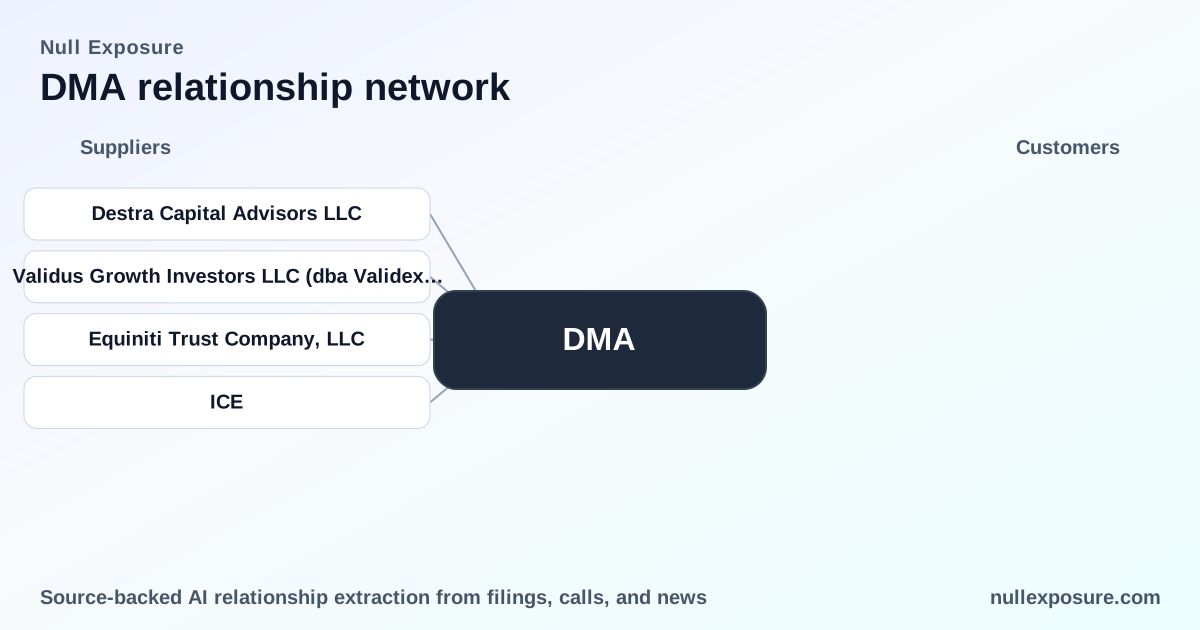
DMA: Investor thesis and what public customer signals reveal
DMA is a publicly traded company whose operating economics derive from its core commercial activities; the public record reviewed here shows institutional ownership exposure rather than revenue-driving customer contracts, so investor analysis should focus on ownership concentration, market liquidity and proxy governance rather than customer-vendor dependencies. For market participants and operators evaluating DMA as a counterparty, the observable relationships suggest low single-customer revenue concentration and an ownership footprint dominated by passive and closed‑end fund holders rather than strategic commercial partners. Explore more corporate relationship intelligence at https://nullexposure.com/.
What the public customer footprint actually shows
Publicly accessible relationship data returned a single identifiable entry: an ETF position. There are no disclosed direct customer contracts, channel partners or material client dependencies recorded in the available results. This pattern signals a business profile where revenue dependence on named customers is low in the public record; investor-owned positions dominate the observable external connections.
The one explicit relationship: CEFS Saba Closed‑End Funds ETF
CEFS Saba Closed‑End Funds ETF holds DMA as a minor position — 0.50% weight with a market value reported at approximately $2.01 million for the fiscal period labeled FY2022. This is an ownership exposure recorded in public market holdings, not a customer-supplier contract. According to a TradingView profile snapshot observed on May 2, 2026, the ETF listing includes this holding and valuation for FY2022 (TradingView, 2026).
How that single relationship translates into operating signals
- Concentration: The presence of one small ETF holder in the public results indicates low concentration risk at the customer level in available disclosures; there is no evidence of a dominant commercial buyer that would create revenue tail risk.
- Criticality: Holdings by investment funds are investor relationships rather than operational customers, so criticality to day‑to‑day revenue is minimal based on the public record.
- Contracting posture: The visible connections are market‑based equity holdings, implying standard public market contracting (avenues such as custody and broker settlement) instead of bespoke commercial procurement contracts.
- Maturity: The identified relationship is passive and institutional; this points to mature capital market participation but offers no signal of long‑term strategic commercial partnerships from the data provided.
These are company-level signals derived from the public relationship footprint rather than assertions about undisclosed commercial agreements.
Why investors should care about an ETF holder showing up in customer scans
An ETF holding position is an ownership signal that affects liquidity, not revenue. A $2.01 million position at 0.50% weight is economically modest, but the presence of institutional holders creates governance and trading implications: voting behavior, secondary market liquidity and potential share‑price sensitivity to fund flows. Analysts focused on customer risk should therefore shift to evaluating shareholder structure and market depth when the customer landscape is thin.
Full list of relationships found in the public record
- CEFS Saba Closed‑End Funds ETF — The ETF reported a 0.50% weight in DMA with market value approximately $2.01 million in the FY2022 label; this is an ownership entry, not a revenue customer relationship (TradingView, observed May 2, 2026).
Risk and governance takeaways for operators and investors
- Revenue risk is not concentrated on any named external customer in the disclosed relationships; revenue analysis should rely on company filings and segment reporting rather than these public relationship snapshots.
- Shareholder composition considerations are primary: even modest institutional stakes can influence trading dynamics in thinly traded names and affect tender offers or proxy contests if combined with other holders.
- Operational counterparties are not visible in this dataset, so procurement, supplier and channel risk assessments require deeper document review (10‑K/20‑F, benefits/contracts disclosures) or direct engagement with management.
Short checklist for next‑step diligence
- Review recent SEC filings for disclosed top customers or material contracts, because public holding data does not substitute for contractual disclosure.
- Assess trading liquidity and shareholder concentration on exchanges to quantify market‑risk exposure tied to institutional flows.
- Validate whether the company has any strategic or recurring commercial partners not visible in market‑ownership scans.
Final read: what this tells the intelligent investor
The observable relationship set is limited and centered on investment ownership rather than customer revenue links. That imposes a clear analytical pivot: focus on shareholder structure, liquidity and formal corporate disclosures to assess counterparty risk and revenue concentration. For teams that need systematic tracking of public relationship signals and investor exposures, visit https://nullexposure.com/ for ongoing coverage and relationship analytics.
Bold takeaway: DMA’s public customer footprint shows ownership entries, not commercial customers — prioritize shareholder and filing analysis over customer-concentration hypotheses.