Dorchester Minerals (DMLP): Royalties, concentration, and predictable cash flow
Dorchester Minerals LP acquires and manages mineral and royalty interests and monetizes those holdings by collecting royalty and lease bonus payments from exploration-and-production companies that operate its acreage. The partnership’s economics are driven by headline royalty cash flows—regular receipts from operators—and intermittent lease bonus and assignment proceeds that support distributions. Learn more about coverage and data at https://nullexposure.com/.
The business in plain terms: owning rights, not drilling wells
Dorchester does not operate oil and gas fields; it owns royalty and net profit interests tied to producing and non‑producing U.S. acreage and contracts with E&P operators through leases and assignments. Revenue streams are straightforward: periodic royalty payments from production, lease bonus receipts when acreage is leased, and occasional proceeds from assignments. Public figures show a sizeable payout profile: market capitalization near $1.31 billion, trailing EBITDA roughly $123.7 million, and a reported dividend per share of $2.792 with a yield around 9.98%, underscoring the income orientation of the business.
Customer relationships that actually move the needle
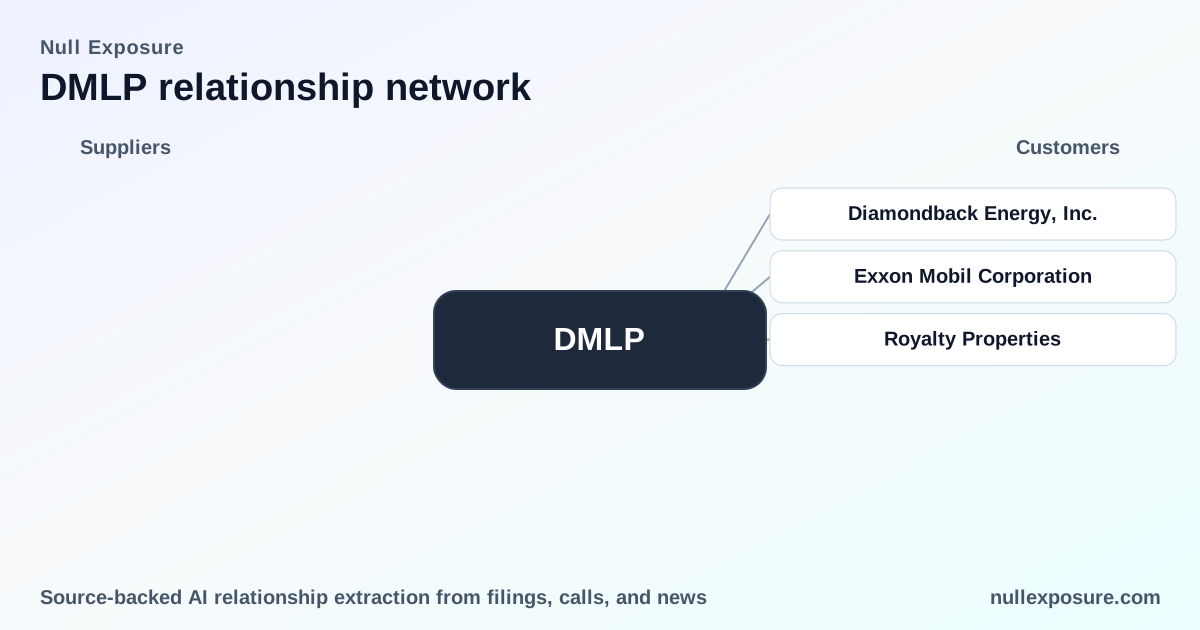
Below are the material counterparties and revenue relationships disclosed in Dorchester’s filings and recent commentary. Each relationship is summarized in plain English with the originating source.
Diamondback Energy, Inc.
Dorchester reports that royalty revenues from properties operated by Diamondback, together with Exxon Mobil, accounted for about 31% of total operating revenues in FY2024, signaling meaningful revenue concentration tied to Diamondback’s operated acreage. This was disclosed in Dorchester’s FY2024 Form 10‑K.
Source: Dorchester Minerals FY2024 Form 10‑K (filed for year ended December 31, 2024).
Exxon Mobil Corporation
Exxon Mobil is the other named operator in the disclosure that, together with Diamondback, represented roughly 31% of Dorchester’s operating revenues in FY2024, making Exxon a co‑driver of near‑term cash flow volatility or upside depending on production and price trends on those fields. This is stated in the same FY2024 Form 10‑K filing.
Source: Dorchester Minerals FY2024 Form 10‑K (filed for year ended December 31, 2024).
Royalty Properties (company unit)
Recent market commentary tied Dorchester’s announced cash distribution to about $32.2 million in cash receipts from the Partnership’s Royalty Properties plus roughly $6.0 million from lease bonus and other income, a clear exposition of what funds distributions and the relative importance of lease bonus receipts. That payout breakdown was discussed in a January 24, 2026 note from Sahm Capital reviewing Dorchester’s Q4 2025 cash distribution.
Source: Sahm Capital commentary on Dorchester Minerals valuation and Q4 2025 distribution (January 24, 2026).
How the contract and operating model shape risk and reward
Several operating-model signals emerge from public filings and disclosures. These are company-level characteristics unless a quoted excerpt names a specific counterparty.
-
Contracting posture: licensing/leases. Dorchester’s core arrangements are lease agreements that transfer development rights to lessees and grant the partnership specified royalty interests, with typical drilling or development timing obligations. This reflects a low‑operating‑intensity, rights‑owner posture rather than an operator risk profile. Evidence: FY2024 10‑K lease agreement description.
-
Geographic concentration: United States only. All proved and developed interests referenced in filings are located in the U.S., which concentrates country risk and regulatory exposure but reduces cross‑border complications. Evidence: FY2024 10‑K geography discussion.
-
Revenue concentration: material counterparty exposure. Exxon Mobil and Diamondback together supplied roughly 31% of operating revenues in FY2024, a meaningful concentration that is a principal single risk factor for cash flow stability. Evidence: FY2024 10‑K disclosure.
-
Role and revenue mix: licensor with recurring and non‑recurring cash flows. The partnership’s stated model is to generate lease bonus revenue by leasing its minerals to E&P firms and to retain royalty streams thereafter; those cash flows are the primary sources of capital. Evidence: FY2024 Form 10‑K language on lease bonus and Royalty Properties.
-
Segment importance: Royalty Properties are core. Dorchester identifies its Royalty Properties (and the NPI) as primary sources of short‑ and long‑term capital, underscoring that the royalty business is not ancillary but the operating core that funds distributions. Evidence: FY2024 10‑K segment description.
These signals create a specific investor profile: asset ownership with cashflow visibility, but with operator concentration and U.S. basin/commodity sensitivity rather than exposure to diversified upstream operations.
How investors should think about risk and upside
-
Cash yield and distributable economics are the investment hook. The reported dividend and the distribution funding disclosure show Dorchester’s ability to convert its royalty receipts into investor returns; the January 2026 payout breakdown gives line‑of‑sight to the cash behind distributions.
-
Concentration is the primary risk. With over 30% of revenue tied to two operators, short‑term revenue volatility or contract changes at those operators would have an outsized impact on distributable cash. Investors should watch operator activity, well performance, and contractual terms on those acres.
-
Lease bonus receipts provide optionality but are irregular. Lease bonuses can materially augment distributions in a given quarter (example: ~$6.0 million cited for the most recent distribution), but they are not a reliable recurring base like production royalties.
-
Regulatory and commodity exposure is concentrated to U.S. onshore basins. That reduces geopolitical complexity but leaves Dorchester sensitive to domestic regulatory shifts and oil/gas price cycles.
Bottom line: Dorchester delivers high income through an asset‑light, royalty‑owner model with clear cash drivers—production royalties and lease bonus events—but investors must price in operator concentration and commodity/geography exposure.
Investment checklist for credit‑sensitive income investors
- Confirm operator health and drilling plans for Exxon and Diamondback acreage.
- Monitor lease bonus cadence and the partnership’s disclosures after major leasing cycles.
- Track production trends and price realizations on Dorchester’s named Royalty Properties.
- Consider portfolio concentration limits given the ~31% revenue tied to two operators.
For deeper coverage, schedules, and ongoing alerts for counterparties and distribution funding, visit https://nullexposure.com/.
Final take
Dorchester Minerals is a classic royalty owner: predictable recurring cash from production complemented by episodic lease bonus cash that together fund an elevated distribution. The investment case is yield plus stability—but with operator concentration as the decisive risk factor. Review operator activity and distribution funding disclosures closely before taking a position.