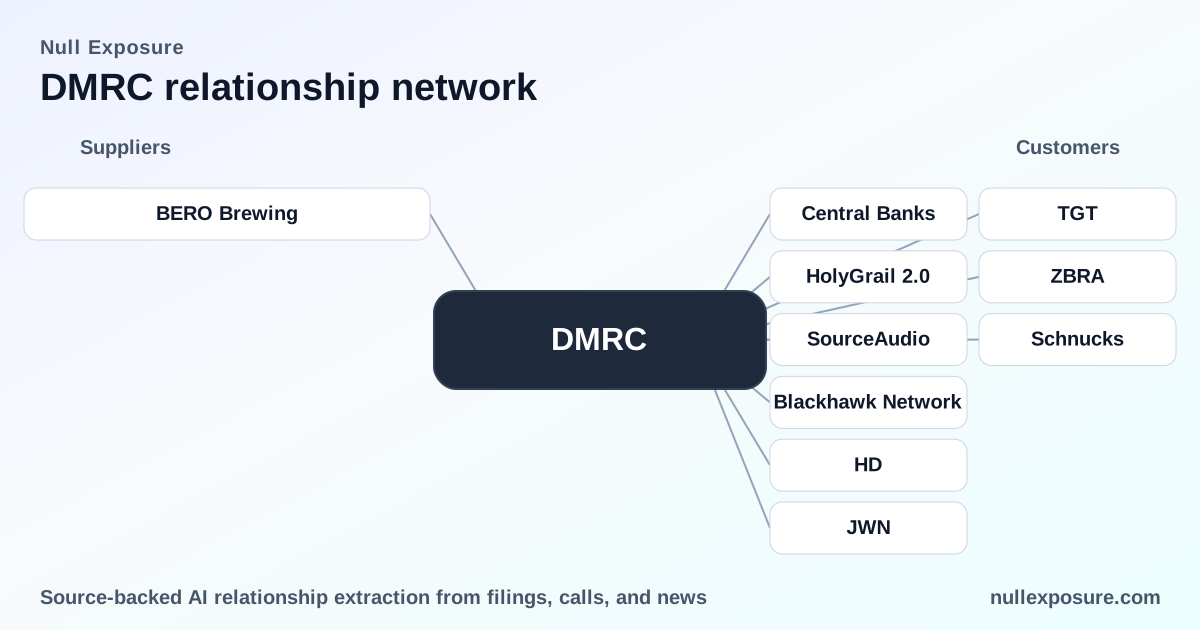
Digimarc (DMRC): Customer map and what it means for revenue concentration and growth
Digimarc embeds robust, hard-to-forge identifiers in media, packaging and physical goods and monetizes primarily through software subscriptions and accompanying services—with supplemental service revenue tied to bespoke projects and integrations. For investors, the company is a hybrid SaaS-and-services vendor with a small-cap balance sheet, high customer concentration and a handful of strategic, long-duration contracts that drive the majority of service revenue. Learn more at https://nullexposure.com/.
How Digimarc makes money and the constraints that shape the model
Digimarc sells access to its watermarking and identification platform via recurring subscription fees (typically 1–3 year terms, paid in advance) and related software development services. The company also generates project-based service revenue tied to custom deployments and integrations. According to the FY2024 Form 10‑K, the majority of subscription contracts are recurring and recognized over contract terms that are usually one to three years.
Several company-level signals matter for valuation and operational diligence:
- Concentration: Five customers represented approximately 76% of revenue in 2024, and Digimarc discloses substantial receivable concentration from its three largest customers, making revenue quality and renewal visibility critical.
- Contracting posture and maturity: Subscription contracts are recurring and often prepaid; in parallel, Digimarc maintains a multi‑decade relationship with central banks—a long-term, mission-critical engagement that runs through December 31, 2029, per the FY2024 filing.
- Counterparty mix and criticality: The revenue base mixes government (central banks) and commercial customers, with the former representing material, long-term work and the latter concentrated among large retail and brand partners.
- Geography and go‑to‑market: Sales are focused in North America and Europe, though the company reports international bill‑to activity and speaks to broader global deployment.
- Segment focus: The business is principally software (SaaS) plus services, with services material when large bespoke projects are undertaken.
These signals combine to create a business where customer wins are high-impact but renewal and concentration risk are elevated—favorable for margin expansion if renewals are solid, adverse if a major account softens.
Who Digimarc is working with right now (relationship-by-relationship)
Below are every customer relationship disclosed in our sources, each summarized in plain English with the originating document.
-
HolyGrail 2.0 — Digimarc reported a modest revenue uplift from HolyGrail 2.0 recycling projects; service revenue from this initiative contributed an incremental $0.6 million in 2024. (Source: Digimarc FY2024 Form 10‑K filing.)
-
SourceAudio — The company signed a deal to embed Digimarc audio watermarks into production music used in TV and commercials to monitor royalty rights across over 150 national channels and 100 local stations, a use case that converts watermarking into rights‑management revenue. (Source: Digimarc Q2 2025 earnings call.)
-
Central Banks — Digimarc’s contract with a consortium of Central Banks accounts for the majority of its service revenue and is a long-term arrangement that runs through December 31, 2029; the relationship spans nearly 30 years. (Source: Digimarc FY2024 Form 10‑K filing.)
-
Blackhawk Network — Digimarc-protected gift cards reached retail shelves in August as part of an initial roll-out that included Blackhawk Network multi‑retailer cards, positioning Blackhawk as a commercial channel partner for the gift‑card use case. (Source: Digimarc Q3 2025 earnings call.)
-
Target — Target was named among the major brands participating in the first wave of Digimarc‑protected gift cards that hit shelves in August, reflecting early adoption by a major U.S. retailer. (Source: Digimarc Q3 2025 earnings call.)
-
Home Depot — Home Depot is listed as one of the initial major brands deploying Digimarc‑protected gift cards, demonstrating retailer engagement across big‑box channels. (Source: Digimarc Q3 2025 earnings call.)
-
Nordstrom — Nordstrom participated in the first cohort of Digimarc gift cards reaching shelves, signaling interest from department‑store channel partners. (Source: Digimarc Q3 2025 earnings call.)
-
TGT (duplicate entry for Target) — The dataset includes a second entry for TGT reiterating that Target was part of the initial roll‑out of Digimarc‑protected gift cards. (Source: Digimarc Q3 2025 earnings call.)
-
ZBRA (Zebra Technologies Corporation) — A StockTitan report noted that Zebra plans to include Digimarc’s latest on‑scanner software across its retail scanner portfolio in preparation for the retail industry rollout of Digimarc’s gift card solution, which materially expands integration reach at point of sale. (Source: StockTitan article / FY2025.)
-
Zebra Technologies Corporation (duplicate listing) — A separate entry reflects the same StockTitan coverage describing Zebra’s plans to deploy Digimarc on‑scanner software across its retail scanners. (Source: StockTitan article / FY2025.)
-
Schnucks — A news item indicated Schnucks implemented Digimarc’s gift card security solution and reported that it eliminated fraud while accelerating checkout, a concrete commercial outcome for a regional grocer. (Source: StockTitan SEC‑filings news snippet / FY2026.)
-
Chinook s — According to an earnings‑call transcript published on InsiderMonkey, Digimarc expects all Chinook s locations to carry secured gift cards in spring, and roughly 600 stores of a major U.S. retailer to follow in summer, with broader expansion planned for holiday 2026. (Source: InsiderMonkey transcript of Q4 2025 earnings call reporting / FY2026.)
-
Schnoke — The same InsiderMonkey transcript references an order for gift cards destined for “Schnoke” stores and ~600 outlets of a major U.S. retailer as the first batch to appear in early spring and summer respectively, representing initial fulfillment activity. (Source: InsiderMonkey transcript of Q4 2025 earnings call reporting / FY2026.)
What the relationship map implies for near-term revenue and risk
The customer list clarifies several investment vectors:
- Commercial validation plus distribution gating: Retail roll‑outs with Target, Home Depot, Nordstrom, Blackhawk and scanner integration with Zebra represent a clear path from proof‑of‑concept to scale at POS—this translates to high upside for recurring license and transaction‑adjacent revenue if retailer rollouts complete as described.
- Revenue concentration and stickiness: The Central Banks engagement is both highly material and sticky—its long duration reduces churn risk on that portion of revenue but increases concentration risk overall. Digimarc’s disclosure that five customers were ~76% of revenue is a structural risk that can amplify volatility.
- Services-fed growth: Project implementations for recycling initiatives (HolyGrail 2.0) and bespoke integrations (gift card batches for regional chains) create lumpy service revenue, which has supported recent top-line moves but is less predictable than subscription flows.
- Distribution leverage via partners: Zebra’s on‑scanner integration is a force-multiplier for adoption; embedding Digimarc at the scanner level materially lowers adoption friction for retailers.
Final read for investors
Digimarc is a niche but strategically positioned technology provider where a small number of high‑impact customers drive results. The upside is tangible: commodity‑level distribution (Zebra) plus major retailer adoption converts technology into scale quickly. The downside is equally tangible: high concentration, lumpy services exposure and relatively small market cap with negative operating margins amplify downside if a large commercial partner delays or a major government contract shifts.
For diligence, focus on renewal economics for the Central Banks contract, the cadence of retailer roll‑outs and the revenue mix shift from services to recurring subscription-recognition. For deeper coverage and regular updates on Digimarc’s customer signals, visit https://nullexposure.com/.
Bold takeaways: high customer concentration, long-term government revenue, accelerating retail distribution through scanner partners, and near-term growth tied to completing retail rollouts.