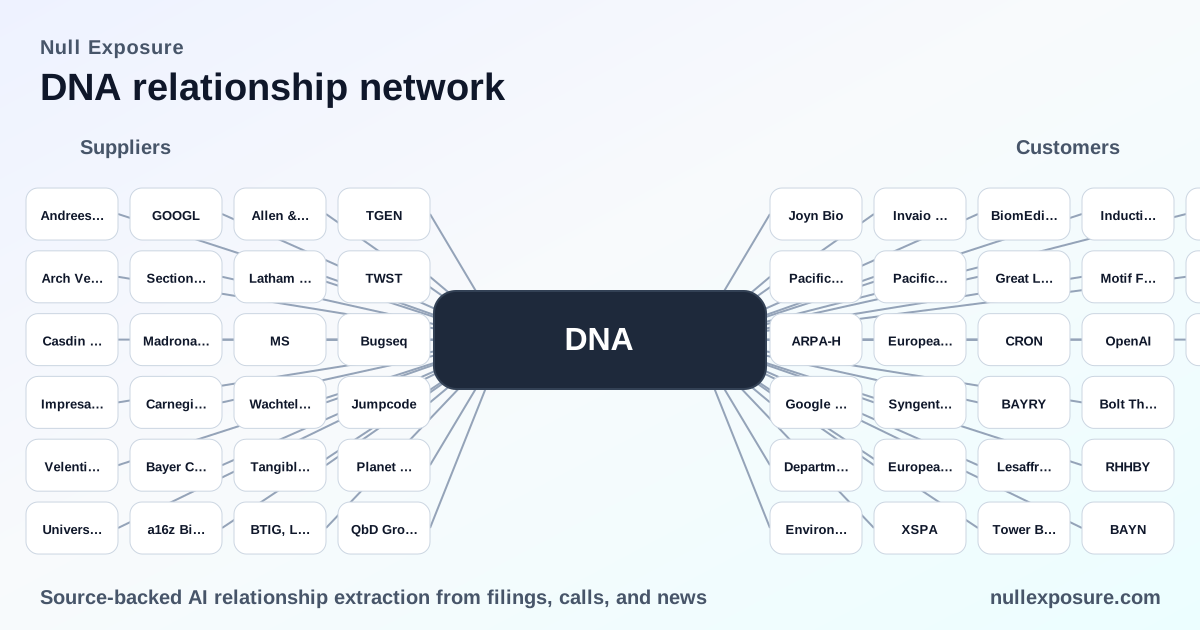
Ginkgo Bioworks (DNA): Customer Relationships Under the Microscope
Ginkgo Bioworks programs cells and sells laboratory services and biosecurity solutions to a spectrum of customers — from pharmaceutical and agricultural giants to U.S. and foreign governments — monetizing through a mix of project fees, recurring subscription-like arrangements for analytics and Canopy services, and multi‑year collaborations that include IP licensing and equity components. Revenue is increasingly a hybrid of short-term project work and growing recurring fees, while a small number of large customers drive materially concentrated top‑line exposure. For further context on commercial rigor and deal flow, visit https://nullexposure.com/.
Market takeaways up front: Ginkgo’s commercial model is services‑led, with rising automation and AI partnerships (notably with Google Cloud and OpenAI) intended to improve throughput and margins; government biosecurity work and a handful of enterprise programs represent both stable revenue anchors and concentration risk.
How Ginkgo’s contracting posture shapes commercial risk and optionality
Ginkgo contracts across four identifiable postures: short‑term engineering engagements (six‑to‑12 month RAC automation projects), spot fixed‑scope work, subscription/recurring Canopy arrangements, and multi‑year collaborations that don’t obligate minimum spend. This mix creates optionality for rapid commercialization while leaving revenue visibility exposed when large counterparties exercise discretion over annual demand. The company also reports significant revenue concentration: three customers accounted for more than 10% each of 2024 revenue and together represented 49% of total revenue, a clear signal of customer concentration risk (10‑K, FY2024).
The operating model in plain terms
- Service-first: Ginkgo sells cell engineering and biosecurity services and runs autonomous labs (Nebula) for customers across pharma, agriculture, and government (10‑K / earnings commentary).
- Licensing and equity: Several partnerships include IP licenses and equity swaps, giving upside beyond service fees where programs commercialize.
- Geography and counterparty mix: Revenue is primarily U.S.‑centric (about 81% in 2024) but with strategic global government and enterprise biosecurity work (10‑K, FY2024).
For a deeper look at counterparties and the evidence behind these signals, see the relationship rundown below and visit https://nullexposure.com/ for the full suite of analytics.
All reported customer relationships — one compact summary per name
Below are every relationship returned in the source material, each with a concise investor‑facing summary and a source note.
- Joyn Bio — Ginkgo recognized services revenue and received a $20.0 million non‑refundable prepayment under the Joyn Bio FSA, indicating a sizeable multi‑year agricultural collaboration with upfront funding (10‑K, FY2024).
- Google Cloud — Ginkgo entered a five‑year strategic cloud and AI partnership with Google Cloud to develop and deploy AI tools for biology and biosecurity, underpinning the company’s push to scale automated design and analysis (10‑K, Aug 29, 2023).
- ARPA‑H — Management stated that Ginkgo is building trust with top pharma and government funders, with ARPA‑H cited as a source of contract activity supporting repeat data‑generation work (earnings call, Q4 2025).
- Department of Energy — Ginkgo disclosed a $47 million contract to build a 97‑robot autonomous lab at PNNL, evidencing large government program wins in biosecurity/automation (earnings call, Q4 2025).
- Pacific Northwest National Laboratory (PNNL) — The $47M award to PNNL for an autonomous lab is a marquee government contract and a proof point for Ginkgo’s autonomous lab build capabilities (earnings call; stock titan reporting, FY2026).
- Environmental Molecular Sciences Laboratory (EMSL) at PNNL — Ginkgo was awarded a four‑year, up to $47M contract to co‑design and build a high‑throughput phenotyping platform for DOE M2PC, confirming PNNL/EMSL as a strategic government program (news report, FY2025).
- Invaio Sciences — As part of commercialization for peptide‑based agricultural products, Invaio will leverage Ginkgo’s platform and microbial strains for protein production, showing ag‑bio commercialization partnerships (Investing News, FY2026).
- ALXO — ALXO appears in the results via an unrelated earnings transcript excerpt referencing an industry executive; there is no direct Ginkgo commercial detail in that note (earnings call extract, FY2025).
- Biogen — Ginkgo lists Biogen among over 100 active R&D programs on its platform, indicating ongoing pharma partnerships and recurring R&D work (press release on Google Cloud partnership, FY2023).
- Bayer / Bayer Crop Science (BAYRY / BAYN / BAYN entries) — Bayer is described as an anchor agricultural customer in multi‑year collaborations, including nitrogen fixation programs and extended partnerships — a strategically material enterprise relationship (press releases, FY2022–FY2025).
- Syngenta Crop Protection / Syngenta — Ginkgo announced a collaboration with Syngenta Crop Protection to accelerate a microbial strain from Syngenta’s biologicals pipeline, reflecting strategic ag‑bio product development work (company updates, FY2024).
- Synlogic (SYBX) — Synlogic has used Ginkgo’s cell programming platform in research collaborations to progress synthetic biotic candidates; this is an example of Ginkgo’s role in preclinical drug lead optimization (news filings, FY2019–FY2022).
- Cronos (CRON) — Reporting indicates Ginkgo’s partnership with Cronos to produce yeast‑based precursors for cannabinoids, illustrating specialty fermentation and ingredient production work (TradingView note, FY2026).
- XpresSpa (XSPA) — A partnership mention frames Ginkgo as the biological platform for travel‑industry testing and monitoring services, pointing to diverse commercial verticals beyond pharma and ag (TradingView commentary, FY2026).
- Tower Biosecurity, Inc. — Ginkgo’s subsidiary agreed to transfer Ginkgo Biosecurity, LLC equity to Tower Biosecurity under a Stock Purchase Agreement, signaling organizational changes in the biosecurity business (8‑K reporting, FY2026).
- BiomEdit, Inc. — Ginkgo recognized $7.5 million in non‑cash revenue related to the release of deferred revenue tied to a terminated BiomEdit contract, indicating contract exits and one‑off accounting impacts (8‑K reporting, FY2026).
- Great Lakes Bioenergy Research Center — Ginkgo will deploy flexible lab automation systems for biofuels and bioproducts research, expanding its lab automation footprint into energy research (press reporting, FY2025).
- Lesaffre et Compagnie, SA — Lesaffre acquired ALTAR from Ginkgo, reflecting portfolio rationalization and commercialization of non‑core assets (news item, FY2025).
- ProQR (PRQR) — ProQR is partnering with Ginkgo for AI‑enabled discovery and high‑throughput screening and will access Ginkgo’s Nebula autonomous lab capacity, showing Ginkgo’s offering for RNA therapeutics discovery (GlobeNewswire, FY2026).
- Bolt Threads — Ginkgo partnered with Bolt Threads to scale biological production of spider silk, illustrating materials/industrial biotech use cases (TradingView commentary, FY2026).
- Motif / Motif FoodWorks (MTFBF) — Ginkgo had a terminated revenue contract with Motif that led to $45.4 million recognized in 2024 for terminated contracts; Motif has historically included equity components and long‑standing R&D ties to Ginkgo (8‑K and news reports, FY2024–FY2026).
- OpenAI — Ginkgo released collaboration results with OpenAI (GPT‑5) where AI was used to design experiments in Ginkgo’s cloud lab, signaling integration of advanced generative AI into lab workflows (8‑K reporting, FY2026).
- Inductive Bio and Tangible Scientific / Tangible — Ginkgo is part of lab‑in‑the‑loop workflows where designs feed into experimental validation with Ginkgo and Tangible, showing partnerships to close the design‑execute‑learn loop (industry press, FY2025).
- Sumitomo Chemical — Sumitomo is listed among enterprise customers that access Ginkgo’s platform for R&D programs, reflecting broad chemical and agrochemical industry engagement (press release, FY2023).
- XWELL (XWEL) — XWELL partners with Ginkgo Biosecurity on traveler‑based genomic surveillance and the Biothreat Radar Detection System, exemplifying public health surveillance collaborations (Globe & Mail / press coverage, FY2026).
- Roche — Roche appears in multiple historical references to collaborative R&D using Ginkgo services, demonstrating long‑standing pharma partnerships (news excerpts, FY2026).
- Merck — Merck is cited as a platform customer among more than 100 active R&D programs, representing another major pharmacopeia client (press release, FY2023).
- Novo Nordisk — Novo Nordisk is listed among active R&D customers on Ginkgo’s platform, underlining presence in large‑cap pharma R&D (press release, FY2023).
- IARPA — Independent reporting links IARPA‑style projects to Ginkgo biosecurity work, indicating defense‑adjacent research applied to screening and safety systems (trading commentary, FY2026).
- European Commission & HaDEA — Ginkgo participates in an EU tender managed by HaDEA up to €24 million to develop next‑gen diagnostics, showing access to European public procurement and scaling pathways (PR Newswire, FY2025).
Constraints mapped to business characteristics (company‑level signals)
- Contracting posture: Ginkgo runs short‑term automation projects typically earned over 6–12 months, spot fixed‑scope fees, growing subscription/recurring Canopy revenues, and multi‑year collaborations that do not obligate minimum annual demand. These traits produce a revenue mix of recurring and transactional streams (10‑K excerpts).
- Customer mix and criticality: Government clients are primary for biosecurity work and large enterprises in pharma and agriculture are significant revenue drivers; three customers accounted for 49% of 2024 revenue, implying high concentration and criticality (10‑K).
- Geography: Revenue is U.S.‑centric (≈81% in 2024) with strategic global government programs — a concentration that concentrates regulatory and funding risk in North America (10‑K).
- Segment and role: The company is primarily a service provider in cell engineering and biosecurity, while simultaneously acting as licensor for certain IP arrangements (explicit IP agreements cited for Arcaea, BiomEdit, Motif, and Allonnia).
- Maturity and spend bands: Ginkgo’s revenue profile includes enterprise contracts and sublease/related‑party flows in the $1M–$10M band, alongside larger government awards that can exceed that range (10‑K disclosures and related filings).
Bottom line for investors
Ginkgo’s commercial value lies in scaleable lab automation and platform services that convert R&D spend into recurring engagements and IP upside. That growth path comes with tangible concentration and contractor risk: a handful of large customers and governments anchor revenue but leave visibility sensitive to renewal cadence and program funding. Monitor renewal schedules with Bayer, PNNL/DOE contract deliverables, and the maturation of AI/cloud integrations (Google Cloud, OpenAI) as primary catalysts for margin improvement and topline stability.
If you evaluate counterparty exposure across life‑science platforms, our full analysis expands these relationship profiles and tracks contractual evidence in one place — learn more at https://nullexposure.com/.