Denali Therapeutics (DNLI): Partner-Driven R&D with License and Royalty Monetization
Denali Therapeutics develops therapeutics for neurodegenerative disease and monetizes primarily through collaboration agreements, licensing arrangements, equity investments by partners, milestone payments, and downstream royalties on products commercialized by large pharmaceutical partners. The company’s value hinges on a small number of deep strategic relationships that provide upfront cash, development funding, and potential high-value milestone and royalty streams rather than recurring product revenue today. (For a concise view of Denali’s partner footprint, see https://nullexposure.com/.)
Why partners matter more than products for DNLI investors
Denali operates as a specialized R&D engine: it retains core platform IP and advances candidates into development, then shares development and commercialization economics with global pharma partners. That structure produces three operational characteristics investors must price:
- Contracting posture: Denali routinely licenses programs and enters co-development/co-commercialization deals that include upfront payments, equity purchases, and staged milestones; contract terms allocate risk and future upside to partners.
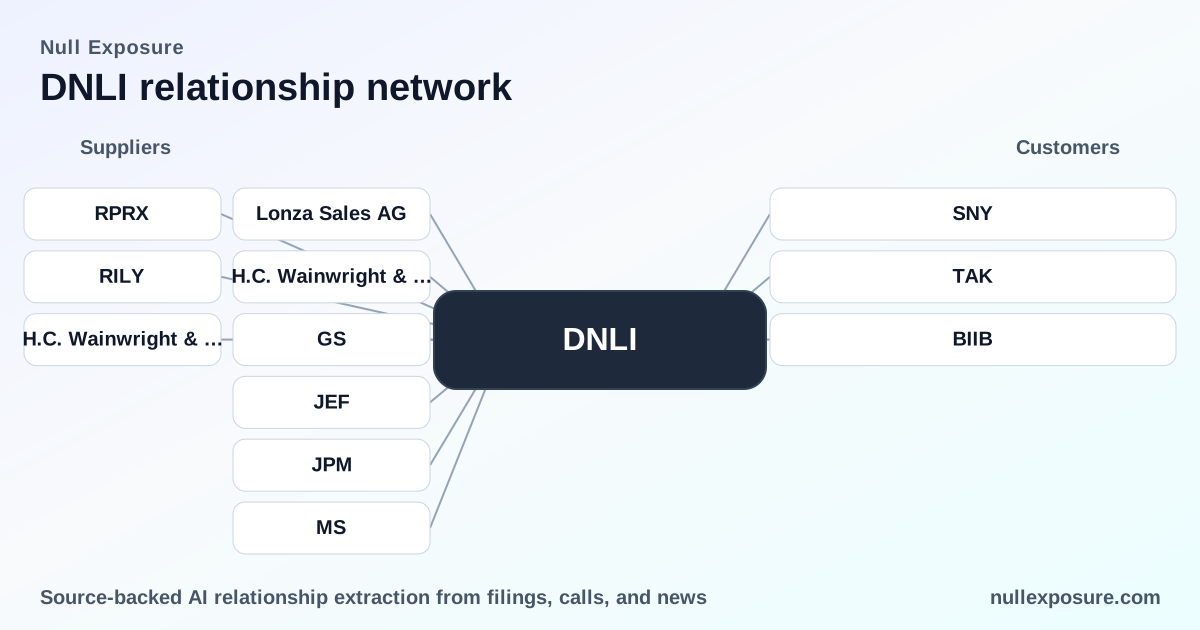
- Concentration risk: A small set of large pharma counterparties — notably Sanofi, Takeda, and Biogen — account for the majority of near-term monetization potential through upfronts, milestones and royalties.
- Criticality and maturity: Programs are at differing clinical maturity; some are near key inflection points (driving milestone sensitivity), while others are earlier-stage platform plays. Recent partner actions demonstrate that commercialization arrangements are material to cash flow and strategic optionality.
Read more about partner exposures and contract-level drivers at https://nullexposure.com/.
Relationship-by-relationship log (one-line takeaways)
Below I list each relationship item found in public coverage and filings, with a one- to two-sentence plain-English summary and a source note so investors can follow the trail.
-
Sanofi — royalty on SAR443122 / DNL758 (TradingView / Zacks, Mar 9, 2026): Denali stands to receive royalty payments on SAR443122 (DNL758), a program licensed to Sanofi that is in development for ulcerative colitis; royalties represent a downstream, non-dilutive upside stream if the program reaches commercialization. According to a Zacks summary published on TradingView (March 9, 2026), the Sanofi license carries royalty upside tied to this program.
-
Takeda — termination notice for DNL593 (ManilaTimes / GlobeNewswire, May 2, 2026): Takeda notified Denali that it will terminate the collaboration agreement for DNL593 (PTV:PGRN), returning full rights to Denali and removing co-development obligations under that program. The GlobeNewswire release republished by ManilaTimes (May 2, 2026) details Takeda’s termination decision.
-
Biogen — active collaboration on BIIB122 / DNL151 (StockTitan, Mar 9, 2026): Denali has an active collaboration with Biogen on BIIB122/DNL151 for Parkinson’s disease with a shared U.S. commercial arrangement; this partnership is a primary commercial route for that candidate. A StockTitan press summary (March 9, 2026) lists Biogen as a co-developer.
-
Biogen (duplicate listing) — same collaboration note (StockTitan, Mar 9, 2026): A second StockTitan entry repeats that Denali and Biogen are collaborating on BIIB122/DNL151 for Parkinson’s disease with shared U.S. rights. The March 9, 2026 StockTitan bulletin reiterates the joint program structure.
-
Sanofi (StockTitan) — royalty and license details (StockTitan, Mar 9, 2026): StockTitan’s March 9, 2026 post again notes that Denali stands to receive royalties for SAR443122/DNL758, reinforcing Sanofi’s licensed position on that program. The StockTitan coverage echoes the royalty exposure to Denali.
-
Sanofi (alternate tag) — royalty exposure (StockTitan, Mar 9, 2026): A duplicate StockTitan item confirms the Sanofi license and potential royalty payments for the ulcerative colitis program; multiple outlets repeated this point in March 2026. StockTitan’s summary restates the revenue mechanics.
-
Takeda (StockTitan) — co-development / 50/50 U.S. commercial rights reference (StockTitan, Mar 9, 2026): StockTitan’s March 9, 2026 notice lists Takeda as a co-developer with Denali on TAK-594/DNL593 and notes 50/50 U.S. commercial rights language in the collaboration descriptions. The entry highlights the original joint-commercialization design.
-
Sanofi — royalty on SAR443122 / DNL758 (TradingView / Zacks duplicate, Mar 9, 2026): A Zacks note republished on TradingView again calls out the royalty stream for Denali on the Sanofi-licensed program, confirming consistent market reporting. TradingView’s March 9, 2026 item reiterates the royalty point.
-
Takeda — historical deal financing and termination context (BioSpace, May 2, 2026): BioSpace reports that the original Takeda partnership began in January 2018 with Takeda providing substantial upfront funding (the articles reference the initial $150 million in support) and that Takeda has now dissolved the collaboration for the dementia program. The BioSpace piece (May 2, 2026) provides both the financial history and the termination news.
-
Takeda — Denali developing other candidates with major pharmas (TradingView / Zacks, Mar 9, 2026): A Zacks write-up on TradingView lists Takeda among Denali’s partners and states Denali is developing multiple candidates in partnership with Takeda, Biogen, and Sanofi. The March 9, 2026 Zacks summary places Takeda in the broader partner roster.
-
Takeda (alternate tag) — partner mention in Q4 coverage (TradingView / Zacks, Mar 9, 2026): TradingView’s March coverage repeats that Takeda is a named collaborator across a set of Denali programs, reinforcing the company-level partner concentration. The article provides program-level mentions in the market note.
-
Biogen Inc. — partner mention in Q4 coverage (TradingView / Zacks, Mar 9, 2026): TradingView’s report mentions Biogen among Denali’s partners in a Q4 review, again underscoring the company’s reliance on big-pharma collaborators for development and commercialization. The Zacks-sourced note appears in March 2026.
-
Sanofi — partner mention in Q4 coverage (TradingView / Zacks, Mar 9, 2026): TradingView’s Zacks recap of Denali’s portfolio lists Sanofi as a collaborator, consistent with multiple contemporaneous market write-ups in March 2026. The coverage frames Sanofi as a source of licensed programs and potential royalties.
(Each entry above corresponds to public reporting and press summaries between March and May 2026; investors should consult the underlying press releases and Denali’s SEC filings for contract-level specifics.)
Contract signals and business-model constraints investors should price
-
Licensee / customer posture: Denali’s public disclosures treat Sanofi and Takeda as customers/licensees for specific performance obligations under ASC 606/ASC 808, implying those partners received deliverables and Denali recognized upfront revenue when applicable. This legal/accounting posture means upfront payments were recognized and future revenue is tied to milestone events and royalties as documented in company filings cited in March–May 2026 coverage.
-
Large-ticket monetization: Public excerpts record material cash flows tied to partner agreements — Sanofi paid $125 million upfront at collaboration inception, and Takeda’s original program terms contemplated combined milestone and regulatory payments in the low hundreds of millions — signaling > $100m financial stakes per major collaboration and concentration of near-term value in a few contracts.
-
Operational implication: These constraints make Denali’s near-term cash profile dependent on milestone timing, partner strategic decisions (as seen with Takeda’s termination), and eventual commercialization outcomes rather than on recurring product revenue now. Investors must model binary milestone events and royalty trajectories rather than steady-state revenue growth.
Investment implications and risk signals
- Upside is event-driven and partner-enabled. Positive clinical readouts or partner-led approvals can trigger material milestone payments and long-duration royalties, creating asymmetric upside relative to current operating losses.
- Downside is concentrated and contract-sensitive. Partner terminations or strategic deprioritizations (Takeda’s May 2026 action) can strip expected cash flows and transfer program risk back to Denali, increasing funding needs or forcing re-licensing.
- Balance-sheet and ownership context: Denali shows high institutional ownership and negative operating margins, which means the market prices a growth story premised on partner success rather than near-term profitability.
For deeper partner exposure maps and contract-level signal tracking, visit https://nullexposure.com/ — the partner list and constraint signals above provide the framework to model Denali’s event-driven cash flows and to stress-test valuation scenarios.