Krispy Kreme (DNUT) — Customer Relationships Drive a Capital‑Light Growth Play
Krispy Kreme operates as a brand‑led retailer and franchisor of fresh doughnuts, coffee and complementary products, monetizing through company‑operated point‑of‑sale stores, long‑term franchise agreements that generate upfront development fees and usage‑based royalties, and selective licensing and retail partnerships. The company is executing a deliberate refranchising / capital‑light strategy to convert company assets into recurring, royalty‑driven revenue while expanding points of access through large retail partners and joint ventures. For a deeper operational signal set, see our research hub at https://nullexposure.com/.
How the business contracts and where revenue actually comes from
Krispy Kreme’s operating model combines long‑term franchise contracts with ongoing, sales‑based royalty streams and strategic retail partnerships. Franchise agreements have a material duration (initial domestic terms typically 15 years) and royalties are recognized monthly as franchisee sales occur, creating a recurring revenue profile tied directly to retail performance. The company reports substantial global scale (17,557 global points of access) and revenue segmentation that is broadly distributed across regions — the U.S. constitutes the largest single geography — and historically no single customer accounted for over 10% of revenue. Licensing relationships, such as with Keurig Dr Pepper, produce modest but steady license income and reinforce brand monetization outside company‑owned stores.
Bold operating signals:
- Contracting posture: long‑term franchise terms + usage‑based royalties underpin recurring revenue.
- Concentration: diversified across retail partners and geographies; no single customer >10% historically.
- Criticality of partners: retailer and club partners expand reach and drive DFD (Delivered Fresh Daily) sales.
- Maturity / strategy: active refranchising to improve capital efficiency and target 50% system‑wide sales from franchisees by early 2027.
The relationship map — who Krispy Kreme is partnering, selling to, or selling assets to
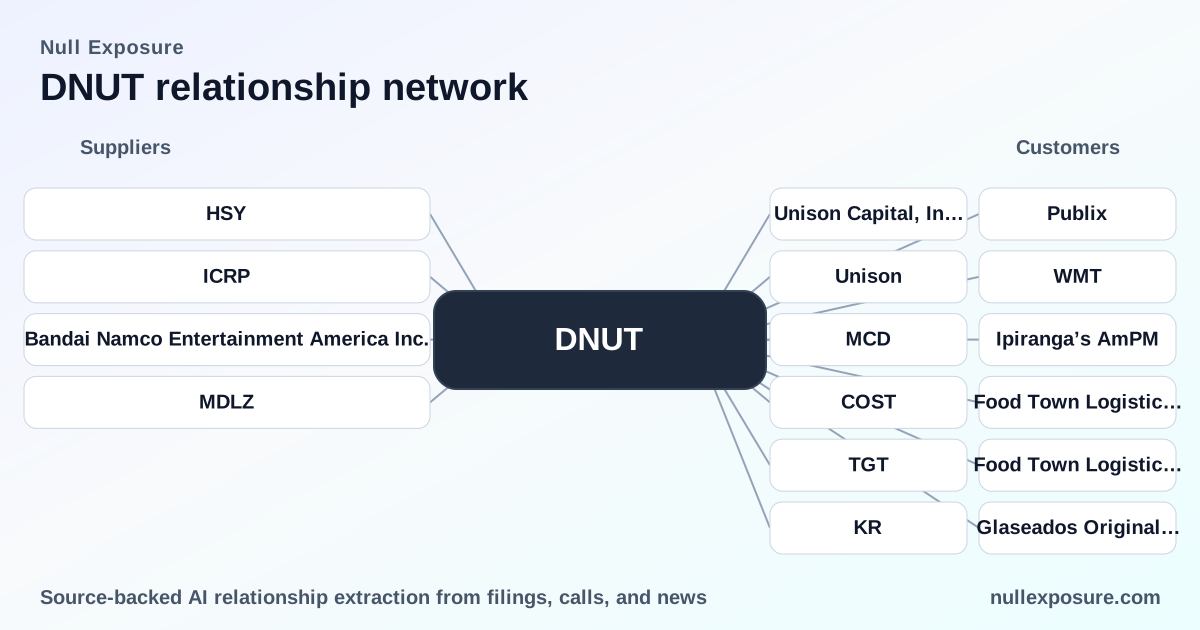
Below are the customers, partners and counterparties referenced in public coverage and filings, each with a concise description and source reference.
-
Unison Capital, Inc. — Krispy Kreme agreed to sell its Japan operations to Unison Capital for approximately $65 million as part of its international refranchising push, reflecting the company’s move to convert company‑owned assets into franchise or JV relationships. Source: company press release filed with the SEC, March 2026 (https://www.sec.gov/Archives/edgar/data/1857154/000185715425000143/a991-121925pressrelease.htm).
-
Unison (Market commentary) — Analysts noted the Japan sale to Unison as a ~$65M transaction and flagged plans to pursue 2–3 additional international refranchising deals in 2026 to tilt the portfolio toward franchisee sales. Source: MarketBeat coverage of quarterly results, March 2026 (https://www.marketbeat.com/instant-alerts/krispy-kreme-nasdaqdnut-releases-quarterly-earnings-results-beats-expectations-by-006-eps-2026-02-27/).
-
McDonald’s / McDonald’s USA (MCD) — McDonald’s terminated its business relationship with Krispy Kreme, which materially reduced net revenues in the U.S. segment and prompted Krispy Kreme to reassess rollout economics after an initial promotional launch under‑performed at McDonald’s locations. Source: BakingBusiness and TradingView summaries of company filings and press reporting (https://www.bakingbusiness.com/articles/65770-krispy-kreme-fiscal-25-loss-tops-515-million; https://www.tradingview.com/news/tradingview:48df9f0f4de68:0-krispy-kreme-inc-sec-10-q-report/).
-
Target (TGT) — Target is part of a group of strategic retail partners where Krispy Kreme added points of access; management reported that more than 200 profitable doors opened with partners including Target during the period. Source: FoodBusinessNews coverage of retail expansion, March 2026 (https://www.foodbusinessnews.net/articles/29592-new-strategies-investments-reshaping-the-fresh-donut-category).
-
Costco (COST) — Costco is listed among strategic partners in Krispy Kreme’s expansion of DFD doors, reflecting supermarket/club channel distribution that drives incremental system sales. Source: FoodBusinessNews, March 2026 (https://www.foodbusinessnews.net/articles/29592-new-strategies-investments-reshaping-the-fresh-donut-category).
-
Kroger (KR) — Kroger partners as a delivery and in‑store DFD channel; the company cited Kroger when describing approximately 1,000 fresh delivery sites with retail partners. Source: BakingBusiness and RestaurantDive coverage of refranchising and JV activity, May 2026 (https://www.bakingbusiness.com/articles/65907-krispy-kreme-shrinks-stake-in-wks-joint-venture; https://www.restaurantdive.com/news/krispy-kreme-90-million-refranchising-transaction-wks-restaurant-group/815642/).
-
Publix — Publix is listed among the strategic partners that contributed to new profitable doors in the third quarter as Krispy Kreme scaled DFD distribution into grocery and convenience channels. Source: FoodBusinessNews, March 2026 (https://www.foodbusinessnews.net/articles/29592-new-strategies-investments-reshaping-the-fresh-donut-category).
-
Sam’s Club (WMT) — Sam’s Club is included in the retailer set supplying DFD reach and contributed to the 200+ profitable doors added during the quarter. Source: FoodBusinessNews, March 2026 (https://www.foodbusinessnews.net/articles/29592-new-strategies-investments-reshaping-the-fresh-donut-category).
-
Walmart (WMT) — Walmart participates as a DFD partner at scale and is referenced alongside other large retailers as part of Krispy Kreme’s national retailer footprint and delivery network. Source: RestaurantDive and BakingBusiness reporting on the WKS transaction and retail partner network, May 2026 (https://www.restaurantdive.com/news/krispy-kreme-90-million-refranchising-transaction-wks-restaurant-group/815642/).
-
WKS Restaurant Group — WKS acquired company‑owned stores in the Western U.S. in a refranchising transaction that elevated WKS’s stake in the JV to 80% and transferred $40.4M in California store assets via a seller note structure. Source: TradingView and RestaurantDive coverage of the refranchising transaction, May 2026 (https://www.tradingview.com/news/tradingview:dbab9aba3b957:0-krispy-kreme-refranchises-west-40-4m-asset-sale-to-wks-jv-stake-shifts-to-80-20/; https://www.restaurantdive.com/news/krispy-kreme-90-million-refranchising-transaction-wks-restaurant-group/815642/).
-
Jafa Holding BV — Krispy Kreme partnered with Jafa Holding BV to open stores in the Netherlands, marking a strategic European expansion through the capital‑light franchise model. Source: FoodBusinessNews reporting on Netherlands expansion, May 2026 (https://www.foodbusinessnews.net/articles/30174-krispy-kreme-to-open-stores-in-the-netherlands).
-
Food Town Logistics‑Group, LLC — Food Town Logistics‑Group is the selected franchisee partner for Uzbekistan (Tashkent), with an aggressive roll‑out plan targeting over 70 shops in five years. Source: Snack&Bakery and MarketScreener coverage of international franchise partnerships, March 2026 (https://www.snackandbakery.com/articles/114588-krispy-kreme-enters-spain; https://www.marketscreener.com/news/krispy-kreme-continues-global-expansion-ce7d5adfd88af12d/).
-
Ipiranga’s AmPM (Brazil) — Krispy Kreme will open locations in São Paulo through a joint venture with Ipiranga’s AmPM, leveraging existing fuel/convenience real estate to accelerate market entry. Source: Snack&Bakery, March 2026 (https://www.snackandbakery.com/articles/114588-krispy-kreme-enters-spain).
-
Glaseados Originales S.L. (Spain) — Krispy Kreme entered the Madrid market via a minority interest JV with Glaseados Originales S.L., launching a Hot Light Theater shop and signaling selective minority‑JV market entries in EMEA. Source: Snack&Bakery, March 2026 (https://www.snackandbakery.com/articles/114588-krispy-kreme-enters-spain).
Constraints and what they mean for investors and operators
-
Long‑term, royalty‑driven contracts: Domestic franchise agreements are typically 15 years, which locks in development schedules and future royalty flows and supports predictable long‑run cash conversion from franchisee sales. Evidence: company disclosures on franchise initial terms.
-
Usage‑based monetization: Royalties are calculated as a percentage of franchisee gross sales and recognized as those sales occur, tying corporate revenue tightly to point‑of‑access performance and retail traffic. Evidence: company description of monthly royalties.
-
Large enterprise counterparties: Management discloses serving large retail customers and resilient DFD infrastructure; this signals contractual complexity and the need for high fixed and semi‑fixed logistics capacity, though no individual customer exceeded 10% of total revenue in recent fiscal years. Evidence: fiscal revenue concentration disclosure.
-
Geographic diversification: Revenue and points of access span NA, APAC, EMEA and LATAM with meaningful U.S. scale — company disclosures show explicit net revenue lines for the U.S., U.K., Australia/NZ and Mexico. Evidence: segment revenue breakout.
-
Licensing income exists but is small: Keurig Dr Pepper licenses the Krispy Kreme trademark for portion packs and generated modest licensing revenue (~$2.2–$2.4M annually in recent fiscal years), demonstrating ancillary brand monetization outside retail doors. Evidence: licensing revenue disclosure in company filings.
-
Relationship roles: Company disclosures classify relationships across licensee, seller and reseller roles — Krispy Kreme sells franchises (seller), licenses its brand to third parties (licensee counterparties like KDP), and collects advertising and rental contributions consistent with reseller economics.
If you want the underlying relationship signals assembled into an actionable vendor map or a governance brief for portfolio diligence, our platform provides a consolidated view — visit https://nullexposure.com/ for the full report.
Investment takeaways: what drives upside and where downside concentrates
- Upside drivers: accelerating refranchising will convert capital expenditures into royalty streams, improving capital efficiency and operating margin trajectory; expanding DFD partnerships with large retailers scales points of access quickly and lifts system sales.
- Risk vectors: partner termination or underperformance (illustrated by the McDonald’s exit) compresses revenue and can lead to store closures, and execution on international JV/franchise rollouts requires disciplined capital allocation and franchisee selection. Royalties are usage‑based, so retail traffic trends and channel economics directly affect top‑line visibility.
This relationship map shows Krispy Kreme is executing a clear pivot from operator to brand and franchisor, trading immediate store profit for longer‑term, recurring royalty income and broader retail reach. That strategic pivot is the principal lens investors and operators should use when evaluating DNUT.