DocuSign (DOCU): Customer Relationships and Commercial Signals (FY2026 snapshot)
DocuSign monetizes a global cloud software platform primarily through subscriptions to eSignature, CLM and Intelligent Agreement Management (IAM) products, supplemented by professional services. The company sells across the full commercial spectrum — from very small businesses to Global 2000 enterprises — and drives value by embedding contract workflows into customers’ day-to-day systems, which increases renewal rates and upsell potential. For a quick look at the source behind this analysis, visit NullExposure.
Why customer mentions in FY2026 matter to investors
Customer-level disclosures in FY2026 highlight two strategic vectors: enterprise-scale wins and platform integrations. Large, multi-year deals (and marketplace integrations) signal durable revenue and higher average contract values, while repeated mentions from smaller buyers show continued penetration at scale. Combined, these threads underpin DocuSign’s subscription economics and explain how the company sustains growth without single-customer concentration.
FY2026 relationship ledger — who’s using what, and why it matters
Below are every customer relationship cited in the FY2026 sources in the record, each with a plain-English summary and a concise source note.
Aon
Aon is implementing DocuSign’s Intelligent Agreement Management (IAM) to surface intelligence from legacy agreements and deliver that capability through Aon’s Meridian product, which shortens time-to-value for client teams. Source: InsiderMonkey Q4 FY2026 earnings call transcript (May 2, 2026) — https://www.insidermonkey.com/blog/docusign-inc-nasdaqdocu-q4-2026-earnings-call-transcript-1720434/
Vestwell
Vestwell connected IAM to its CRM and reduced the time to build a customer agreement package from 75 minutes to 5 minutes, illustrating productivity wins for fast-growing fintech customers. Source: InsiderMonkey Q4 FY2026 earnings call transcript (May 2, 2026) — https://www.insidermonkey.com/blog/docusign-inc-nasdaqdocu-q4-2026-earnings-call-transcript-1720434/
Move Forward Financial
Move Forward Financial, a real estate lender, is using IAM to cut costs and improve the borrower experience, a classic productivity and CX use-case that supports higher retention in lending workflows. Source: InsiderMonkey Q4 FY2026 earnings call transcript (May 2, 2026) — https://www.insidermonkey.com/blog/docusign-inc-nasdaqdocu-q4-2026-earnings-call-transcript-1720434/
Bank of Queensland (BOQ)
Bank of Queensland signed a three-year strategic agreement and upgraded to IAM via the Microsoft Azure Marketplace, indicating both multi-year contracting and cloud-platform distribution. Source: InsiderMonkey Q4 FY2026 earnings call transcript (May 2, 2026) — https://www.insidermonkey.com/blog/docusign-inc-nasdaqdocu-q4-2026-earnings-call-transcript-1720434/
Century Communities (CCS)
Century Communities uses DocuSign to electronically execute home purchase contracts across multiple community announcements and press releases during FY2026, showing consistent use in residential real-estate transactions. Source: multiple press items including FT Markets (Mar–Apr 2026) and PR Newswire releases — e.g., https://markets.ft.com/data/announce/detail?dockey=600-202603251241PR_NEWS_USPRX____LA19264-1 and https://www.prnewswire.com/news-releases/century-communities-announces-grand-openings-for-new-homes-in-austell-and-mcdonough-ga-302725129.html
Elastic
Elastic is deploying Navigator to automate contract workflows across its business, indicating adoption of DocuSign’s contract automation in data and AI-focused companies. Source: InsiderMonkey Q4 FY2026 earnings call transcript (May 2, 2026) — https://www.insidermonkey.com/blog/docusign-inc-nasdaqdocu-q4-2026-earnings-call-transcript-1720434/
Clasp
Clasp, a fintech leader referenced alongside Elastic, is leveraging Navigator and app extensions to automate agreement workflows and centralize contract data, highlighting how vertical fintechs adopt the platform. Source: InsiderMonkey Q4 FY2026 earnings call transcript (May 2, 2026) — https://www.insidermonkey.com/blog/docusign-inc-nasdaqdocu-q4-2026-earnings-call-transcript-1720434/
Payworks
Payworks integrated IAM with a complex Salesforce implementation and increased 24‑hour contract completion rates from 55% to 87%, recovering over $400,000 in annual sales rep productivity. This underscores measurable ROI for SMB-to-midmarket workflow automations. Source: InsiderMonkey Q4 FY2026 earnings call transcript (May 2, 2026) — https://www.insidermonkey.com/blog/docusign-inc-nasdaqdocu-q4-2026-earnings-call-transcript-1720434/
Clasp (repeat mention)
See above for Clasp’s Navigator and extension adoption; listed separately in source results but reflecting the same FY2026 narrative. Source: InsiderMonkey Q4 FY2026 earnings call transcript — https://www.insidermonkey.com/blog/docusign-inc-nasdaqdocu-q4-2026-earnings-call-transcript-1720434/
PRDS
A corporate finance leader quoted in Fortune in 2022 noted heavy internal use of DocuSign for approvals and contracts, demonstrating long-standing adoption among healthcare and biotech executives. Source: Fortune profile (2022) cited in FY2026 results — https://fortune.com/2022/01/21/this-leader-has-been-a-cfo-at-5-biotech-startups-and-just-helped-a-covid-pill-developer-go-public/
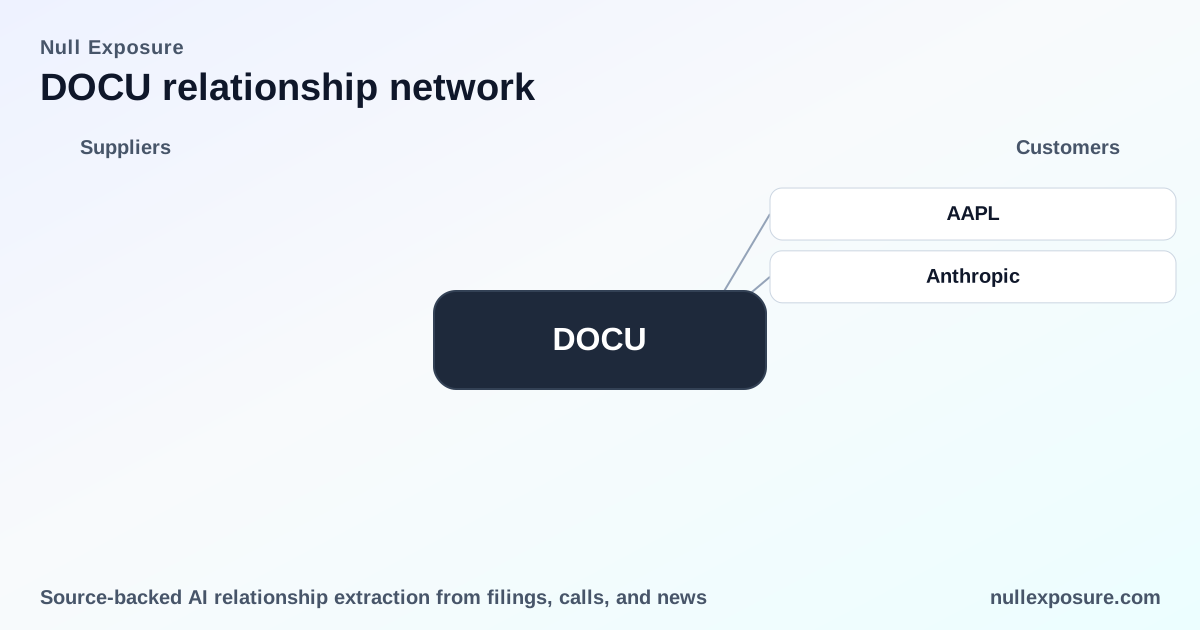
Apple Operations International Limited (AAPL)
DocuSign’s Irish entity subleased office space to Apple Operations International Limited for a 30‑month term in 2024, a leasing detail captured in FY2026 reporting and reflecting corporate real‑estate interactions. Source: RTE business article (Jan 9, 2026) — https://www.rte.ie/news/business/2026/0109/1552329-irish-arm-of-docusign-back-in-profit-after-restructuring/
Anthropic
Anthropic named DocuSign as a connector partner for its enterprise AI platform Cowork, enabling agreement drafting, routing, and execution via natural language prompts — a strategic integration that elevates DocuSign inside enterprise AI workflows. Source: Intellectia article (Mar 2026) — https://intellectia.ai/news/stock/docusign-nasdaqdocu-faces-seventh-consecutive-loss-down-1712-yeartodate
Slack (WORK)
DocuSign integrated IAM directly into Slack so users can create, negotiate, and execute contracts inside Slack conversations, extending contract automation to collaboration workflows. Source: SahmCapital news commentary (Apr 13, 2026) — https://www.sahmcapital.com/news/content/docusign-slack-integration-arrives-as-shares-trade-below-analyst-targets-2026-04-13
For a consolidated view of these relationships and additional signals, visit NullExposure.
Operational constraints and what they imply for the business model
- Subscription-first contracting posture. DocuSign reports that subscriptions accounted for 97% of revenue, with typical multi-year contracts and many customers paying one year in advance; this underpins recurring revenue visibility and cash conversion. (Company filings cited in FY2025–FY2023 excerpts.)
- Wide counterparty breadth. The customer base includes VSBs through Global 2000 enterprises, government institutions and individuals, which signals diversified demand and reduces reliance on a handful of large buyers.
- Low single-customer concentration. No customer exceeded 10% of revenue in the periods presented, making revenue concentration immaterial and lowering client-specific tail risk.
- Global footprint with U.S. revenue dominance. DocuSign has a worldwide presence, but U.S. revenues remain the largest component (see revenue breakdown for FY2025). International offices span Europe, Asia, Latin America, Israel and Australia, supporting expansion and local compliance.
- Services as an expansion lever. Professional services and training are present but secondary; they function as a customer success and adoption engine, not the primary revenue driver.
- Meaningful enterprise spend band. The company disclosed 1,131 customers with >$300k ACV (Jan 31, 2025), indicating a meaningful cohort of high‑value enterprise relationships that support gross retention and net expansion.
Investment implications: risk vs reward
- Upside drivers: marketplace and AI integrations (Anthropic, Slack, Azure) accelerate product stickiness and create embedded distribution channels that raise lifetime value. Enterprise multi-year contracts (Bank of Queensland, Aon) validate higher ACV plays.
- Structural risks: heavy dependence on subscription renewals creates exposure to retention and competitive churn, and U.S. revenue predominance concentrates macro and regulatory risk geographically.
- Net argument: DocuSign’s commercial signals in FY2026 show durable enterprise adoption and platform extensibility, supporting its premium valuation relative to software peers, while the subscription model and global customer breadth limit single-customer downside.
Bottom line
DocuSign’s FY2026 customer mentions map cleanly to a strategy of embedding intelligent contract workflows across enterprise and mid‑market accounts while continuing scale at the lower end through ubiquitous eSignature use. The combination of multi-year enterprise agreements, marketplace distribution, and AI/collaboration integrations creates a stronger recurring revenue profile and multiple vectors for expansion.
For deeper customer-level signal analysis and ongoing tracking of DOCU relationships, visit NullExposure.