Dow Inc. customer relationships: what investors should price in now
Dow Inc. is a global commodity chemical manufacturer that monetizes through product sales, long‑term supply contracts, and licensing of technology and patents, extracting margin from feedstock advantage, integrated operations and recurring royalties. For investors and operators, the most relevant signal set is not a single counterparty but the mix of short‑cycle commodity sales, multiyear supply commitments and targeted licensing relationships that together drive cash flow and operational optionality. Explore the underlying customer intelligence at https://nullexposure.com/.
How Dow’s customer model actually works — one operating picture
Dow runs a hybrid commercial model. Product sales are predominantly short‑term commodity transactions, where the interval between order confirmation and performance is typically under a year, while the company also maintains long‑term supply contracts and advance payments from large customers that smooth revenue and working capital. The 2025 10‑K documents that Dow derives licensing revenue from sales‑based royalties and technology licenses, and that some business lines operate through distributors and manufacturers rather than exclusively direct sales.
Geographically, Dow’s revenue footprint is broad — about 40% North America, ~31% EMEAI, and the remainder Asia Pacific and Latin America — which reduces single‑market concentration but exposes Dow to regional feedstock and logistics dynamics (10‑K, 2025). The 2025 filing also states no single customer represented a significant portion of sales, an important signal for counterparty concentration risk. Overall, expect a contracting posture that mixes short cycles for commodity products with select long‑term, high‑criticality supply and licensing arrangements.
Relationship roll call: the counterparties cited in filings and media
Below are every counterparty cited in the collected material, each with a concise investor‑grade summary and source note.
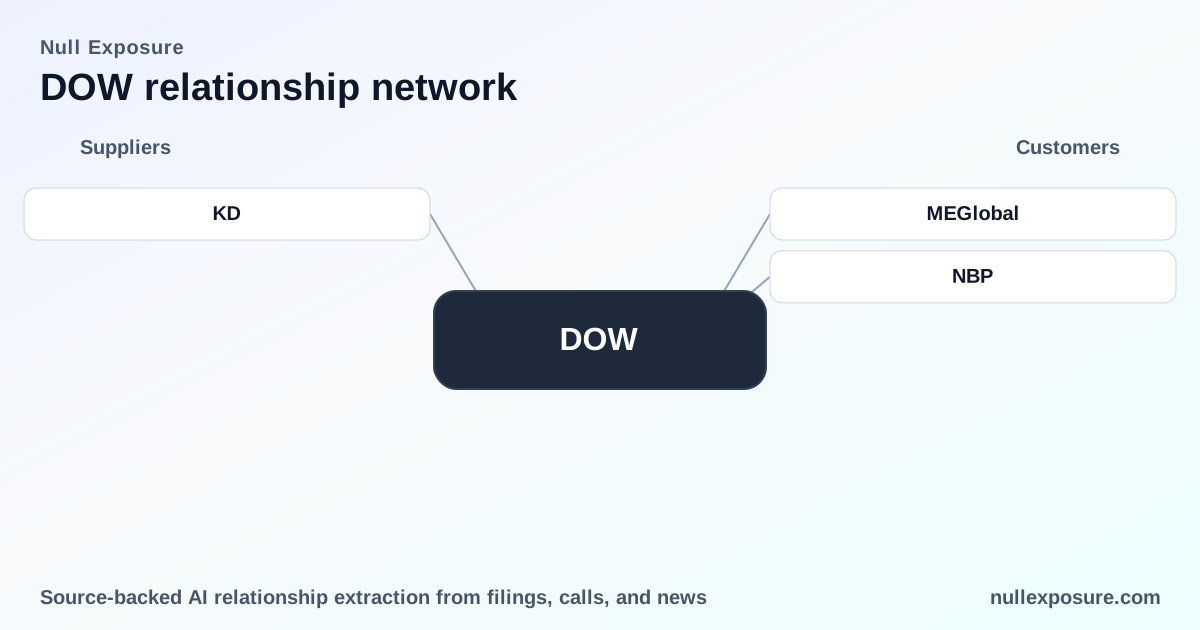
MEGlobal
Dow sells excess ethylene glycol produced at its U.S. and European facilities to MEGlobal, a subsidiary of EQUATE, indicating commercial offload of surplus intermediates to a large regional trading counterparty. This is cited in Dow’s 2025 10‑K.
ANRO
ANRO reports it in‑licenses a patent from Dow for intermediate compounds used in manufacturing ALTO‑100, reflecting Dow’s role as a licensor of specialty chemical IP. Source: ANRO 2024 10‑K filing.
TSE
TSE states it maintains a significant relationship with Dow for technology, site services, utilities and the supply of raw materials, signaling integrated site‑level cooperation and cross‑supply arrangements rather than a simple buyer‑seller relationship. Source: TSE 2024 10‑K.
CBT (Cabot Corporation)
Cabot’s Q4 2025 earnings call reports Dow’s closure of its siloxanes plant in Barry, Wales and that Cabot exchanges feedstock and materials under a long‑term agreement that runs through 2028, with compensation mechanisms for nonperformance. This identifies neighboring asset interdependence and contractual remedies; see Cabot Q4 2025 earnings call and subsequent transcript (early 2026).
OLN (Olin Corporation)
Olin disclosed roughly $70 million of stranded costs tied to Dow’s closure of a Freeport propylene oxide plant, showing how Dow’s site actions create quantifiable counterparty impacts for adjacent manufacturers. Source: Olin Q4 2025 earnings call.
INV / Refinity (Innventure)
Refinity — an Innventure company — is deepening commercialization collaboration with Dow, which has provided technical expertise and product‑specification support as Refinity advances its conversion technology toward commercial demonstration. This collaboration underscores Dow’s strategic role in commercialization partnerships for circular chemistry; see Refinity press release via GlobeNewswire and related coverage (Feb 17, 2026).
NBP (as cited in PlasticsNews)
PlasticsNews reported that Nova must pay Dow more than $1 billion in an ethylene dispute, a material legal/contractual settlement that affects commodity cash flows and counterparty credit dynamics. Source: PlasticsNews coverage (March 9, 2026).
Nova
The same PlasticsNews item is recorded under “Nova” as well, confirming the dispute outcome and its financial magnitude relative to Dow’s commodity business. Source: PlasticsNews (March 9, 2026).
What these relationships tell investors about risk and leverage
- Contract mix matters: Dow runs both short‑term commodity sales and longer‑dated supply/licensing contracts. The company’s 2025 disclosures explicitly call out product contracts as generally short‑term while also noting advance payments and multiyear supply arrangements — a combination that stabilizes cash flow but leaves margins exposed to spot feedstock volatility.
- Licensing is a steady annuity: Licensing income is described as sales‑based royalties and licensing arrangements in the 10‑K, making it a predictable, if smaller, revenue stream that reduces cyclicality relative to bulk commodity sales.
- Geographic diversification cushions but doesn’t remove regional risk: With roughly 40% sales in North America and strong EMEAI and APAC exposure, Dow’s customer base spreads regional shocks; however, plant closures or disputes (Freeport, Barry, Nova) create concentrated operational impacts for local suppliers and partners.
- Counterparty impact is real and measurable: The Freeport and Barry plant closures produced direct financial consequences for nearby firms (Olin, Cabot) and contractual compensation claims, illustrating that Dow’s operational decisions propagate through supply chains with quantifiable outcomes.
- No single‑customer concentration: Management’s 2025 statement that no single customer accounted for a significant portion of sales reduces headline counterparty concentration risk, though individual disputes and plant actions can still produce business‑line level stress.
Actionable takeaways for investors and operators
- Watch Dow’s advance payments and long‑term contract backlog for signs of revenue stability and potential downside protection; these are clear levers management uses to smooth commodity cyclicality.
- Monitor legal outcomes and settlement receipts (e.g., the Nova ruling) because they materially affect near‑term cash flow and risk allocation across counterparties.
- For operators, account for site‑level interdependencies when evaluating capex or closures: neighboring producers face real stranded‑cost exposure, as Olin and Cabot disclosures demonstrate.
- For research and competitive diligence, track Dow’s licensing activity for specialty chemistries — licensing receipts are a durable, less cyclical revenue component referenced in the 2025 filing.
For a consolidated view of these and other counterparty signals, visit Null Exposure: https://nullexposure.com/ — the source for these relationship extractions and ongoing monitoring. If you need a tailored counterparty risk brief or an investor‑ready summary for portfolio screening, Null Exposure can provide deeper, document‑linked profiles.
Bold takeaways: Dow’s business is a portfolio of short‑cycle commodity sales tempered by long‑term supply and licensing relationships; operational decisions such as plant closures create measurable counterparty cost and litigation outcomes that investors must price into near‑term cash flow projections.