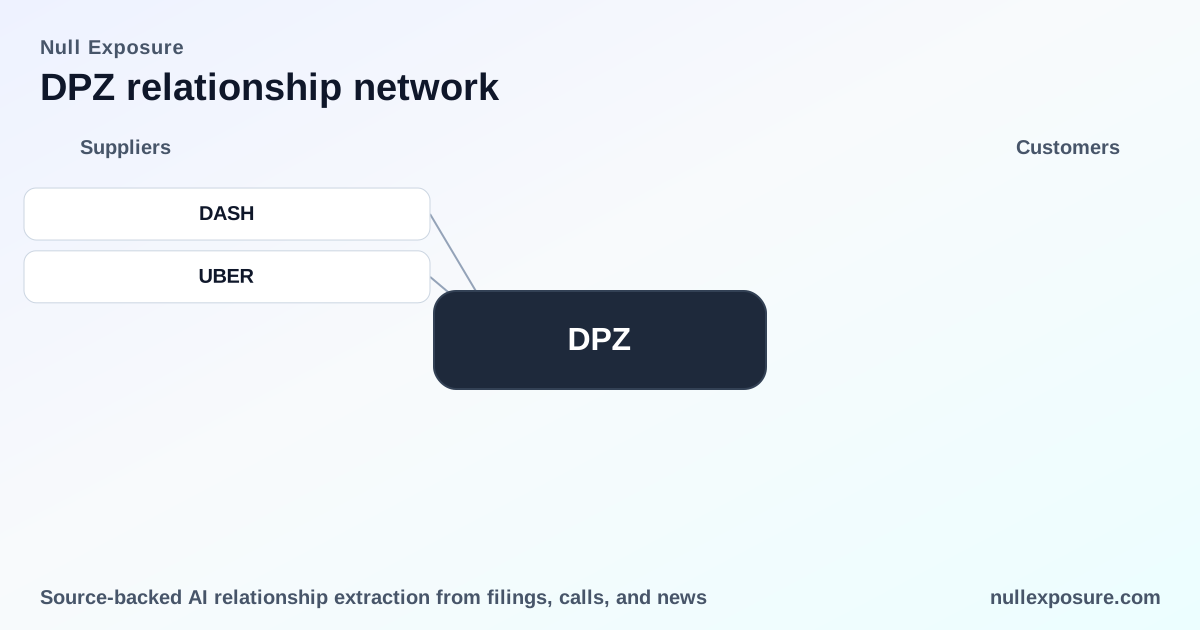
Domino’s (DPZ) Customer Relationships: Franchise backbone and aggregator growth
Domino’s monetizes primarily through a franchise-driven model: the company charges royalties and fees to franchisees, sells supply-chain goods to owned and franchised stores, and receives recurring revenue from long-term franchise agreements. Franchise royalties, supply-chain sales, and digital ordering penetration are the core profit drivers—together they convert store-level retail sales into predictable corporate revenue and high operating leverage for investors.
For more granular signals on counterparty exposure and concentration, see our platform: https://nullexposure.com/
The operating model investors should internalize
Domino’s is a franchisor at scale with an integrated supply-chain business. Corporate disclosures and recent evidence establish several company-level operating characteristics that determine counterparty risk and revenue durability:
- Contracting posture: long-term and renewal-oriented. Domino’s typically grants franchise rights for ten-year terms with renewal options, and reported a roughly 99% franchise renewal rate in 2024, creating a high level of contractual stability and predictable fee streams.
- Revenue concentration and criticality. The supply-chain segment accounted for ~60% of consolidated revenues in 2024, making supply-chain sales a critical source of cash flow in addition to royalties and franchise fees.
- Global footprint with North American concentration. Domino’s operates in over 90 markets globally, yet over 90% of supply-chain revenue is U.S.-centric, exposing the distribution business to North American demand cycles while franchise royalties reflect a broader geographic sales base.
- Maturity and repeatability. Franchise fees are recognized over ten-year store agreements, creating straight-line, recurring revenue recognition that supports margin stability. The company also enforces a standard royalty (commonly 5.5% of sales) which ties corporate economics to systemwide retail performance.
These observations come directly from Domino’s public disclosures and recent company commentary included in the FY2024/early-FY2026 reporting cycle.
Two customer relationships that matter right now
Below I cover every relationship surfaced in the customer-scope results and what each means for investors.
DPC Dash Ltd — investment and master-franchise exposure in China
Domino’s recorded a $30 million unfavorable swing related to the valuation of its investment in DPC Dash Ltd, the company’s master franchisee in China, signaling impairment pressure tied to that franchise arrangement and local market performance. This is a direct charge investor should treat as an indicator of development friction and capital-at-risk in the China master-franchise position (PizzaMarketplace, May 2026: https://www.pizzamarketplace.com/news/dominos-profits-fall-as-consumers-curb-spending-based-on-rising-costs/).
DoorDash (DASH) — aggregator platform growth and distribution channels
Management highlighted continued growth on aggregator platforms, particularly DoorDash, noting that the DoorDash roll-out was not fully completed until mid‑2025 and is expected to contribute to growth in 2026. This underscores third-party delivery platforms as an expanding distribution channel that increases order volume but also shifts mix toward aggregator economics and fee structures (Benzinga earnings call transcript, Q4 2025 / FY2026 guidance commentary, Mar 2026: https://www.benzinga.com/markets/earnings/26/02/50790121/dominos-pizza-q4-2025-earnings-call-transcript).
Why these relationships matter to valuation and risk
Both relationships crystallize how Domino’s revenue model converts store-level demand into corporate earnings:
- Master-franchise investments are strategic but capital-exposed. The DPC Dash impairment demonstrates that Domino’s balance sheet carries equity stakes and valuation sensitivity in certain international franchise arrangements; investors should treat such investments as potential one-off hits to earnings when local franchise economics deteriorate.
- Aggregator partnerships alter channel economics. Growth through DoorDash increases addressable demand and digital penetration (Domino’s already generates a high share of U.S. retail sales from digital channels), but aggregator fees and order mix changes can compress unit-level economics for franchisees and influence royalty growth over time.
Practical constraints that shape counterparty risk
Company disclosures surface a set of constraints that shape Domino’s customer relationships as a whole:
- Long-term contract structure stabilizes revenue but concentrates renewal risk. Ten-year franchise terms with renewals smooth revenue recognition and underpin royalty streams, which supports valuation multiples that price durability.
- U.S.-centric supply-chain exposure creates geographic concentration. With the majority of supply-chain revenue coming from the U.S., Domino’s has a single-region sensitivity on the largest portion of its corporate sales.
- High materiality of supply-chain sales. Supply-chain sales accounted for a large share of consolidated revenue, so any disruption to distribution or material-cost inflation in the supply chain is systemically material to consolidated margins.
- Low contingent liability from lease guarantees. The company reports modest guaranteed lease payment exposure (in the low tens of millions), which management classifies as immaterial to liquidity and operating performance.
- Role clarity—licensor and seller. Domino’s acts as both a licensor (collecting royalties, typically 5.5% of sales) and a seller through supply-chain operations, creating dual revenue levers that are sensitive to systemwide store sales and product costs.
- High renewal rates and maturity of the franchise base. A ~99% renewal rate and standardized agreements indicate a mature franchising model with low churn among existing franchisees.
These constraints come from the company’s public filings and the excerpts disclosed in the FY2024–FY2026 reporting cycle.
Investment implications and risk checklist
- Upside: Digital penetration and aggregator rollouts like DoorDash accelerate same-store sales and royalty growth without commensurate corporate capital spending. Domino’s operating margins and return on assets remain strong relative to peers, supporting premium multiples.
- Downside: International master-franchise stakes (for example, DPC Dash Ltd in China) expose Domino’s to one-off impairments and local market volatility; supply-chain cost shocks in the U.S. hit a disproportionately large share of consolidated revenue.
- Balance-sheet sensitivity: Recent valuation swings on international holdings are earnings-affecting but limited versus total market cap; investors should watch for further impairments as a near-term earnings risk.
- Operational watch-list: franchise renewal trends, supply-chain cost inflation, aggregator fee pass-through, and the pace of DoorDash/system rollout.
If you want a deeper counterparty exposure map or tracking for DPZ counterparties, visit our research hub: https://nullexposure.com/
Bottom line
Domino’s operates a predictable, royalty-and-supply-chain-first model with strong digital distribution tailwinds and concentrated U.S. supply-chain exposure. Aggregator growth (DoorDash) is an important demand driver, while international master-franchise investments (DPC Dash Ltd) represent capital at risk and are the primary source of episodic earnings volatility. Investors should value Domino’s for its recurring royalties and high operating leverage, while monitoring international franchise valuations and supply-chain cost dynamics as the principal near-term risk factors.