Daqo New Energy (DQ): Customer Relationships and What They Mean for Investors
Daqo New Energy is a vertically focused polysilicon producer that monetizes through sales of high-purity polysilicon to large solar module manufacturers and wafer/ingot producers. The company's economics derive from feedstock pricing power, capacity utilization in its Xinjiang and Chongqing operations, and sustained demand from tier-one module OEMs; investors should treat Daqo primarily as a materials supplier whose fortunes track module demand and polysilicon pricing. For a concise view of customer exposures and vendor dynamics, visit https://nullexposure.com/ for ongoing coverage.
Quick company snapshot: position in the solar supply chain
Daqo is headquartered in Shanghai and listed on the NYSE under ticker DQ. Fiscal metrics show TTM revenue of $665 million with negative EPS and operating margins under pressure, reflecting cyclical input costs and capacity ramp timing. The company sits upstream in the PV value chain: polysilicon is a critical raw material for wafers and modules, making Daqo a strategically important supplier to a concentrated set of large module manufacturers. Analysts maintain a consensus target price that implies upside to current levels, supported by strong buy-side coverage.
Who actually buys Daqo’s product: the customer list from the record
The dataset of customer-related mentions is compact but revealing. A SolarQuotes industry write-up documents Daqo’s customer relationships historically, and the entries below reflect every relationship record returned in the search results.
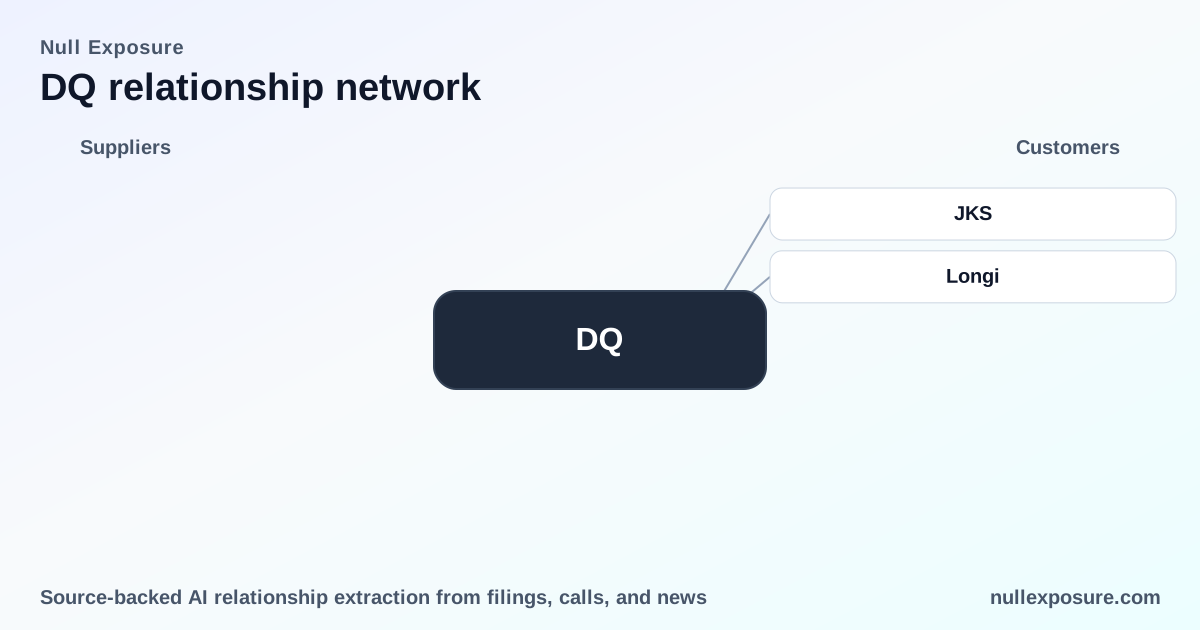
JinkoSolar (JKS) — large module OEM that sources Daqo polysilicon
JinkoSolar is listed among the major module manufacturers that use Daqo’s polysilicon, identifying Jinko as a material customer in the company’s supply footprint for FY2020. According to a SolarQuotes report published March 9, 2026, Jinko is explicitly named as a buyer of Daqo polysilicon, highlighting Daqo’s linkage to tier‑one module demand (SolarQuotes, March 2026 — reporting on FY2020).
JKS (duplicate record) — same counterparty reflected again
The results include a duplicate entry for JKS with the same FY2020 reference and same SolarQuotes source; this confirms the data point is repeated in the corpus and reinforces the visibility of Jinko as a named customer. The underlying source is the same SolarQuotes write-up from March 2026 referencing FY2020 sourcing relationships.
Longi — another top-tier module customer using Daqo polysilicon
Longi is also named alongside Jinko as a major module manufacturer that has used Daqo’s polysilicon, again tied to the FY2020 time frame in industry reporting. The SolarQuotes analysis (March 9, 2026) lists Longi as a buyer, underscoring exposure to the handful of global module leaders that dominate volume and pricing.
What these relationships imply for contracting posture and concentration
- Customer concentration is material. The named buyers—Jinko and Longi—are global leaders that take large volumes; relationships with such scale buyers imply Daqo’s revenue base is concentrated among a few strategic customers rather than a highly diversified retail base.
- Supplier criticality is high. Polysilicon is an upstream bottleneck; being a named supplier to tier‑one module makers positions Daqo as a critical input provider whose sales are closely correlated with the module manufacturers’ production schedules.
- Contracting posture is supplier-driven but dependent on offtake volumes. Given the scale of customers referenced, Daqo’s commercial model is consistent with long-term offtake and spot arrangements that prioritize volume and delivery reliability; this implies sensitivity to negotiated pricing and contract tenure.
- Maturity and risk profile: The company is operationally mature enough to supply tier‑one customers, but financials show cyclical profitability and negative EPS, flagging execution and commodity‑price risks that can compress margins during oversupply cycles.
These are company-level signals derived from documented customer links and Daqo’s placement in the value chain; they are not assigned to any specific constraint record because no explicit contractual excerpts were provided.
Investment implications and risk checklist for operators and allocators
- Revenue sensitivity to module cycles: With named customers concentrated among global module leaders, Daqo’s top-line is directly exposed to fluctuations in downstream demand and module pricing.
- Pricing leverage is double-edged. When polysilicon is tight, suppliers like Daqo benefit; when capacity floods the market, margins can compress quickly. The current financials show negative profitability metrics that investors should monitor alongside polysilicon spot and contract spreads.
- Customer dependency risk: A limited set of large buyers increases counterparty concentration risk. Operational continuity and contract terms with Jinko and Longi will be determinative for cash flow stability.
- Geopolitical and jurisdictional considerations: Headquartered in China and operating significant capacity there, Daqo’s supply chain and market access are influenced by regional policy, export dynamics, and trade flows—factors investors must model into scenario analyses.
For ongoing updates on Daqo’s customer exposures and supply‑chain mapping, see https://nullexposure.com/ for regular investor briefs.
Where to focus due diligence next
- Review the tenor and structure of offtake agreements with named customers, including pricing formulas and minimum take commitments.
- Track polysilicon spot prices versus contract indexes to quantify margin sensitivity.
- Validate capacity utilization and new‑capacity commissioning timelines in Daqo’s operating regions.
- Monitor buyer diversification efforts and any strategic downstream integration by module customers that could shift sourcing patterns.
Bottom line: concentrated customers, material strategic positioning, watch pricing
Daqo occupies a strategic upstream position supplying polysilicon to a small set of global module leaders such as JinkoSolar and Longi, which creates both significant upside in tight markets and pronounced exposure in oversupply scenarios. Investors and operators should treat customer relationships as a primary lens for assessing revenue durability and margin cycles—contract terms, volumes, and price pass-through will determine whether Daqo converts strategic supplier status into consistent cash generation.