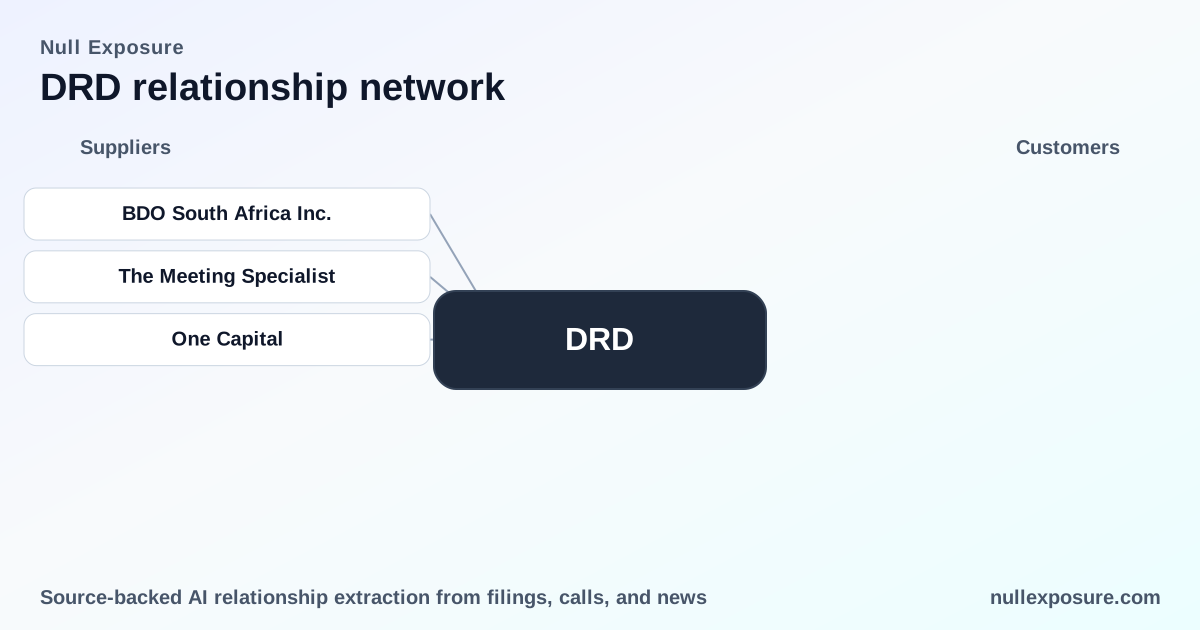
DRDGOLD (DRD) — Customer Map and What It Means for Investors
DRDGOLD operates a focused, asset-light gold-tailings retreatment business in South Africa, monetizing through the processing of surface tailings and selling refined gold into market channels. The company converts legacy mining waste into saleable gold via tolling and offtake arrangements with large industrial counterparties, generating high operating margins and strong cash conversion. For investors, the core question is counterparty concentration — who pays DRD for processing and gold offtake and how dependent is the business on a small set of customers? Explore deeper relationship analytics at NullExposure: https://nullexposure.com/.
How to read DRDGOLD’s customer picture — practical signals for valuation
DRDGOLD’s financial profile shows a mature, profitable operator: revenue TTM roughly $9.13B, operating margin ~46% and market capitalization about $2.32B (latest public figures through FY2026/Dec‑2025). Those metrics establish DRD as a cash-generative specialty miner where customer dynamics materially influence both upside and downside.
From the customer intelligence available, investors should extract four company-level signals:
- Concentration: The customer map shows clear concentration risk — a single counterparty dominates FY2026 sales. That concentration compresses the margin of error for revenue forecasts and increases negotiation leverage for the largest buyer.
- Criticality: When a large share of top-line receipts is tied to one or two counterparties, those relationships are functionally critical to free cash flow and capital allocation decisions.
- Contracting posture: The industry practice for tailings retreatment and DRDGOLD’s operating model imply commercial relationships structured as offtake/tolling and multi-year supply arrangements rather than spot cash sales to many small buyers; that structure increases predictability but also raises counterparty bargaining power.
- Maturity and resilience: High operating margins and positive returns on capital signal a mature, defensible business that can absorb cyclical swings in gold price through operational leverage, provided counterparty access remains stable.
These signals should be treated as primary drivers when modeling downside scenarios, negotiating engagements, or sizing position risk.
Every named customer relationship in the available results
Ergo
Ergo is the dominant commercial partner for DRDGOLD in FY2026: Ergo accounted for 73.7% of total sales, equivalent to $117.42 million, making it the central revenue engine for the period in question. According to an Intellectia financials report for FY2026, Ergo’s contribution is the largest single line item on DRD’s revenue side (Intellectia, May 2026: https://intellectia.ai/en/stock/DRD/financials).
FWGR
FWGR is listed as another important revenue stream for DRDGOLD in FY2026, though the public excerpt does not disclose a percentage or dollar amount. The Intellectia FY2026 summary cites FWGR as a material secondary customer alongside Ergo (Intellectia, May 2026: https://intellectia.ai/en/stock/DRD/financials).
What the customer mix means for credit, valuation, and operations
- Valuation sensitivity: With ~74% of FY2026 sales from Ergo, DRDGOLD’s revenue and free cash flow estimates are highly sensitive to the continuity and pricing terms of that single relationship. A disruption or renegotiation could swing near-term cash flow materially and change enterprise valuation multiples.
- Negotiating leverage: High concentration gives Ergo outsized bargaining power on price, payment terms, and capital allocation priorities for DRDGOLD. Expect contract economics to reflect that power asymmetry unless DRD secures diversified offtake or raises counterparty switching costs.
- Operational risk: The processing operations are specialized; while margins are attractive, the fixed-cost nature of plant operations increases downside when throughput or offtake reduces. Loss of a major buyer would not only cut revenue but also underutilize capacity, eroding unit economics.
- Counterparty credit and payment flow: Investors should treat large customers as quasi-creditors. The credit standing and payment behavior of Ergo and FWGR directly affect DRD’s cash conversion and working capital metrics.
Practical diligence checklist for investors and operators
- Obtain and review contract length, pricing formulas, termination clauses, and minimum offtake guarantees for the Ergo and FWGR arrangements to quantify replacement cost and downside.
- Stress-test models for a multi-quarter reduction in volumes from Ergo, including fixed-cost absorption, margin compression, and dividend capacity.
- Monitor public filings and company disclosures for receivable aging and concentration notices; changes in those metrics are early signals of counterparty strain.
- Assess options to diversify revenue: incremental customers, processed-product sales channels, or value-added refining that reduce single-counterparty dependence.
Learn more about how concentrated customer relationships change risk profiles and underwriting through targeted analytics at NullExposure: https://nullexposure.com/.
Bottom line — risk is concentrated but transparent
DRDGOLD is a profitable and mature operator with elevated customer concentration in FY2026. Ergo represents a single-point risk, accounting for roughly three-quarters of sales in the referenced period, while FWGR plays a meaningful secondary role. For investors, the immediate tasks are contract-level diligence and scenario analysis: quantify the impact of a disruption to Ergo, validate payment mechanics, and evaluate DRD’s plan to diversify offtake. Those steps convert the observable customer map into investable conviction or a risk-mitigated trade.