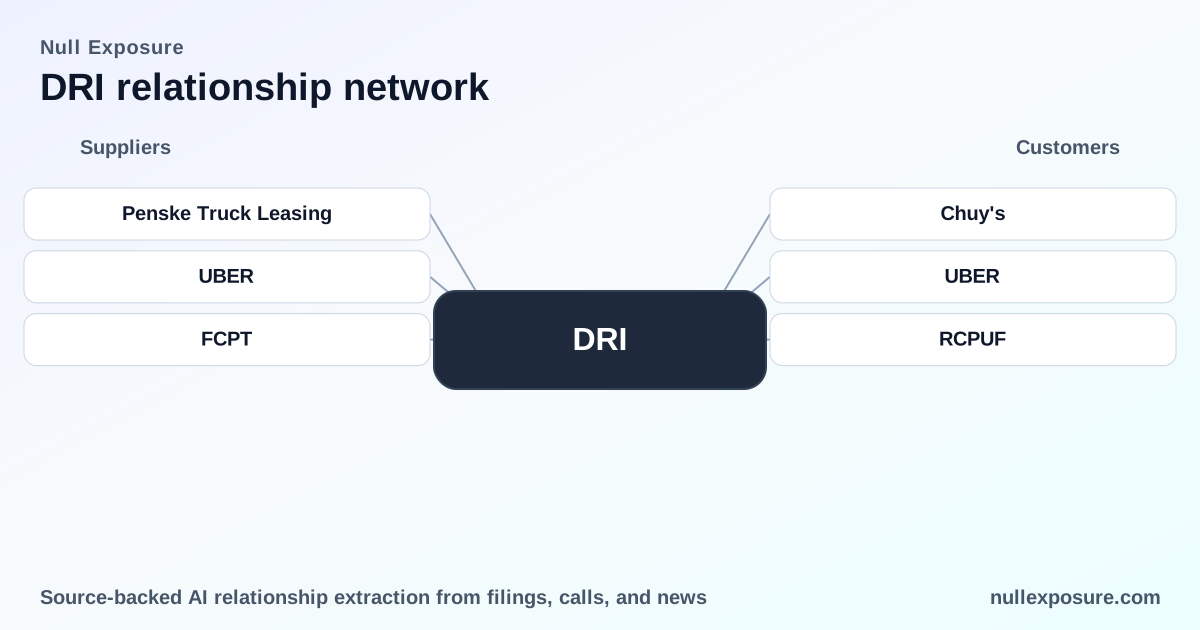
Darden Restaurants (DRI): Customer Relationship Map and Investment Thesis
Darden Restaurants operates a portfolio of full‑service dining brands and monetizes through restaurant sales, franchise royalties, licensing of branded consumer products, and strategic partnerships that extend delivery and convenience channels. With trailing revenue of roughly $12.8B and EBITDA near $2.0B, Darden combines high recurring consumer sales with royalty and licensing streams that boost margins and cash flow. For investors focused on customer and partner exposure, the following analysis inventories every public customer/partner mention, explains how these relationships move profit and risk, and translates those threads into actionable signals. For additional company‑level relationship intelligence see https://nullexposure.com/.
What drives Darden’s commercial model and contracting posture
Darden is principally a seller of full‑service restaurant experiences supplemented by licensing and franchise agreements that produce royalties and product sales. Public disclosures classify revenue sources into food and beverage sales, franchise royalties, and revenues from licensed consumer packaged goods; the latter generate ongoing royalty streams tied to retail sales rather than one‑time receipts. These contract characteristics produce a hybrid posture: large, stable retail and company‑operated sales combined with long‑dated franchise/licensing obligations.
Company filings explicitly state Darden does not rely on a small set of customers for sales and that the business is geographically concentrated in North America, with a smaller franchised presence across Canada, Latin America, the Caribbean, Asia, and the Middle East. That footprint implies domestic demand and operating leverage remain primary, while international exposure is handled largely through franchise partners. These are company‑level signals rather than partner‑specific attributions.
Key operational signals:
- Contracting: licensing and franchise agreements create recurring royalties and multi‑year performance obligations. (Company 10‑K, FY2025)
- Counterparty mix: predominantly individual consumers and franchise operators, not a small roster of enterprise buyers. (Company 10‑K, FY2025)
- Geography: North America is dominant; selective international franchising in LATAM, APAC and EMEA regions. (Company 10‑K, FY2025)
- Role: Darden is fundamentally a seller of services and branded product rights. (Company 10‑K, FY2025)
Relationship map: every customer and partner mentioned in filings and coverage
Below are every counterpart referenced in the supplied results, with concise plain‑English takeaways and source context.
Chuy's
Darden financed and subsequently closed an acquisition related to Chuy’s, and terminated a term loan tied to that transaction when it issued senior notes in October 2024. According to Darden’s FY2025 10‑K filing, the financing for the Chuy’s acquisition was refinanced through a senior notes issuance (10‑K, FY2025).
Recipe Unlimited (RCPUF / Recipe Unlimited Group)
Darden sold eight Olive Garden locations in Canada to Recipe Unlimited; the company confirmed the deal closed on July 14. Management discussed the definitive sale in its Q4 FY2025 and reiterated closure in the Q1 FY2026 earnings call, identifying Recipe Unlimited as the largest full‑service operator in Canada (Q4 FY2025 earnings call; Q1 FY2026 earnings call).
MZTI (The Marzetti Company)
Darden’s Olive Garden brand maintains licensing relationships for retail dressings and sauces that are part of Marzetti’s branded portfolio; press coverage in May 2026 notes Olive Garden dressings are included among Marzetti’s exclusive license agreements. These licensing arrangements translate restaurant brand equity into retail sales and ongoing royalty revenue (FinancialContent press release, May 3, 2026; FoodManufacturing coverage, May 2026).
Barbeque Integrated Inc. (Smokey Bones buyer in 2007)
Darden historically sold the Smokey Bones brand to Barbeque Integrated Inc. in 2007 for $80 million; contemporary reporting references that transaction in the context of the Smokey Bones chain closing locations. This is a legacy divestiture that reduced Darden’s non‑core portfolio exposure (news coverage, May 2026).
Uber / Uber Direct
Darden operates a first‑party delivery partnership with Uber Direct, which management credits with helping capture younger, more affluent guests who prioritize convenience, particularly for Olive Garden. The company named Uber Direct explicitly on the Q1 FY2026 earnings call as a distribution partner improving reach and guest mix (Q1 FY2026 earnings call, March 2026).
What these relationships imply for revenue mix and strategic priorities
- Franchising and licensing are deliberate profit multipliers. Darden converts brand strength into royalties (retail and franchised restaurants) that scale without a proportional increase in restaurant‑level operating costs. (Company 10‑K, FY2025)
- Delivery partnerships are a deliberate channel strategy to capture demographic segments with higher frequency and ticket size; the Uber Direct tie is an example of first‑party delivery integration driving guest acquisition. (Q1 FY2026 earnings call)
- Selective asset sales tighten geographical focus. Selling eight Canadian Olive Garden locations to Recipe Unlimited reduces Darden’s direct international operating footprint while preserving brand presence through franchising. (Q4 FY2025 earnings call; Q1 FY2026 earnings call)
- Retail licensing extends brand economics into consumer packaged goods, creating non‑restaurant revenue streams that contribute stable royalties and margin lift. (Marzetti / MZTI coverage, May 2026)
For a succinct, investor‑oriented view of counterparties and contract exposures, see more at https://nullexposure.com/.
Risk profile and concentrations investors must monitor
- Geographic concentration in North America. While franchising exists internationally, consumer demand and the bulk of long‑lived assets are U.S.‑centric; macro or consumer‑spend shocks in North America will disproportionately impact results. (Company 10‑K, FY2025)
- Execution risk in asset rationalization. Divestitures (e.g., Canadian Olive Garden sale) alter revenue composition and require seamless migration of guests and brand economics to franchise operators. (Earnings calls, FY2025–FY2026)
- Royalty and licensing dependency on retail partners. Licensing revenues rely on third‑party manufacturers and retailers for shelf presence and promotional execution; loss of distribution for a licensed product would reduce royalty flow. (Company 10‑K, FY2025; Marzetti reporting)
- Channel and demographic shifts. Reliance on delivery partners for younger, affluent guest capture is advantageous but increases exposure to delivery economics and labor/cost dynamics. (Q1 FY2026 earnings call)
Bottom line for investors
Darden’s commercial model is a mature, diversified full‑service operator that monetizes both through high‑frequency restaurant sales and scalable, lower‑capital royalty/licensing streams. Strategic moves—selling select international restaurants, extending retail licensing, and deepening first‑party delivery—are consistent with a playbook focused on margin expansion and cash generation. Key monitoring items are North American consumer demand, execution of franchising transitions, and the health of retail licensing partners.
For continuous mapping of Darden’s partner exposures and to translate relationship signals into portfolio decisions visit https://nullexposure.com/.