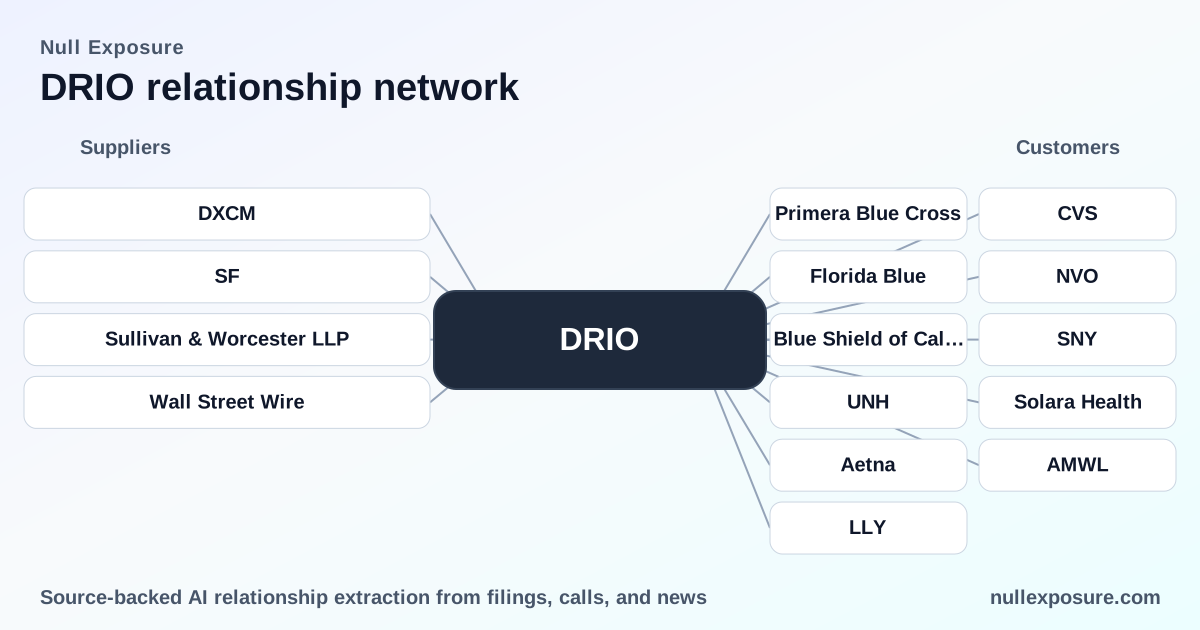
DarioHealth (DRIO) — Customer Relationships That Drive Scale and Risk
DarioHealth sells a vertically integrated digital health platform to individuals, employers and health plans and monetizes primarily through subscription-based, per-member pricing (PMPM / PEMPM) for software and engagement services, supplemented by fee-for-service clinical add-ons and hardware sales (blood-pressure monitors, glucometers). The company advances market penetration through curated channel partners (Solara, Amwell, Solera) and large payor rollouts that convert covered lives into recurring revenue. For investors, the thesis is simple: growth will be driven by channel-enabled distribution to large health plans and enterprise customers while margins depend on shifting mix between subscription services, usage-based clinical services, and hardware.
Explore the author’s broader research hub at https://nullexposure.com/ for related diligence.
How Dario contracts and where revenue comes from
Dario operates with a clear SaaS-first posture: revenue is recognized on a per-user/per-member subscription basis (PMPM/PEMPM) and is supplemented by usage-based clinical services and hardware sales. Company filings disclose that services and hardware are distinct revenue streams (services $20,197; consumer hardware $6,843 in the referenced revenue breakdown), and management repeatedly frames growth as subscription-led. The firm sells both directly to consumers and, increasingly, to large enterprise and health-plan customers—a two-pronged commercial model that reduces CAC through channel partners but concentrates revenue toward large payors.
Key operating signals:
- Contracting posture: Subscription (PMPM/PEMPM) is primary; clinical services available on fee-for-service or per-member basis. This creates recurring cashflow but exposes the company to large counterparty contracting cycles.
- Counterparty mix: Revenue originates from individuals, medium-to-large employers and major health plans; the company discloses exposure to very large enterprise customers.
- Concentration & materiality: Dario notes a major customer represented 41.6% of accounts receivable at year-end, indicating material counterparty concentration that investors must monitor.
- Maturity & stage: The business is in active commercial scaling—management reports dozens of signed contracts and both pilot and ramping engagements across plans and employers.
- Product mix: The offering is software + services + hardware, with software and services driving engagement and hardware acting as a complementary product sold alongside subscriptions.
Customers and channel partners that matter — one-by-one coverage
Below I list every named relationship cited in company materials and press coverage, with a short plain-English summary and source.
Primera Blue Cross
Primera Blue Cross has launched Dario through a Solara-enabled channel arrangement; this is positioned as a plan-level deployment within the Pacific Northwest. Source: DRIO 2025 Q3 earnings commentary (2025Q3).
Florida Blue
Florida Blue selected Amwell as a channel partner and included Dario as part of that new business, giving Dario access to Florida Blue’s self-insured and fully insured segments. Source: DRIO 2025 Q3 earnings call and related commentary (2025Q3).
Blue Shield of California
Blue Shield of California integrated Dario into its Wellvolution platform for hypertension, expanding access to Spanish-speaking members and embedding Dario in a widely marketed plan benefit. Source: Blue Shield of California press release (Nov 29, 2023).
UnitedHealthcare (UNH)
UnitedHealthcare listed Dario on its digital marketplace in a 2025 soft launch with a planned national rollout in January 2026, positioning Dario for broad national distribution through UNH’s channels. Source: DRIO 2025 Q3 earnings call and follow-up commentary (2025Q3 / FY2025-FY2026).
Aetna
Aetna has selected Dario via Solara for a major employer deployment (reported as ~126,000 lives) and DRIO management disclosed they are finalizing a three-year contract extension with Aetna, indicating multi-year commercial commitment. Source: DRIO earnings commentary and transcript summaries (2025Q3 / FY2026).
Centene
Dario is finalizing a four-year contract extension with Centene, reflecting an extended strategic relationship and multi-year revenue visibility from that payor. Source: DRIO FY2026 earnings commentary (InsiderMonkey transcript reporting).
HCSC (Health Care Service Corporation)
HCSC has been announced as launching digital health capabilities through Solara’s network beginning January 2027, and Dario has been named a preferred in‑network partner for that rollout—this is a large-member rollout (HCSC ~25 million members). Source: FY2026 earnings call summary (InsiderMonkey reporting).
Premera Blue Cross
Premera Blue Cross is cited among key new plan wins in 2025 that contributed to what management called its strongest year for new business, adding regional plan distribution. Source: DRIO FY2026 reporting and earnings call summaries.
Sanofi (SNY)
Sanofi is listed among pharmaceutical clients of Dario (and Twill), which shows the company’s enterprise pharma engagement capability for condition-specific programs. Source: FY2025 earnings call transcript excerpts.
Eli Lilly (LLY)
Eli Lilly is cited as a client of Dario/Twill, reinforcing commercial relationships with major pharma firms on disease-specific engagements. Source: FY2025 earnings call transcript excerpts.
Novo Nordisk (NVO)
Novo Nordisk is reported among pharma clients engaged with Dario/Twill, further validating the company’s footprint within pharma partnerships for chronic care programs. Source: FY2025 earnings call transcript excerpts.
Amwell (AMWL)
Amwell functions as a channel partner; management highlighted that Amwell was selected by Florida Blue and that Dario was chosen as part of the new business, enabling Dario distribution within virtual care ecosystems. Source: Amwell earnings commentary and DRIO 2025 disclosures (FY2025–FY2026).
CVS / Aetna relationship context
CVS/Aetna appears in management commentary where Solara and Aetna selected Dario to serve a very large employer population; the reference ties Dario to the CVS/Aetna employer channel via Solara. Source: DRIO 2025 Q3 earnings call transcript.
Solara Health
Solara Health operates a curated digital network where Dario is a preferred partner, and Solara has been a central channel through which multiple payors and employers deploy Dario’s solutions. Source: DRIO FY2025 earnings remarks and related reporting.
Solera (SLRK)
Management cites partnerships with "Solera" as a distribution channel contributing to coverage of approximately 116 million lives, indicating another channel-level agreement that materially expands addressable covered lives. Source: Intellectia / private placement commentary and DRIO disclosures (FY2026 reporting).
What these relationships mean for investors
- Distribution scale: Channel partners (Solara/Solera/Amwell) plus national payors (UNH, Centene, Aetna, regional Blues) translate to rapid covered-life scale — management claims access to ~116 million covered lives through partners, which directly lowers customer acquisition costs and accelerates penetration. Source: Intellectia reporting tied to company disclosures (FY2026).
- Revenue quality: The subscription-first model delivers recurring revenue but large-payor concentration (one major customer sizable in receivables) introduces counterparty risk; contract renewals and extensions (Aetna, Centene) materially de‑risk near-term revenue.
- Monetization levers: Cross-sell of clinical services on FFS/usage basis and hardware sales provide margin variability; increased services mix lifts gross margins while hardware is lower-margin and capital-dependent.
- Execution risk: National rollouts (UnitedHealthcare) require complex integration and multi-stakeholder procurement — success converts into meaningful recurring revenue, failure would stall projected scale.
Bottom line — investability checklist
- Positive: Channel-enabled distribution and multi-year extensions with major payors create tangible pathways to recurring revenue scale.
- Watchlist: High customer concentration, reliance on plan rollouts for scale, and product mix between subscription, usage-based clinical services, and hardware will determine margin expansion.
For ongoing monitoring and to review the primary materials that substantiate this note, see our research hub at https://nullexposure.com/.
Bold takeaway: Dario’s commercial upside rests on converting channel and payor relationships into sustained PMPM revenue; contract extensions with Aetna and Centene plus UNH marketplace rollout materially improve near-term revenue visibility but concentration and execution on national rollouts remain the principal risks.