Leonardo DRS (DRS): Customer Relationships that Drive Backlog and Valuation
Leonardo DRS monetizes advanced sensors, power and propulsion systems, and mission payloads primarily by selling multi‑year defense contracts and long‑run production work to U.S. national security agencies and allied partners. The company’s revenue model is concentrated in government contracting, with a large, multi‑year backlog and a mix of prime and subcontractor roles that convert engineering and manufacturing capacity into predictable revenue streams. For a deeper look at contract-level exposure and implications for operating risk, visit https://nullexposure.com/.
Why customers matter: concentrated, long‑duration revenue that underpins the multiple
DRS generates most of its revenues from U.S. government work and related prime contractors. Government counterparties account for roughly four‑fifths of revenue, and a meaningful portion of backlog is tied to long‑term Navy power and propulsion programs, creating high revenue visibility but also client concentration risk. The company serves as both prime and subcontractor, and a large installed base of incumbent programs supports steady production‑phase cash flow.
Customer‑by‑customer: what investors need to know
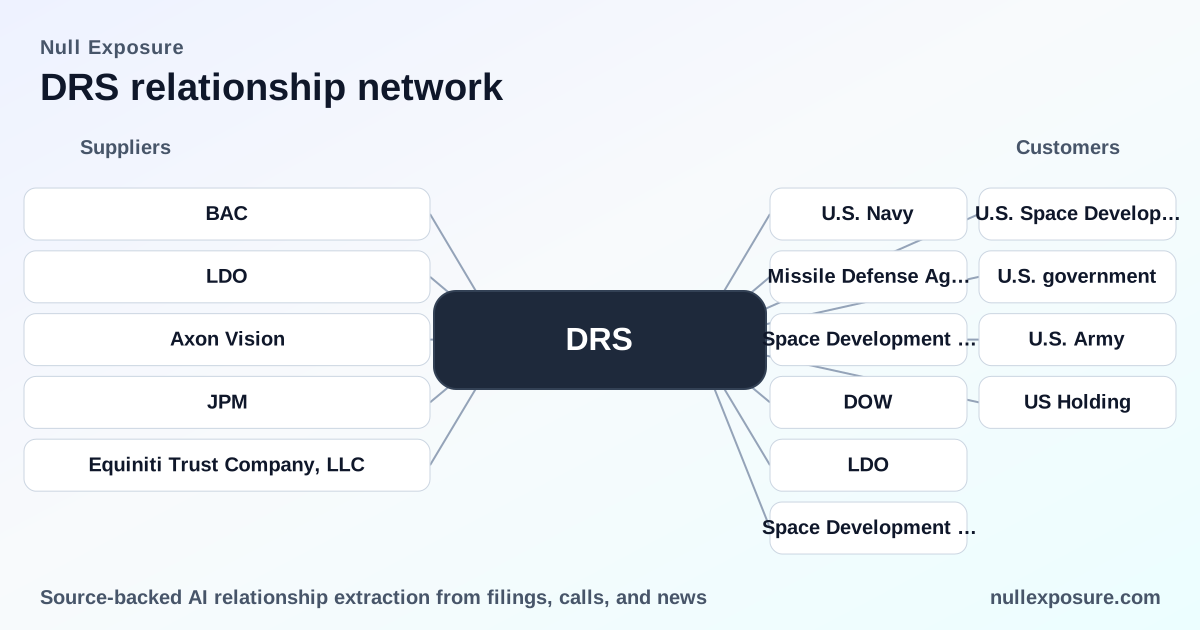
Below are concise, source‑linked summaries for every relationship captured in recent reporting and press coverage.
DoW — 10‑K reference (StockTitan, FY2026)
Leonardo DRS’s FY2026 10‑K filing states the company depends on revenues from contracts and subcontracts with the U.S. government, including defense programs with the Department of Defense and a broad range of programs with the U.S. Navy and U.S. Army. (Source: company FY2026 10‑K as reported on StockTitan, March 2026.)
Missile Defense Agency — SHIELD IDIQ award (MarketScreener, FY2026)
DRS was awarded multiple contracts under the Missile Defense Agency’s SHIELD IDIQ, which carries a program ceiling reported at $151 billion, positioning DRS to supply scalable homeland and layered defense capabilities. (Source: MarketScreener press release, March 2026.)
Space Development Agency — Infrared Mission Payload subcontract (StockTitan/news, FY2026)
DRS was awarded a subcontract to supply Infrared Mission Payloads for SDA’s Tracking Layer Tranche 3 (TRKT3), tying the company directly into the U.S. military’s space‑based missile warning and tracking architecture. (Source: company announcement via StockTitan, January–March 2026 coverage.)
U.S. Navy — systems for submarine detection (Finviz, FY2026)
Public reporting highlights DRS’s work on submarine detection systems and other naval electronics, reinforcing the company’s role as a supplier to maritime platforms and undersea warfare programs. (Source: Finviz coverage of Q4 CY2025 results, March 2026.)
DOW (duplicate 10‑K reference) — government contract dependence (StockTitan, FY2026)
The FY2026 10‑K reiterates dependence on U.S. government contracts and subcontracts, specifying substantial programs with Navy and Army end‑users that materially influence revenue and backlog. (Source: company FY2026 10‑K as reported on StockTitan, March 2026.)
U.S. Navy — new naval power and propulsion facility (Defence‑Industry.eu, FY2026)
DRS opened a 140,000‑square‑foot Charleston facility to expand domestic production capacity for Navy submarine and shipbuilding programs, signaling capital investment to support Columbia‑class and other naval platforms. (Source: Defence‑Industry.eu facility announcement, March 2026.)
Leonardo S.p.A. — intercompany services and obligations (StockTitan 10‑K, FY2026)
The 10‑K confirms ongoing reciprocal services with parent‑group Leonardo S.p.A., where DRS provides and receives corporate services under an amended proxy agreement—an operational dependency that can divert resources and requires governance oversight. (Source: company FY2026 10‑K via StockTitan, March 2026.)
LDO (duplicate Leonardo S.p.A. entry) — group services relationship (StockTitan 10‑K, FY2026)
The filing again notes historical and expected continued provision of services to Leonardo S.p.A. and affiliates in support of U.S. operations, and receipt of certain group services under the proxy agreement. (Source: company FY2026 10‑K via StockTitan, March 2026.)
MOG‑A (Moog) — integration on C‑UAS and M‑SHORAD efforts (Defence‑Industry.eu, FY2024/2026)
Industry reporting documents Moog’s supply scope for a counter‑UAS system that integrates Leonardo DRS Multi‑Mission Hemispheric Radars (MHR) and associated C2 systems, underscoring DRS’s role as a platform component supplier in joint systems. (Source: Defence‑Industry.eu coverage of C‑UAS and M‑SHORAD integration, originally reported in FY2024 with ongoing references, March 2026.)
Space Development Agency — Tranche 3 payload award (Defence‑Industry.eu, FY2026)
Independent defense press confirmed the SDA TRKT3 infrared payload subcontract award to DRS, aligning the company with a high‑visibility, multi‑partner space tracking program. (Source: Defence‑Industry.eu report, March 2026.)
Space Development Agency (ASD News) — advanced infrared sensor payload (ASD News, FY2026)
ASD News reiterated the SDA subcontract, describing DRS as a provider of multi‑domain cooled and uncooled infrared systems for U.S. government and allied customers, reinforcing the company’s sensor leadership. (Source: ASD News, January 27, 2026.)
U.S. government — concentration disclosure (StockTitan 10‑K, FY2026)
The FY2026 filing states revenues derived directly or indirectly from the U.S. government represented 79%, 80% and 84% of total revenues in 2024–2022, respectively, confirming extreme customer concentration. (Source: company FY2026 10‑K via StockTitan, March 2026.)
U.S. government — role as multi‑national supplier (ASD News, FY2026)
Coverage highlights DRS as a leading supplier of infrared systems to the U.S. government and allied nations, emphasizing export channels and allied procurement as secondary revenue sources. (Source: ASD News, January 2026.)
U.S. Navy — backlog and contractual importance (StockTitan 10‑K, FY2026)
The 10‑K quantifies that roughly 50% of total backlog relates to long‑term electric power and propulsion contracts with the U.S. Navy, indicating material program depth tied to naval shipbuilding cycles. (Source: company FY2026 10‑K via StockTitan, March 2026.)
U.S. Army — program participation (StockTitan 10‑K, FY2026)
The filing lists the U.S. Army among principal DoD end‑users, with Army programs contributing to the company’s mix of production and system‑integration work. (Source: company FY2026 10‑K via StockTitan, March 2026.)
US Holding — tax allocation and administrative obligations (StockTitan 10‑K, FY2026)
Under the tax allocation agreement DRS administers certain U.S. federal and state tax matters on behalf of Leonardo S.p.A. and its subsidiaries (including US Holding), embedding DRS in group tax administration responsibilities. (Source: company FY2026 10‑K via StockTitan, March 2026.)
What the contractual and commercial constraints mean for investors
- Long‑term, production‑phase contracts dominate cash flow. Approximately half the backlog is tied to long‑duration Navy electric power and propulsion work that amortizes revenue over up to 15 years; this supports predictability but lengthens exposure to program‑level execution risk. (Company FY2026 10‑K evidence.)
- Government counterparty concentration is material and critical. The U.S. government accounted for roughly 79% of 2024 revenue; DoD specifically contributed an even larger share, making political budget cycles and defense procurement priorities central valuation drivers. (Company FY2026 10‑K evidence.)
- Operating posture blends prime and subcontract work. DRS generates revenue both as a prime (≈37% in 2024) and as a subcontractor (≈63%), which influences margin profile, billing cadence, and supplier/customer negotiation leverage. (Company FY2026 10‑K evidence.)
- Geographic exposure is North America‑centric with targeted global sales. Roughly 80% of revenue is U.S.‑sourced while the remaining business comes from foreign governments and commercial customers, providing modest diversification but primary dependence on U.S. defense budgets. (Company FY2026 10‑K evidence.)
- Maturity and materiality tradeoffs. Many programs are mature and in production—supporting steady revenue—but no single contract represented more than 10% of revenue, which reduces single‑contract concentration risk even as aggregate government dependence remains high. (Company FY2026 10‑K evidence.)
For investors wanting program‑level clarity and scenario analysis on award pipelines and margin sensitivity, see additional analysis at https://nullexposure.com/.
Investment implications and final takeaways
- Upside driver: wins on large IDIQs (MDA SHIELD) and space payload work (SDA TRKT3) accelerate revenue recognition and support multiple expansion if execution remains on plan.
- Key risk: extreme U.S. government concentration and long contract tails create sensitivity to budget shifts and program delays.
- Operational note: capital investments (e.g., Charleston facility) and parent‑group service arrangements require monitoring for cash allocation and governance impact.
Bold, repeatable revenue streams anchored in Navy and DoD programs define DRS’s investable profile; the central question for valuation is execution on multi‑year programs and the company’s ability to convert backlog into incremental free cash flow while managing program‑specific risks.