Alpha Tau Medical (DRTS): Customer Relationships That Drive Clinical Validation and Commercial Entry
Alpha Tau Medical commercializes Alpha DaRT, an implantable alpha-emitting radiation therapy for solid tumors, by advancing clinical programs and partnering with regional commercialization specialists who secure regulatory approvals and lead local rollouts; the company monetizes through product sales, post-market studies, and licensing/partner-led launches rather than direct global distribution. Alpha DaRT is transitioning from clinical-stage validation to initial commercial release (Japan) while clinical partners continue to generate pivotal evidence in Europe and Israel. For deeper customer and partner mapping, see https://nullexposure.com/.
Market context: Alpha Tau is clinical-stage with no reported revenue in the trailing twelve months, negative EBITDA of approximately -$41.1 million, and a market capitalization near $663 million, reflecting investor value placed on approval and early commercialization milestones.
Why these relationships matter
- Early commercial launches and high-profile clinical sites accelerate physician adoption and payer conversations.
- Regional partners that obtain regulatory clearance and lead post-market surveillance are critical revenue conduits for a small-company manufacturer without a global sales infrastructure.
- Clinical centers that run investigator-led trials provide the evidence base that underpins broader market access and reimbursement.
Key customer and clinical relationships
-
CHU Grenoble Alpes — The hospital in Grenoble performed the first European Alpha DaRT procedure for pancreatic cancer under the ACAPELLA multicenter trial. According to a GlobeNewswire release on April 23, 2026, the procedure was led by Professor Gaël Roth as part of ACAPELLA’s pancreatic cancer cohort. This is evidence of European clinical adoption and investigator-led validation for new indications. (GlobeNewswire, April 23, 2026)
-
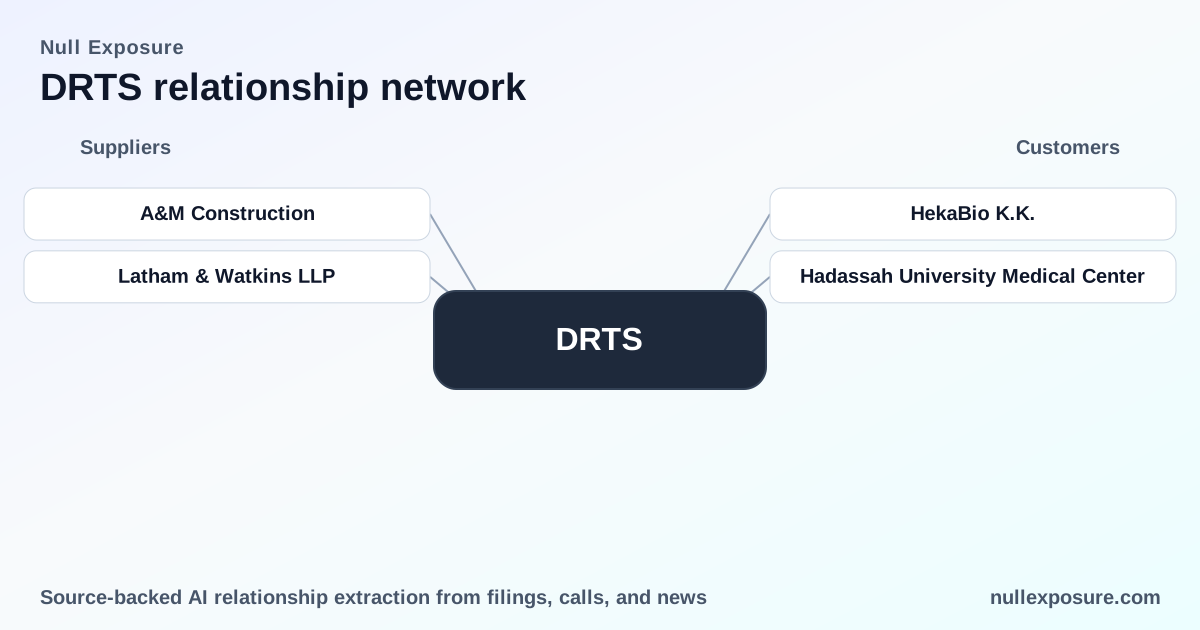
HekaBio K.K. — HekaBio is Alpha Tau’s commercialization partner in Japan and led the regulatory, medical society, and government interactions that resulted in Japanese marketing approval for Alpha DaRT in head-and-neck cancer; HekaBio’s CEO emphasized the program’s seven-year focus and readiness to launch and manage the post-marketing surveillance study. A GlobeNewswire release dated February 24, 2026 documented the marketing approval and HekaBio’s role, and subsequent coverage (Yahoo Finance and March 2026 media) noted HekaBio’s leadership of clinical rollout and PMS initiation at selected centers. HekaBio is the primary commercial agent in Japan and the immediate revenue pathway for Alpha Tau in Asia. (GlobeNewswire, Feb 24, 2026; Yahoo Finance, March 2026; StockTitan coverage, March 9, 2026)
-
Hadassah University Medical Center — Hadassah’s Advanced Endoscopic Unit reported use of Alpha DaRT to treat a patient with inoperable pancreatic cancer, highlighting a real-world implantation conducted by Drs. Harold Jacob, Ari Benson, and Julia Epstein. A StockTitan news item from March 2026 described the case as the first such treatment in that center, underscoring early adopter clinical experience in Israel and reinforcing the company’s home-market physician network. (StockTitan, March 2026)
Operational and business-model signals investors should weigh
-
Contracting posture: Alpha Tau relies on regional commercialization partners (notably HekaBio in Japan) to navigate local regulatory regimes and conduct post-market studies, indicating a partnership-first go-to-market approach rather than building full in-house, country-by-country sales forces.
-
Concentration: The company’s early commercialization footprint is highly concentrated by geography and partner — Japan’s launch is centered on HekaBio and a small set of selected centers for PMS — which creates asymmetric revenue upside if launches succeed and corresponding single-partner concentration risk.
-
Criticality: Clinical site partnerships (e.g., CHU Grenoble Alpes, Hadassah) are strategically critical for label expansion and physician adoption because investigator-led procedures and multicenter trials will determine new-indication approvals and payer acceptance in Europe and elsewhere.
-
Maturity: Alpha Tau is in a transitional phase — clinical-stage to early commercialization; approval in Japan represents a material de-risking milestone, but reported financials (zero reported TTM revenue, negative EBITDA) show commercial revenue is nascent and dependent on partner execution and reimbursement progress.
Financial and governance cues that matter for partner risk
- No reported revenues TTM combined with negative EBITDA (about -$41M) signals that near-term valuation depends on successful commercial execution and licensing/partner payments rather than recurring product sales today.
- Insider ownership is meaningful (about 32%) while institutional ownership is low (~3%), which points to concentrated control and potential alignment with management but also lower institutional liquidity in the shareholder base.
Risks and upside drivers — what to watch next
- Upside catalysts: successful HekaBio-led rollout in Japan, positive PMS data, and expanded investigator-site results (e.g., ACAPELLA pancreas outcomes) that support label expansion and reimbursement.
- Principal risks: partner concentration, commercial execution by third parties, and the timing of payer coverage decisions outside Japan; clinical results will determine the speed and scope of penetration in major Western markets.
Practical takeaway for investors evaluating customer relationships
- HekaBio is the single most consequential customer/partner for near-term revenue in Asia; CHU Grenoble Alpes and Hadassah are high-value clinical partners that increase the probability of label extension and market acceptance in Europe and Israel. Alpha Tau’s business model is designed around partner-enabled market entry and investigator-driven evidence generation, not immediate broad direct sales.
For ongoing tracking of partner disclosures, regulatory developments, and center-level outcomes, consult the company’s releases and specialist monitoring at https://nullexposure.com/. Invest with attention to partner execution and the cadence of post-marketing clinical data that will determine commercial durability.
Bold, clear decision points: Japan launch execution and PMS data will be the principal value drivers over the next 12–24 months; partner execution risk is the principal downside.